Why the Cost of Trust vs Will Matters for Your Financial Future
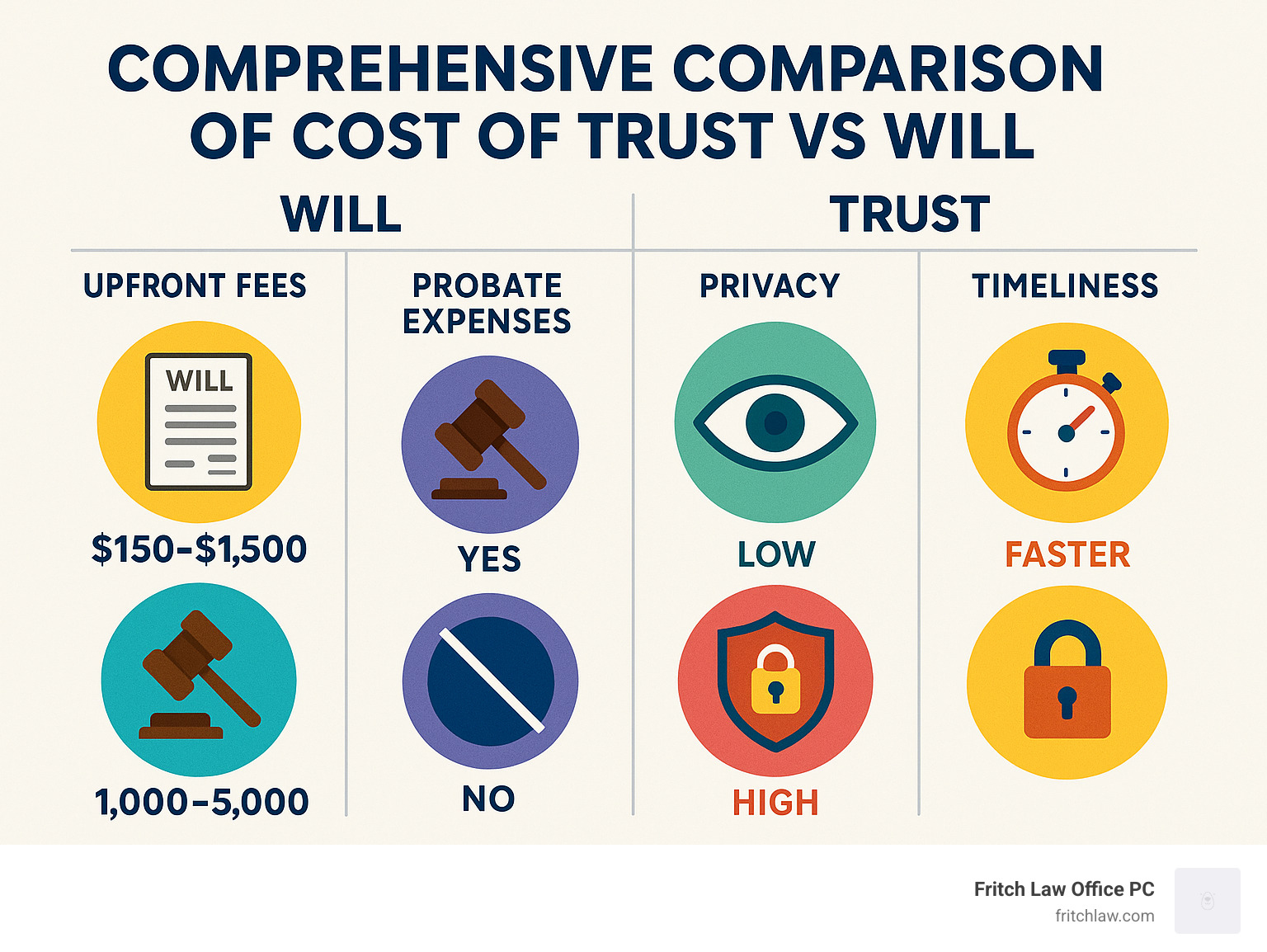
The cost of trust vs will varies significantly. Wills typically cost $150-$1,500 to create, while living trusts range from $1,000-$5,000 upfront. However, the true cost includes long-term expenses like probate fees, which can consume 4-8% of an estate’s value when using a will.
Quick Cost Comparison:
| Document Type | Initial Cost | Long-term Costs |
|---|---|---|
| Will | $150-$1,500 | Probate fees: 4-8% of estate value |
| Living Trust | $1,000-$5,000 | Trust administration: 0.5-2% annually |
Making the wrong choice can cost your family thousands of dollars and months of legal headaches. For example, a simple will might seem cheaper, but probate could cost an estate over $30,000 and take years to resolve, making a living trust a smarter investment.
The decision isn’t just about upfront costs; it’s about protecting your family’s time and money after you’re gone. Some estates need the flexibility of a trust, while others work fine with a will.
About the Author
I’m David Fritch. With 40 years of experience in my law firm and CPA practice, I’ve seen that the cheapest upfront option often becomes the most expensive choice for loved ones later.
The Upfront Price Tag: A Cost Breakdown of Wills and Trusts
When families visit our Jasper office, a common first question is about cost. Let’s break down what you can expect to pay upfront for both wills and trusts.
What is the Average Cost of Creating a Will?
A will is a budget-friendly starting point for estate planning.
Attorney-drafted wills generally cost between $300 and $1,500. The price depends on complexity—a simple plan is cheaper than one with specific gifts, charitable bequests, or business provisions.
Most attorneys prefer flat fees for will preparation, so you know the cost upfront. Some still use hourly rates ($150 to $450 per hour), which can make budgeting difficult.
Additional costs include notarization (around $10-$20) and meeting witness requirements. In Indiana, two witnesses must sign your will, which we handle during your appointment.
Legal fees in larger cities like Indianapolis may be higher than in Jasper, highlighting the benefit of working with a local attorney.
For a detailed breakdown, see our guide on How Much Does it Cost to Make a Will?.
What is the Average Cost of Creating a Living Trust?
Living trusts require a larger upfront investment, typically $1,000 to $5,000. This reflects the more complex work involved.
Revocable trusts, which offer flexibility and probate avoidance, usually cost between $1,000 and $3,000 for basic setups. Irrevocable trusts are more permanent and complex, often costing $2,000 to $10,000 or more.
A significant part of the cost is funding the trust—transferring your assets into it. Asset transfer fees can add 15-25% to the initial cost. For example, transferring real estate involves recording fees ($100-$200 per property) and attorney fees for new deeds ($150-$300 per deed).
An attorney-drafted trust ensures your plan is effective and compliant with Indiana law.
Learn more in our guide on the Average Cost for a Living Trust.
So, What’s the Initial Cost of Trust vs Will? A Summary
Upfront, wills are the more affordable option, making them a good entry point for those with simpler estates. Trusts have a higher initial expense but offer long-term benefits that can save your family thousands later.
Here’s a typical cost breakdown:
| Document Type | Attorney-Drafted Cost Range |
|---|---|
| Will | $300 – $1,500 |
| Living Trust | $1,000 – $5,000+ |
These are starting costs. The true cost of trust vs will becomes clearer when you consider what happens after you’re gone.
Function vs. Function: What Are You Paying For?
Understanding the cost of trust vs will is easier when you know what each document does. Wills and trusts serve different purposes, which is why their costs differ.
The Role of a Will
A will is a set of instructions that only takes effect after you pass away. Its primary functions include:
- Asset distribution after death: A will specifies who gets your property. Without one, Indiana’s intestacy laws determine who inherits, which may not align with your wishes.
- Appointing an executor: You name an executor to manage your estate, pay bills, and ensure your instructions are followed.
- Naming guardians for minor children: This is a critical function a trust cannot perform. A will tells the court who you want to raise your children. Learn more in our Guardianship guide.
A key drawback is that wills become public record after death through the probate process, exposing your financial details. For more information, the American Bar Association offers an Introduction to Wills.
The Power of a Trust

A trust is a legal entity that holds and manages assets for your benefit during your life and for your beneficiaries after you’re gone. Its key advantages include:
- Probate avoidance: Assets in a trust bypass the lengthy and expensive probate process, allowing beneficiaries to receive their inheritance faster.
- Privacy protection: Since trust assets avoid probate, your family’s financial affairs remain private.
- Incapacity planning: If you become unable to manage your finances, your chosen successor trustee can step in immediately without court intervention.
- Control over distribution timing: You can set specific conditions for when and how beneficiaries receive their inheritance, such as at a certain age or for specific purposes like education.
- Asset management during life: You can act as your own trustee, maintaining full control while you are able.
Trusts are especially useful for real estate. Our article on the Indiana Real Estate Trust explains these benefits further. A trust is an ongoing financial management system, while a will is a final message.
The Lifetime Cost of Trust vs Will: Beyond the Initial Fee
The initial price is only part of the story. To truly compare the cost of trust vs will, you must consider long-term expenses, where the cheaper upfront option can become more expensive later.
The “Hidden” Costs of a Will: Navigating Probate
The biggest “hidden” cost of a will is the probate process—the court-supervised procedure for validating a will and distributing assets.
Probate is often:
- Time-consuming: It can take months or even years, delaying inheritance.
- Public: All documents, including your will and asset list, become public record.
- Expensive: Probate fees can consume 3% to 8% of your estate’s value. For a $300,000 estate, that’s $12,000 to $24,000 in costs. These fees include court costs, executor fees (2-5% of the estate), and attorney fees.
Learn more in our articles on Probate Lawyer Fees and Indiana Probate Law. This financial burden is often unanticipated when choosing a will.
The Ongoing Costs of Maintaining a Trust
Trusts avoid probate but have their own ongoing costs, which are generally more predictable.
- Trust administration: A professional trustee (like a bank) may charge 0.5% to 2% of trust assets annually. A family member serving as trustee may waive this fee.
- Accounting fees: Complex trusts may require annual tax filings, costing $500 to $2,000 for tax preparation.
- Cost of amending a trust: As life changes, you may need to update your trust. Simple amendments can cost $200-$800, while a full restatement can be $1,000 to $3,500.
Often, these maintenance costs are significantly less than the one-time cost of probate. For more on this, see our article on Estate Planning Attorney Fees.
Making the Right Choice for Your Estate
Choosing between a will and a trust is about finding the right fit for your family’s unique situation and gaining peace of mind.
Working with an Experienced Attorney: A Cost-Benefit Analysis

While DIY online forms seem tempting, they can be the most expensive mistake. Your estate plan is your family’s financial parachute; you don’t want the lowest bidder.
The value of an experienced attorney is providing personalized legal advice that spots potential problems generic forms miss, like out-of-state assets or business succession issues. This helps in avoiding legal errors that can cost more to fix than creating a proper plan from the start. A poorly executed plan, like an unfunded trust, offers no protection.
With an attorney, you get comprehensive planning that covers financial and medical decisions, and you gain peace of mind knowing your plan will work. Learn more in our guide on the Estate Planning Attorney Consultation.
How Your Situation Impacts the Cost of Trust vs Will
The right choice depends on your circumstances. Key factors include:
- Estate size: For modest estates (under $200,000), a will may suffice. For larger estates, a trust’s ability to avoid probate costs often makes it a bargain.
- Types of assets: Owning real estate in multiple states complicates probate, making a trust more attractive.
- Business ownership: A trust can ensure a seamless transition of management for a business, while a will could leave it tied up in probate.
- Family dynamics: Trusts offer more control for complex situations, like blended families or beneficiaries who need financial guidance.
As your Indiana Estate Planning Attorney, we help you steer these factors.
When You Might Need Both a Will and a Trust
Often, the best plan includes both documents. A “pour-over will” acts as a safety net, directing any assets left out of your trust into it after your death.
This creates a comprehensive plan. The trust handles most assets and avoids probate, while the will addresses key issues only it can, such as:
- Guardianship provisions for minor children: Only a will can name guardians for your kids.
- Specific bequests outside the trust: You can leave specific personal items to individuals.
- Covering unfunded assets: It provides a backup for any forgotten assets.
Adding a pour-over will to a trust package is a small additional investment that provides tremendous peace of mind.
Frequently Asked Questions about the Cost of a Trust vs. a Will
Here are answers to the most common questions we hear from families.
Is a trust always better than a will to avoid probate?
Not always. While trusts are excellent for avoiding probate, a will can be a better fit in some cases. For smaller estates, Indiana’s simplified procedures, like a small estate affidavit, may be sufficient. You can learn more in our guide to Indiana Probate Law Small Estate.
Also, wills are essential for naming guardians for minor children, a function a trust cannot perform. The right choice depends on your estate size, family needs, and desire for privacy.
Can I create a will or trust for free?
While free online templates are tempting, they carry significant risks. These generic forms often fail to account for Indiana’s specific laws, leading to invalid documents. I’ve seen wills invalidated for improper witnessing and trusts fail because they were never funded.
Fixing a botched DIY plan can cost thousands, far more than creating a professional one from the start. Your family’s financial future deserves professional care.
How much more expensive is a trust than a will upfront?
A trust can cost several hundred to a few thousand dollars more than a will upfront. A will might be $300-$1,500, while a trust is often $1,000-$3,000 or more.
However, the true cost of trust vs will is a long-term calculation. Spending an extra $2,000 on a trust today could save your family $20,000 or more in probate costs tomorrow. Think of it as an investment in your family’s peace of mind and financial security. For a deeper comparison, see our article on the Average Cost of a Trust and Will.
Conclusion

The cost of trust vs will isn’t just about the initial price tag; it’s an investment in your family’s future. While a will is cheaper upfront ($300-$1,500), it often leads to probate costs that consume 4-8% of your estate. A trust costs more initially ($1,000-$5,000+) but helps your family avoid the time, expense, and public nature of probate.
The right choice provides the best long-term value. If you want to protect your loved ones from court proceedings and keep your affairs private, the higher initial investment in a trust often pays for itself.
Your personal circumstances—estate size, family dynamics, and types of assets—determine the best path. Sometimes, the ideal solution is a combination: a trust for major assets and a pour-over will for guardianship and other matters.
At Fritch Law Office PC in Jasper, Indiana, we know there is no one-size-fits-all answer. The most expensive mistake is doing nothing or using a DIY approach that leaves your family vulnerable. Your loved ones deserve certainty and peace of mind.
We are here to provide the personalized attention your situation deserves. Secure your family’s future with a personalized estate plan that works for you and the people you love.