At its core, it’s a straightforward but powerful legal document that allows you—the “principal”—to appoint another person you trust (the “agent” or “attorney-in-fact”) to handle decisions and take actions on your behalf.

This could cover finances, healthcare choices, real estate transactions, tax matters, or even very specific one-off tasks like signing a single document while you’re traveling or unavailable. People create POAs for practical reasons: to prepare for potential incapacity (illness, accident, dementia), to manage affairs during long absences, or simply to make everyday business smoother without constant involvement.

Indiana regulates powers of attorney under Title 30, Article 5 of the Indiana Code—the state’s version of the Uniform Power of Attorney Act, with some local adjustments. As of 2026, the framework hasn’t seen significant overhauls: execution rules (signing, notarization, witnesses), default durability, fiduciary duties for agents, and revocation procedures all remain consistent with prior years. A POA is not the same as a guardianship (court-appointed control when you’re incapacitated) or a will (which only takes effect after death). It’s a proactive planning tool often bundled with estate planning, advance directives, or family protection strategies—to avoid the need for costly, restrictive court guardianship later.

Without a POA in place, if you become unable to manage your own affairs, a family member or concerned party typically has to petition the court for guardianship. That process involves hearings, medical evaluations, ongoing reporting, and court supervision—expensive (thousands in fees), public, and sometimes contentious. A properly executed POA lets your chosen agent step in immediately or when needed, bypassing court entirely in most cases.

The Main Types of Power of Attorney Recognized in Indiana

Indiana offers flexible POA types. Choose based on your needs.

1. Durable Power of Attorney (Financial)

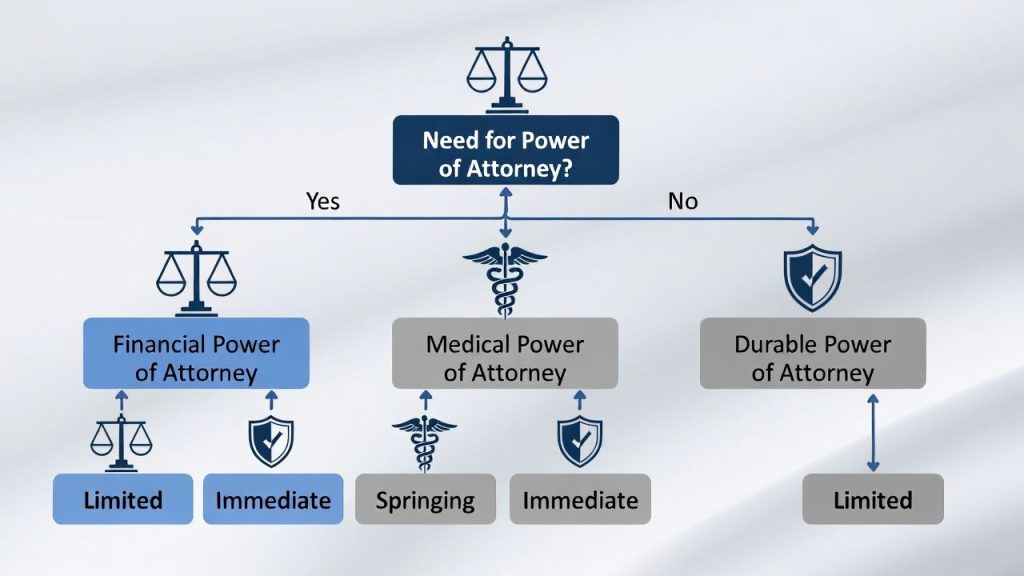
 — This is the go-to type for most long-term planning. It stays in effect even if you later become incapacitated (e.g., from a serious illness, stroke, or cognitive decline). Indiana makes all POAs durable by default unless the document explicitly states it terminates upon incapacity (Ind. Code § 30-5-5-1 et seq.). The agent can handle a wide range of financial and property matters: paying bills from your accounts, managing investments, filing your taxes, buying or selling real estate, operating your business, applying for benefits, or handling insurance claims. You can make it as broad (“all financial matters”) or as limited as needed.

2. General Power of Attorney (Non-Durable) 

— Grants sweeping authority similar to a durable one but automatically ends if you lose capacity. Rarely used for estate planning—most people prefer the durability feature to cover future unknowns.
 

3. Limited or Special Power of Attorney

— Restricts the agent’s authority to a single transaction or narrow purpose. Examples: authorizing someone to sign closing papers on a house sale while you’re abroad, picking up a vehicle title, or handling one specific bank transaction. Ideal for short-term, low-risk needs where you don’t want broad control given away.

4. Medical or Healthcare Power of Attorney

 (also known as Advance Directive for Health Care or Healthcare Proxy) — Authorizes your agent to make medical decisions if you’re unable to communicate (unconscious, severe illness, etc.). Covers treatments, surgeries, life support, hospice, or end-of-life choices. Often combined with a living will (which states your wishes directly). Indiana requires minimal formalities—usually one witness suffices, though notarization adds strength and acceptance by hospitals/doctors.

5. Springing Power of Attorney

— Activates only upon a specified trigger, typically a physician’s written certification of incapacity. Indiana permits springing POAs, but they’re less popular than immediate durable ones because verifying the trigger (getting doctor statements) can cause delays when time is critical.

6. Other Specialized or Niche Types

— Real estate-specific POA (for property deals only), tax POA (e.g., Indiana Department of Revenue Form POA-1 for state tax matters), or temporary POA for minor child care (delegates parental authority for up to 12 months, useful for travel or military deployment).
Flowchart of Power of Attorney types in Indiana: durable, medical, springing, limited, financial, and when each applies (2026 guide)

Key Requirements for a Valid Power of Attorney in Indiana

To ensure enforceability under Ind. Code § 30-5-4-1 and related sections:

● Must be in writing (typed preferred for clarity; handwritten acceptable if legible).
● Clearly identifies the principal and agent(s), with alternates recommended.
● Specifies granted powers—broad language or incorporation of statutory powers (e.g., real estate, banking, taxes) keeps it concise.
● Signed by the principal while mentally competent.
● Notarized (highly recommended—many banks, title companies, and institutions insist on it) or signed before two disinterested witnesses (witnesses cannot be the agent, agent’s spouse, or certain relatives to avoid conflicts).
● No official state-mandated form—custom attorney-drafted is safest; free templates from reputable sources (Indiana Bar Association, legal aid sites) work but carry risks of omissions.
● Date the document—Indiana allows specifying start/end dates or events.
Principal signing a Power of Attorney document in front of a notary public to make it legally binding in Indiana.

Step-by-Step: How to Create and Implement a Power of Attorney in Indiana

1. Assess your needs — Do you need broad financial control (durable POA)? Healthcare decisions (medical POA)? A one-time task (limited POA)? Talk through scenarios with family or an advisor.
2. Select your agent carefully — Choose someone trustworthy, organized, financially responsible, and willing to serve. Name one or more alternates. The agent must be an adult (18+), competent, and ideally live nearby or be easily reachable.
3. Draft the document — Work with an Indiana attorney (fees $200–$800 for basic durable POA; higher for complex or combined financial/healthcare) to customize powers, add safeguards (e.g., gifting limits, co-agent requirements), and comply with statutes. If using a template, double-check against Indiana Code and have it reviewed.
4. Execute properly — Principal signs in front of notary (preferred) or two witnesses. Agent can sign acceptance. Notary verifies identity/competence.
5. Distribute and activate — Provide original to agent, copies to relevant parties (banks, doctors, family). Keep original secure. For immediate durable POA, agent can act right away; for springing, obtain doctor’s certification when needed.
6. Maintain and update — Review annually or after major life events. Revoke in writing if circumstances change (notify agent and institutions promptly).
Family consulting with attorney to discuss and finalize power of attorney options in Indiana – typical estate planning session (2026)

When a Power of Attorney Takes Effect and How Long It Lasts

● Immediate durable POA — Effective the moment signed; agent can act immediately (though you can direct them to wait until needed).
● Springing POA — Starts only on trigger (usually physician certification of incapacity)—requires medical proof, which can slow things down.
● Healthcare POA — Generally springing (activates when principal can’t decide).
● Duration: Until death, revocation (while competent), court invalidation, or specified end date/event. Agent’s fiduciary duty requires acting in your best interest—breaches (self-dealing, negligence) can lead to lawsuits or removal.

Revocation, Termination, and Agent Responsibilities

● Revoke anytime while competent: Create a written revocation, sign/notarize, deliver to agent and any institutions relying on the POA.
● Termination triggers: Principal’s death, court order (e.g., incapacity finding overrides), agent resignation, or explicit end date.
● Agent duties: Act loyally, in good faith, avoid conflicts, keep records. Indiana imposes fiduciary standards—breach can result in damages or removal.

Common Real-World Uses and Benefits in Indiana

● Long absences (travel, military): Agent pays bills, manages property.
● Aging or health decline: Seamless transition without guardianship.
● Business continuity: Agent handles operations if unavailable.
● Medical crises: Agent follows your healthcare wishes.
● Benefits: Avoids guardianship (costs $5k–$15k+), maintains privacy/control, reduces family stress.


Pitfalls to watch: Unreliable agent (choose wisely), overly vague powers (causes disputes), failure to notify banks/doctors (agent blocked), outdated document (wrong agent after divorce), or not coordinating with other plans (conflicts with will/trust).

If you’re considering a power of attorney in Southern Indiana—Jasper, Huntingburg, or nearby areas—Fritch Law assists with drafting durable financial POAs, healthcare directives, limited/special powers, and integration into broader estate/family plans. They ensure documents meet Indiana requirements, explain fiduciary duties, and help avoid common mistakes. Visithttps://www.fritchlaw.com/ for POA and estate planning resources, or call 812-482-9232 for straightforward, no-pressure advice.

This content reflects Indiana Code Title 30, Article 5 as of 2026. It is provided for general informational purposes only and does not constitute legal advice. Because each situation is unique, consult a licensed Indiana attorney for guidance specific to your needs.

Please follow and like us:
error
fb-share-icon
Follow by Email
YouTube
LinkedIn