
Child Custody Laws in Indiana: Mother vs Father Rights – Protect What Matters Most
Child custody laws in Indiana: mother vs father rights – protect what matters most is the guide every parent in 2026 needs when divorce, separation, or paternity cases threaten the most important relationship in their life — the one with their child. Indiana law is clear: there is no automatic preference for mothers or fathers. Courts decide custody based solely on the best interest of the child under Indiana Code § 31-17-2-8, with both parents starting on completely equal legal footing.
The state strongly encourages joint legal custody (shared major decisions) and frequent, meaningful parenting time for both parents unless one parent is unfit. Sole custody is rare and only awarded when necessary for the child’s safety or well-being. The Parenting Time Guidelines (current as of 2026) promote schedules that keep both parents actively involved.
This complete, verified 2026 guide walks you through everything in plain language: types of custody, how judges really decide (the 8 best-interest factors), mother vs father rights in practice, standard parenting time schedules, modification process, grandparents and third-party rights, unmarried parents, costs and timeline, real-life Indiana court examples, common myths, and FAQs. Understanding these laws helps you protect your bond with your child and negotiate or prepare for court with confidence.
The Fundamentals of Child Custody in Indiana – Equal Rights, No Gender Bias
Indiana Code § 31-17-2-8 explicitly states there is no presumption favoring either parent. Custody decisions focus only on what serves the child best. Gone are any old “tender years” ideas favoring mothers — the law has been gender-neutral for decades.
If parents agree on a parenting plan, the court usually approves it without a fight. If not, a judge decides after evidence, guardian ad litem reports, or evaluations.

Another view of parents and attorney in an Indiana custody mediation session — a common first step to reach agreement without full court battle.

What is an Emergency Custody Hearing?
Types of Child Custody in Indiana (Legal, Physical, Sole, Joint Explained)
Indiana divides custody into two main categories:
- Legal Custody — Who makes major decisions (education, health, religion). Joint legal custody is preferred (both parents decide together). Sole legal custody if one parent is uncooperative or unfit.
- Physical Custody — Where the child lives day-to-day. Joint physical (shared time) or primary physical (child lives mostly with one parent, other has parenting time).
- Joint Legal & Physical Custody: Both parents share decisions and time (e.g., 50/50 schedules). Common when parents live close and cooperate.
- Sole Legal & Physical Custody: One parent has full control, other has limited parenting time. Awarded if the other parent is absent, abusive, or addicted.
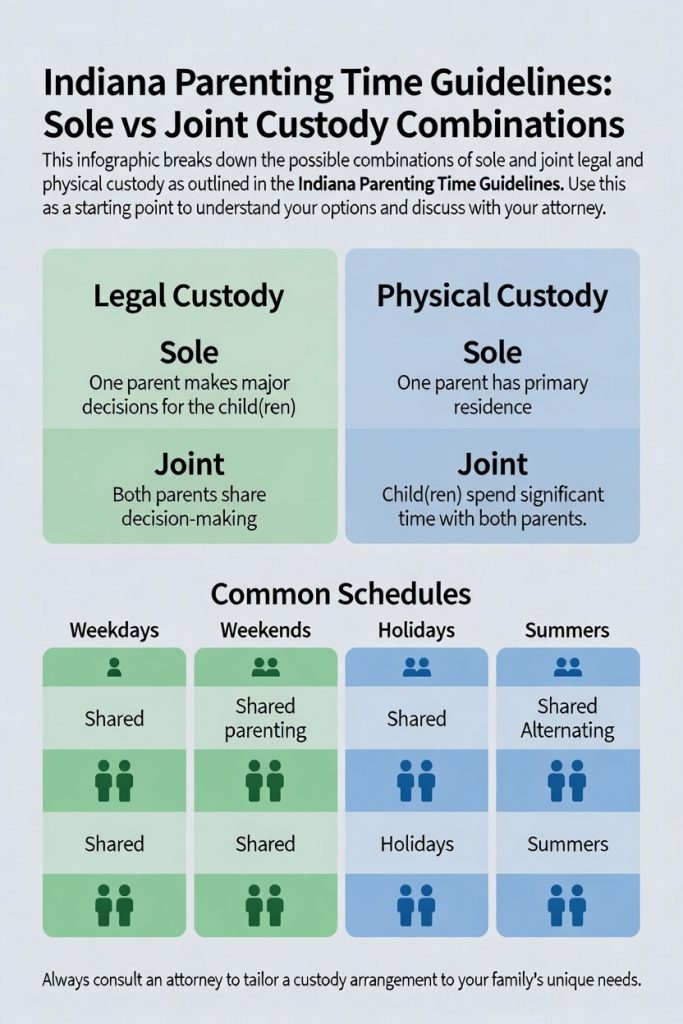
This chart illustrates the types of custody: sole vs joint, legal vs physical — a simple visual breakdown for understanding Indiana options.
The Indiana Parenting Time Guidelines provide recommended schedules as a starting point for parents and judges.
This chart visually breaks down sole vs joint legal and physical custody combinations in Indiana easy to understand your options.
Mother vs Father Rights in Practice – Equal Legal Standing, Evidence-Based Outcomes
Mother vs Father Rights in Indiana Custody Cases (Gender Neutral in Law, But Practice Varies)
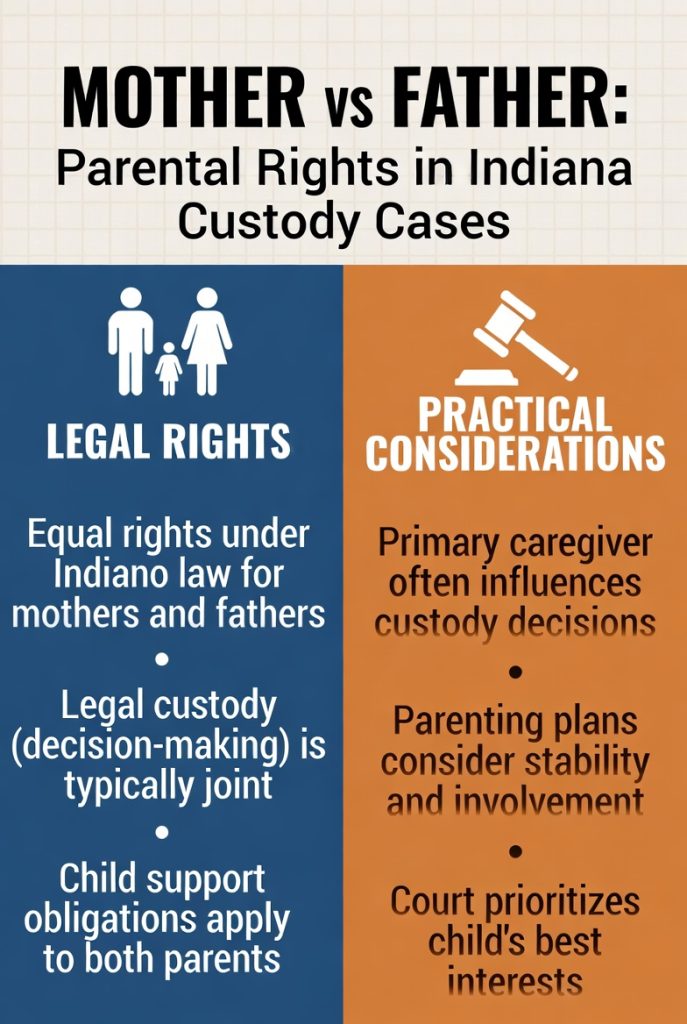
Indiana law is completely gender-neutral, but real-world outcomes depend on evidence of parenting involvement and stability.
Real-life example: In a 2025 Allen County case, a father received joint legal and primary physical custody after presenting evidence of the mother’s substance issues and his own strong daily involvement with the child.
This infographic compares mother vs father rights in Indiana custody cases — equal legal rights with practical factors that influence decisions.
Best Interest of the Child Factors – The 8 Things Judges Must Consider
Indiana Code § 31-17-2-8 lists these 8 factors (no single factor controls):
1. The age and sex of the child.2. The wishes of the child’s parent or parents.3. The wishes of the child (more weight if 14+).4. The child’s relationship with parents, siblings, and others.5. The child’s adjustment to home, school, and community.6. The mental and physical health of all involved.7. Evidence of domestic or family violence.8. Evidence that the child has been cared for by a de facto custodian.Judges may consider any other relevant factors, such as parental cooperation.
This chart summarizes Indiana’s 8 best-interest factors with practical examples for parents preparing evidence.
Parenting Time Schedules in Indiana – Keeping Both Parents Involved
The Indiana Parenting Time Guidelines (current 2026) promote frequent contact. Standard non-primary parent schedule:
Joint physical often uses 50/50, 2-2-3, or 2-2-5-5 schedules. Distance, child’s age, and school are always considered.
Real-life example: In a 2025 Marion County case, a father received a 2-2-5-5 schedule after showing it minimized disruption to the child’s school routine.
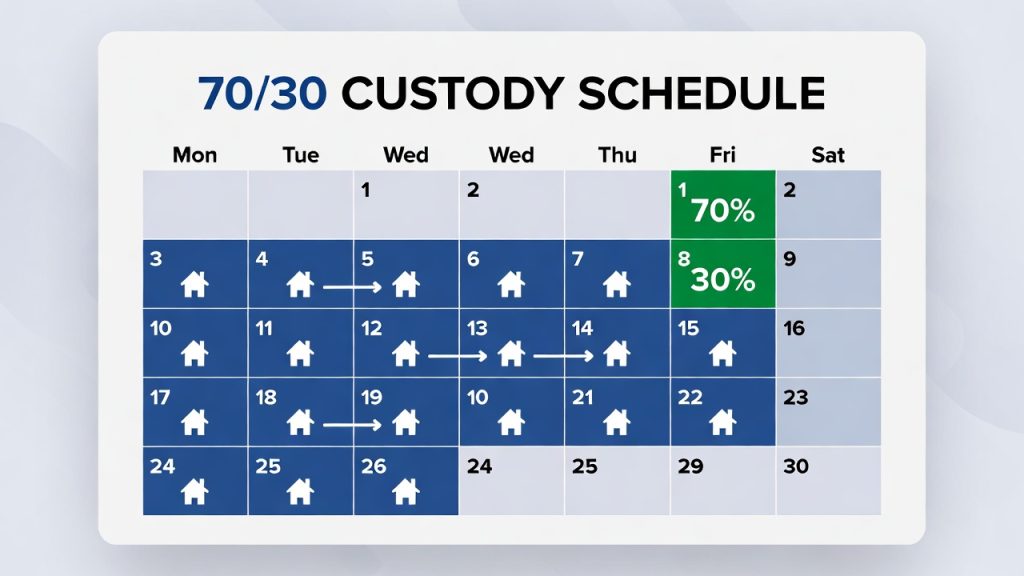
This calendar example shows a common 70/30 custody schedule when one parent has primary residence.
Grandparents, Third-Party Rights & Unmarried Parents
How to Modify Custody or Parenting Time
File a petition showing a “substantial and continuing change in circumstances” (e.g., relocation, abuse, major income change). Process usually takes 3–6 months.
Costs: Filing $100–$300 + attorney fees $3,000–$10,000+.
Common Myths Debunked
Myth: Mothers always win custody. Fact: Gender-neutral law; fathers win equal or primary custody with strong evidence every day.
Myth: The child’s preference decides everything. Fact: Considered (especially age 14+), but one of many factors.
This photo shows parents consulting with a family law attorney on custody planning — the smartest first step for strong agreements.
Frequently Asked Questions
Q1. Does Indiana favor mothers in custody cases?
No — the law is completely gender-neutral.
Q2. Can a father get 50/50 custody?
Yes — very common when both parents are fit and cooperative.
Q3. What age can a child choose which parent to live with?
No automatic age; wishes are considered more at 14+, but not decisive.
Q4. How long does a custody case take?
Uncontested: 2–4 months. Contested: 6–18+ months.
Q5. Can custody be modified later?
Yes — with proof of substantial change in circumstances.
If child custody or parenting time concerns you in Southern Indiana (Jasper, Huntingburg, Dale, Tell City, Washington, Boonville, Evansville or surrounding areas), Fritch Law provides experienced, compassionate help with custody determinations, parenting plans, modifications, paternity, and court representation. They focus on the child’s best interest while protecting both parents’ rights. Visit https://www.fritchlaw.com/ for family law resources or call 812-482-9232 for straightforward, no-pressure advice.
This guide is based on Indiana Code § 31-17-2-8 and the official Indiana Parenting Time Guidelines (verified current as of 2026). No major legislative changes affect the core rules. This is not legal advice — every case is unique. Consult a licensed Indiana family law attorney for advice specific to your situation.