
Indiana Real Estate Tax Strategies (2026 Guide for Investors)
Why Tax Planning Matters for Real Estate Investors
6 must-know tax strategies for savvy real estate investors in Indiana 2026 can literally save you tens or even hundreds of thousands in taxes while protecting and growing your portfolio. With the federal estate/gift tax exemption now at $15 million per person (up from $13.99 million in 2025), permanent 100% bonus depreciation reinstated for qualified property placed in service after January 19, 2025, and Indiana’s ongoing property tax relief (10% homestead credit + increasing supplemental deductions), 2026 is one of the best years ever to optimize.
Indiana has no state estate or inheritance tax, making it one of the most investor-friendly states. The key is combining federal tools (bonus depreciation + cost segregation, QBI deduction, 1031 exchanges) with Indiana-specific property tax strategies and smart gifting/estate planning.
This complete 2026 guide (verified with IRS Notice 2026-11, Indiana Department of Local Government Finance updates, and current tax code) breaks down the 6 most powerful strategieswith step-by-step implementation, real costs, timelines, real-life Indiana investor examples, common pitfalls, myths debunked, and FAQs.
1. Unlock 100% Bonus Depreciation with Cost Segregation Studies (Biggest Cash-Flow Win in 2026)
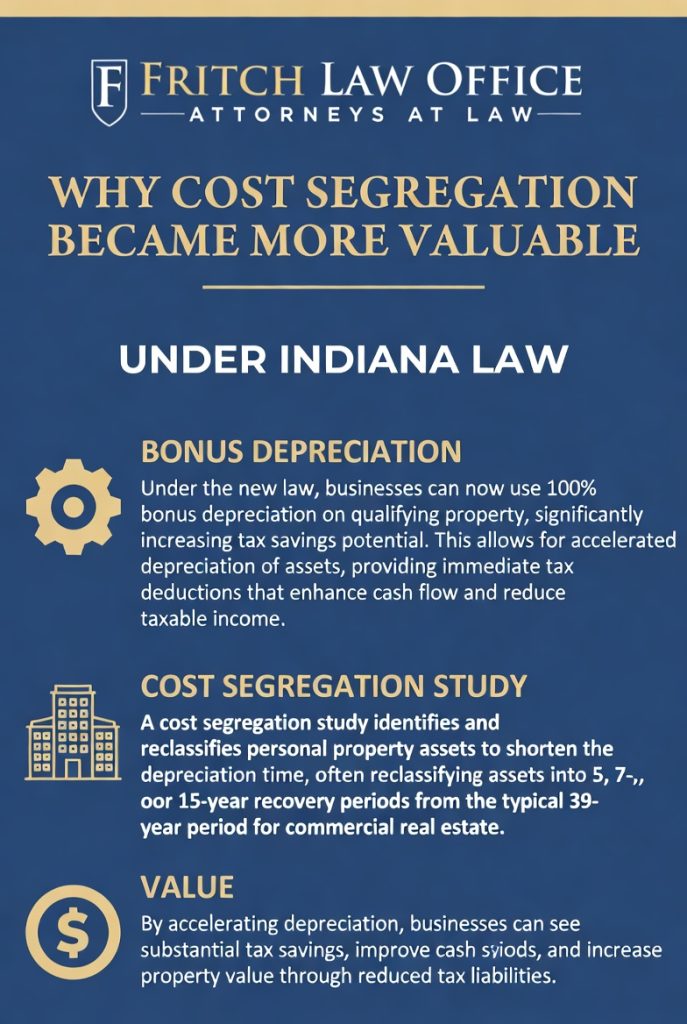
The One Big Beautiful Bill Act made 100% bonus depreciation permanent for qualified property acquired and placed in service after January 19, 2025. Real estate investors win big by using a cost segregation study to reclassify building components (HVAC, flooring, lighting, parking lots, landscaping) from 27.5/39-year real property into 5-, 7-, or 15-year personal property that qualifies for immediate 100% deduction.
How to do it in 2026:

Why Cost Segregation Just Became More Valuable – MGO CPA
Another visual breaks down bonus depreciation options after a cost segregation study.
2. Claim the Permanent 20% QBI Deduction on Rental Income
Section 199A (Qualified Business Income deduction) is now permanent and available for qualifying rental real estate. Many Indiana investors qualify via the IRS safe harbor (250+ hours of rental services per year with records) or by proving it’s a trade or business.
2026 benefit: Up to 20% deduction on net rental income (plus REIT/PTP income). Widened phase-in ranges make it easier for higher-income investors.
Tips for Filing a Police Report in Jasper
This flowchart shows exactly how to calculate and claim the QBI deduction for rental real estate.

3. Defer Taxes Indefinitely with 1031 Like-Kind Exchanges
Section 1031 exchanges remain fully available for real property. Sell one investment property and roll gains into a “like-kind” replacement — no capital gains tax now (or ever, if repeated).
Pro tip for 2026: Do a cost segregation study on the replacement property (excess basis gets 100% bonus depreciation). Combine for massive deferral + immediate deductions.
Real-life example: An Evansville investor sold a $900K rental in 2026, did a 1031 exchange into a $1.2M multifamily, and used cost segregation on the new property to deduct $320,000 in year one.
This flowchart shows the 1031 exchange process step-by-step for Indiana investors.

4. Reduce Indiana Property Taxes with New Deductions, Credits & Appeals
Indiana’s 2026 property tax reforms include:
Strategies:
This chart shows Indiana’s new 2026 property tax credits and deductions for real estate investors.

5. Use Strategic Annual Gifting to Lower Future Estate Taxes
With the $15 million federal exemption, most Indiana investors won’t owe estate tax — but gifting still reduces your taxable estate and shifts income to lower-bracket heirs.
2026 rule: $19,000 per recipient per year tax-free. Married couples can gift $38,000 per person.
Combine with 1031 exchanges and trusts for multi-generational tax savings.
6. Integrate Estate Planning with Opportunity Zones & Energy Credits
Protecting Real Estate Assets Through Estate Planning
Place appreciated real estate into Opportunity Zones for tax deferral + potential step-up. Claim Section 179D energy efficiency deductions for qualifying improvements.
Pro move: Pair with a revocable living trust for probate avoidance and seamless transfer.
This visual shows how combining estate planning with real estate tax strategies creates a complete wealth-protection system.

Common Myths Debunked
Myth 1: Bonus depreciation is gone. Fact: Permanent 100% since 2025 for qualified assets.
Myth 2: Rental income never qualifies for QBI. Fact: Safe harbor makes it easy for most Indiana landlords.
Real-Life Indiana Investor Wins in 2026
Frequently Asked Questions (FAQ) – 2026 Indiana Real Estate Tax Strategies
Q1. Is 100% bonus depreciation really back for 2026? Yes — it’s permanent for qualified property placed in service after January 19, 2025, thanks to the One Big Beautiful Bill Act. This makes cost segregation even more powerful for immediate deductions.
Q2. Can Indiana rental income qualify for the QBI deduction? Absolutely — most Indiana landlords qualify using the IRS safe harbor (250+ hours of rental services per year with proper logs) or by meeting the trade-or-business test. The 20% deduction applies federally and flows through to Indiana returns.
Q3. How do I start a cost segregation study? Hire a qualified engineering firm specializing in cost seg (cost typically $5,000–$15,000, fully deductible). They’ll produce an IRS-defensible report. Pair it with your CPA for maximum benefit—many Jasper-area clients see ROI in year one.
Q4. Do I still need a Qualified Intermediary (QI) for a 1031 exchange? Yes — always. Strict IRS rules require a QI to hold proceeds and handle paperwork. Skipping this risks full taxation on gains. We recommend planning early to avoid boot or timeline issues.
Q5. Should I appeal my Indiana property taxes? Yes — especially in 2026 with the new assessment changes and supplemental deduction phase-in. Successful appeals often reduce bills 10–30%. Gather evidence (comps, photos, errors) and file by the deadline—our firm can guide you through the process.
Q6. Does Indiana require an add-back for federal bonus depreciation? Yes — Indiana does not fully conform to IRC §168(k) bonus depreciation. You must add back the bonus portion on your state return, so the big savings are mostly federal. Regular accelerated depreciation (from cost seg) still helps at the state level.
Q7. How does the step-up in basis work with real estate when I pass away? At death, heirs receive a step-up in basis to fair market value, erasing built-in capital gains. This pairs beautifully with cost segregation (catch-up deductions on final return) and estate planning (trusts/LLCs) to minimize taxes for the next generation.
Q8. Can I combine multiple strategies (e.g., cost seg + 1031 + QBI)? Yes — stacking is the key to maximum savings. For example: Use cost seg + 100% bonus on a replacement property after a 1031 exchange, then claim QBI on the new rental income. Consult us to model your specific scenario.
Q9. What about Opportunity Zones or energy credits in Indiana? Opportunity Zones still offer deferral + potential 10-year basis step-up for qualifying investments. §179D energy-efficient commercial building deductions apply nationwide. Local Indiana incentives (e.g., TIF districts) may add extra layers—worth exploring for new developments.
Key Takeaways for Indiana Real Estate Investors
- Tax planning can significantly increase real estate investment profitability.
- Bonus depreciation and cost segregation accelerate deductions.
- 1031 exchanges allow investors to defer capital gains taxes.
- Estate planning protects real estate assets for future generations.
If you’re a real estate investor in Southern Indiana (Jasper, Huntingburg, Dale, Tell City, Washington, Boonville, Evansville or surrounding areas), Fritch Law specializes in tax-efficient estate planning, 1031 exchanges, cost segregation coordination, and Indiana-specific strategies. They help investors protect assets, minimize taxes, and build lasting wealth. Visithttps://www.fritchlaw.com/ for real estate and estate planning resources or call 812-482-9232 for a free, no-pressure consultation.
This guide is based on IRS Notice 2026-11, OBBBA provisions, and Indiana Department of Local Government Finance updates (verified current as of 2026). Tax laws can change; always verify with current IRS and Indiana sources. This is not legal or tax advice — every situation is unique. Consult a licensed Indiana tax attorney, CPA, and qualified cost segregation professional for advice specific to your investments.