

Noblesville divorce lawyer: Complete 2026 Guide
Fritch Law Office handles noblesville divorce lawyer cases for Indiana residents every day. First, our attorneys examine your situation carefully. Next, we identify your strongest legal options. Furthermore, we explain every step in plain language. Therefore, you make confident decisions from day one.
Key Facts About Noblesville divorce lawyer in Indiana
Indiana courts apply strict 2026 rules to noblesville divorce lawyer matters. Moreover, experienced attorneys win better outcomes for clients. Additionally, early legal advice prevents costly mistakes. Consequently, clients who hire Fritch Law gain a clear advantage. However, waiting too long weakens your position significantly.
Take Action on Noblesville divorce lawyer Today
Do not delay your noblesville divorce lawyer case. First, call our Jasper office directly. Next, we schedule your free consultation immediately. Then, we build a winning strategy for you. Additionally, we represent you at every court hearing. Finally, we resolve your case as fast as possible.

Visit the Indiana Courts website for official legal information. Contact Fritch Law for your free consultation today.
Navigating Divorce in Noblesville: Finding Your Legal Advocate
Looking for a Noblesville divorce lawyer? Here’s what you need to know:
- Residency requirements: Must live in Indiana for 6 months and Hamilton County for 90 days before filing
- Waiting period: Indiana law requires a 60-day waiting period after filing
- Legal approach: Indiana is a no-fault divorce state with 50/50 property division presumption
- Local expertise: Choose a lawyer familiar with Hamilton County Family Court procedures
- Free consultations: Many Noblesville divorce attorneys offer free initial consultations
- Cost considerations: Discuss payment plans, retainers, and fee structures during consultation
The day you decide to move forward with a divorce often marks the beginning of a profound life transition. If you’re searching for a Noblesville divorce lawyer, you’re likely facing questions, concerns, and perhaps even some fears about what lies ahead. That’s completely normal – and having the right legal guidance can make all the difference.
Indiana divorce laws create a specific framework for ending a marriage, with particular requirements that must be followed. From the initial filing to property division decisions, child custody arrangements, and financial settlements, each step involves important choices that can impact your life for years to come.
What many people don’t realize is that finding the right attorney isn’t simply about legal expertise – though that’s certainly important. It’s about connecting with someone who listens to your unique situation, understands your priorities, and can advocate effectively while helping you steer the emotional complexities that inevitably arise during divorce.
At Fritch Law Office, we’ve walked alongside countless clients through divorce proceedings in Hamilton County. With decades of experience as a Noblesville divorce lawyer, I’ve seen how the right legal approach can help people move through this challenging time with dignity and secure a fresh start.
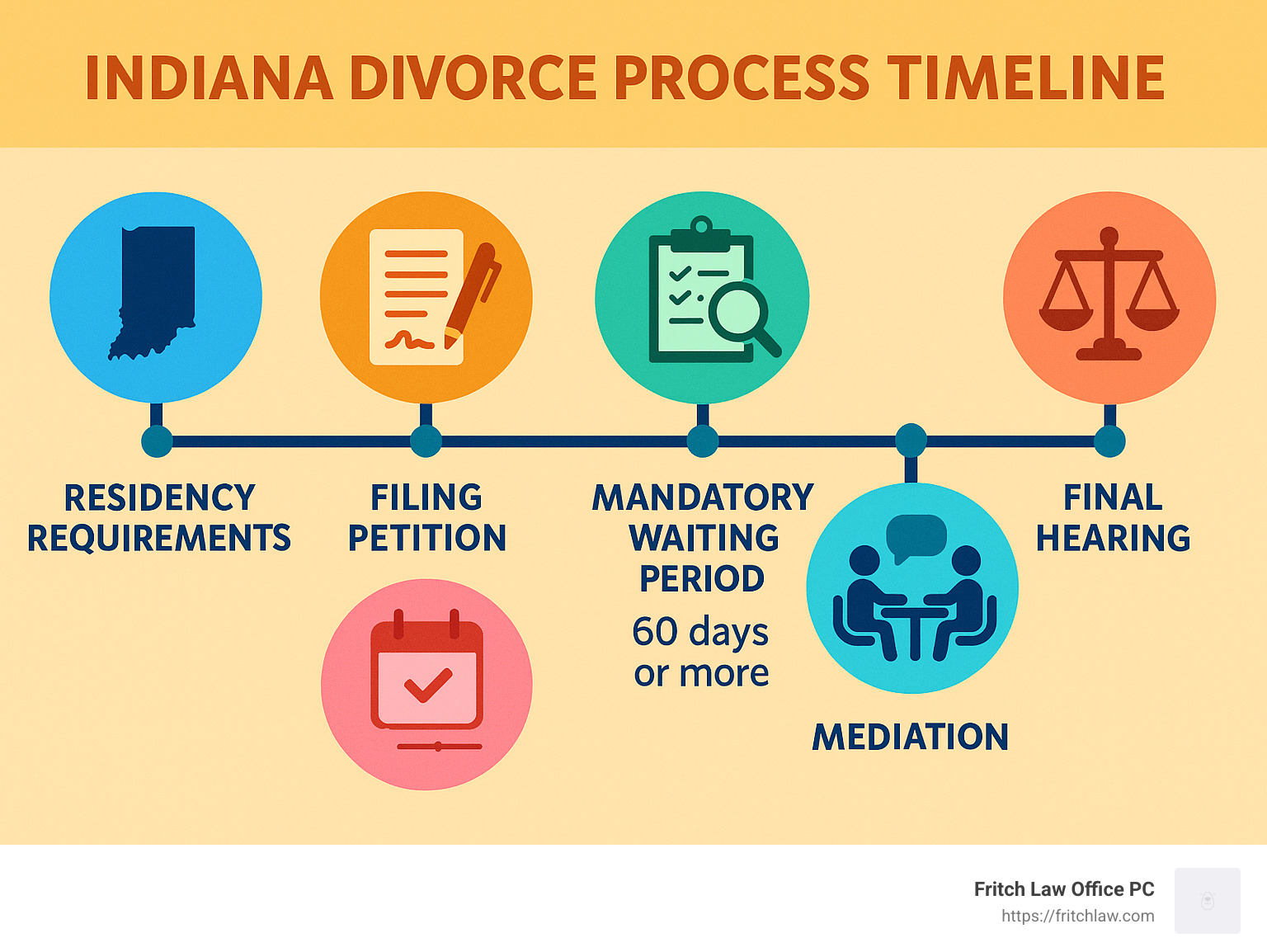
Understanding the divorce process in Noblesville begins with knowing the basics. You must have lived in Indiana for at least 6 months and in Hamilton County for at least 90 days before filing. Once filed, there’s a mandatory 60-day waiting period before your divorce can be finalized – even in the most amicable situations.
Indiana follows a “no-fault” approach to divorce, meaning you don’t need to prove wrongdoing to end your marriage. The state also presumes a 50/50 division of marital property is fair, though various factors can shift this balance. These nuances are where having a knowledgeable Noblesville divorce lawyer becomes particularly valuable.
Local expertise matters tremendously in divorce cases. The Hamilton County Family Court has specific procedures and expectations that can impact your case. Working with an attorney who regularly practices in these courts means you benefit from their familiarity with local judges, mediators, and court staff.
Most reputable divorce attorneys in Noblesville offer free initial consultations, giving you a chance to discuss your situation and determine if they’re the right fit for your needs. During this meeting, be sure to ask about their approach to cases like yours, their communication style, and their fee structure – including retainers and payment plans.
Divorce is both a legal process and a personal journey. The attorney you choose should not only have the legal knowledge to protect your interests but also the compassion to support you through this significant life transition.
Handy noblesville divorce lawyer terms:
– abogados de divorcio en indianapolis
– divorce lawyers crown point indiana
– divorce lawyers indiana
Understanding Indiana Divorce Basics
When couples begin exploring divorce in Indiana, there’s a lot to understand about the process. As a Noblesville divorce lawyer, I’ve guided hundreds of families through these waters, and I’ve found that knowing the basics helps reduce anxiety from the start.
Indiana requires that at least one spouse has lived in the state for six months before filing for divorce. You’ll also need to have been a resident of Hamilton County for at least 90 days if you want to file at the courthouse in Noblesville. These residency requirements ensure you have sufficient connection to our community before using our local court system.
One piece of good news for many clients is that Indiana follows “no-fault” divorce principles. This means you don’t need to prove your spouse did something wrong to get divorced. Simply citing an “irretrievable breakdown of the marriage” is sufficient grounds. This approach often reduces blame and conflict during an already stressful time.
Something that surprises many people is Indiana’s mandatory 60-day waiting period. Even if you and your spouse agree on everything immediately, the law requires at least 60 days to pass between filing the initial petition and finalizing your divorce. Think of it as a built-in cooling-off period that gives everyone time to carefully consider the life-changing decisions ahead.
For those who aren’t quite ready for divorce but need legal protection, Indiana offers legal separation as an alternative. A legal separation decree lasts up to one year and addresses many of the same issues as divorce – property division, support, and custody arrangements – without permanently ending the marriage.
| Aspect | Contested Divorce | Uncontested Divorce |
|---|---|---|
| Definition | Spouses disagree on one or more major issues | Spouses agree on all major issues |
| Timeline | 6-12+ months | As little as 60 days (after waiting period) |
| Cost | $5,000-$20,000+ | $1,500-$5,000 |
| Court Appearances | Multiple hearings likely | Minimal court time, often just final hearing |
| Stress Level | High | Lower |
| Control Over Outcome | Judge makes final decisions | Spouses maintain control |
| Need for Attorney | Highly recommended | Recommended for review |
Contested vs Uncontested Divorce in Indiana
When I sit down with new clients, one of the first things we discuss is whether their divorce is likely to be contested or uncontested, as this dramatically affects the path forward.
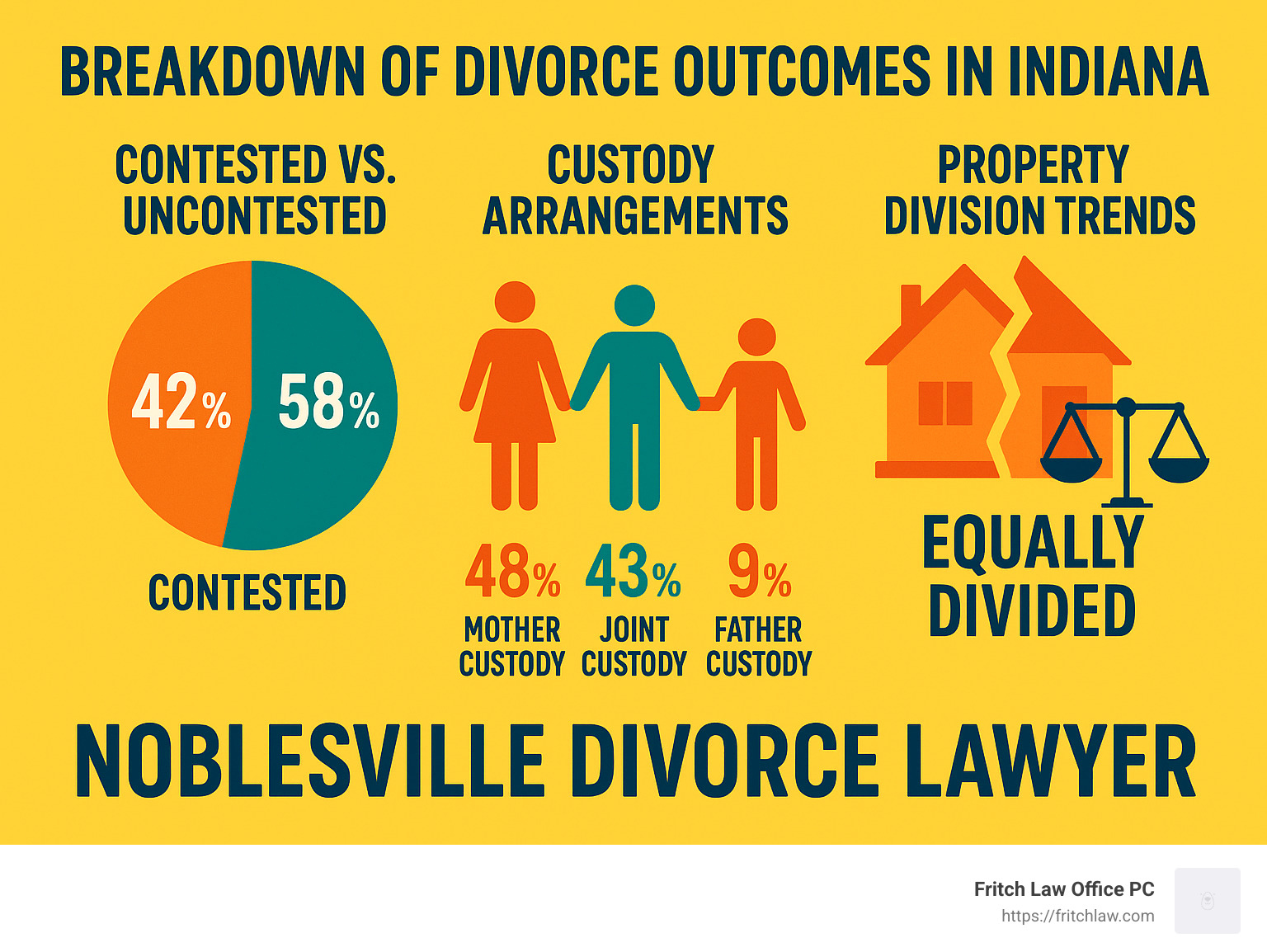
In an uncontested divorce, both spouses have reached agreement on all major issues – how to divide property and debts, arrangements for children, support payments, and anything else that needs resolving. These cases move through the system much more smoothly, typically costing far less in legal fees. The biggest advantage? You and your spouse – not a judge – maintain control over these important life decisions.
By contrast, a contested divorce involves disagreements on one or more key issues. These cases require more extensive work – negotiations, document preparation, mediation sessions, and potentially court hearings. While more time-consuming and expensive, sometimes this process is necessary to protect your rights, especially if your spouse is being unreasonable or if complex assets are involved.
Reality often falls somewhere in the middle. You might agree on parenting arrangements but disagree about the house, or vice versa. As your Noblesville divorce lawyer, I can help identify where compromise makes sense and where standing firm protects your future.
Mandatory Waiting Periods & Typical Case Length
“How long will this take?” is probably the question I hear most often in my office. While every divorce has its own timeline, understanding the typical process helps set realistic expectations.
As mentioned earlier, Indiana requires that 60-day waiting period after filing. This is the absolute minimum – your divorce cannot be finalized any sooner than that, even if you both agree on everything immediately.
For a typical contested divorce in Noblesville, the process usually takes between 6 and 12 months from filing to final decree. Cases involving complex financial situations, business valuations, or heated custody disputes can extend well beyond this timeframe, sometimes taking 18 months or longer.
Several factors can speed up your divorce:
– Both parties approaching negotiations with reasonableness
– Complete and transparent financial disclosures
– Effective use of mediation
– Attorneys focused on problem-solving rather than conflict
On the flip side, these factors commonly slow things down:
– High-conflict personalities or communication breakdowns
– Hidden assets or financial complications
– Disputes over business ownership or valuation
– Serious allegations affecting custody
– Relocation issues that impact parenting arrangements
While it’s natural to want your divorce “over with,” rushing through the process often leads to mistakes and unfavorable agreements that can affect you for years. As your Noblesville divorce lawyer, I balance efficiency with protecting your long-term interests – because getting it done right is just as important as getting it done.

Key Financial & Parenting Issues in Noblesville Divorces
When I sit down with clients in Noblesville, most are concerned about two main things: their money and their children. These worries are completely natural, and understanding Indiana’s approach to these issues can help ease some of that anxiety.
Indiana follows what we call the “one-pot theory” for dividing property. This means everything—yes, everything—acquired before or during your marriage goes into the marital pot for division. The law starts with a presumption that a 50/50 split is fair, but this isn’t set in stone. Courts can adjust this based on factors like your contributions to acquiring property, your economic circumstances, conduct during the marriage, and each person’s ability to earn income moving forward.
For parents, nothing matters more than their children. Indiana courts make custody decisions based on what’s in the “best interests of the child,” considering things like the child’s age, the wishes of both parents and the child (if old enough), how well the child has adjusted to their home and school, everyone’s mental and physical health, any history of domestic violence, and the relationships between the child and family members.
The Indiana Parenting Time Guidelines provide a helpful framework for visitation schedules based on your child’s age and developmental needs. Remember though, these are just guidelines—you and your ex can create arrangements that better fit your family’s unique situation.
Property & Debt Division Strategies
As a Noblesville divorce lawyer, I’ve helped clients with everything from straightforward property divisions to complex financial portfolios with multiple homes, businesses, and retirement accounts.
The marital home often represents your largest asset and can be handled in several ways:
– Selling the house and splitting the proceeds
– One spouse buying out the other’s interest
– Continuing to co-own for a period (often until children finish school)
Retirement accounts need special handling to avoid tax penalties. We typically use a Qualified Domestic Relations Order (QDRO) to divide 401(k)s and pensions, while IRAs can be split through a “transfer incident to divorce.”
Business interests create unique challenges. If either of you owns a business, we’ll likely need a professional valuation to determine its worth. From there, options include buying out the non-owner spouse, selling the business entirely, creating a co-ownership agreement, or offsetting the business value with other assets.
Don’t forget about debts—they get divided too! Credit cards, mortgages, car loans, and student loans all become part of the negotiation. An important caveat: while your divorce decree assigns debt responsibility between you and your ex, creditors can still come after you if your name remains on the account. We’ll discuss strategies to protect you from your ex’s potential default.
Child Custody, Parenting Time & Support Rules
Indiana recognizes two types of custody: legal custody (who makes important decisions) and physical custody (where the child primarily lives).
Many parents share joint legal custody, making decisions together about education, healthcare, and religion. This works well when parents can communicate effectively. In cases involving domestic violence, substance abuse, or extreme conflict, sole legal custody might be more appropriate.
For physical custody and parenting time, the Indiana Parenting Time Guidelines suggest schedules based on your child’s age. For school-age children, a common arrangement includes alternating weekends, one weeknight visit each week, extended time during summer and school breaks, and alternating holidays.
Child support calculations follow the Indiana Child Support Guidelines, considering both parents’ incomes, number of children, health insurance costs, childcare expenses, and parenting time. While the worksheet produces a recommended amount, courts can adjust this when circumstances warrant.
If your ex isn’t paying court-ordered support, several enforcement tools exist, including income withholding, license suspension, tax refund interception, and in extreme cases, criminal charges.
Want to learn more about family law issues? Check out our family law page for additional information.
Spousal Maintenance (Rare but Possible)
Unlike some states, Indiana doesn’t routinely award alimony (called “spousal maintenance” here). In fact, it’s only available in three specific situations:
Incapacity maintenance applies when your spouse is physically or mentally incapacitated to the extent they cannot support themselves.
Caregiver maintenance comes into play when a spouse lacks sufficient property and income while caring for a child whose condition requires the parent to forgo employment.
Rehabilitative maintenance is limited to three years maximum and helps a spouse acquire education or training to improve their employment prospects.
As a Noblesville divorce lawyer, I find rehabilitative maintenance is the most common type awarded, but even this is relatively rare compared to other states. Courts look at education level, work history, and the time needed to become self-supporting when determining the amount and duration.

Process Options: Litigation, Mediation & Collaborative Paths
When you’re working with a Noblesville divorce lawyer, one of the first big decisions you’ll face is choosing which path to take through your divorce. Think of this like choosing between different routes on a road trip – each has its own scenery, timeline, and challenges.
Traditional litigation is what most people picture when they think of divorce – filing paperwork with the court, exchanging information through formal findy, attending hearings, and possibly going to trial. While this approach provides structure and may be necessary in high-conflict situations or complex cases, it’s typically the most expensive and time-consuming option. It’s like taking the highway during rush hour – you’ll get there, but it might be a bumpy ride.
Mediation offers a more collaborative approach. Here, you and your spouse work with a neutral third party who helps guide your conversations toward agreement. What many Noblesville residents don’t realize is that Hamilton County courts actually require mediation before allowing most divorce cases to proceed to trial. Your Noblesville divorce lawyer will be right beside you during these sessions, ensuring your interests are protected while helping find middle ground.
Collaborative divorce takes the cooperative approach even further. Both spouses and their attorneys sign a commitment to resolve all issues without court intervention. This process often brings in other professionals like financial advisors or child specialists to create a support team focused on solutions. If the collaboration breaks down, everyone starts over with new attorneys – a powerful incentive to stay at the table and work things out.
The right choice depends on your specific situation – your relationship with your spouse, the complexity of your assets, whether children are involved, and your personal priorities regarding time, money, and emotional well-being.
The Role of Mediation in Noblesville
Mediation has become the cornerstone of divorce resolution in Hamilton County. Courts in Noblesville typically order couples to attempt mediation before they can take their case to trial, reflecting growing evidence that mediated settlements lead to more lasting agreements and healthier post-divorce relationships.
During a typical mediation session, you’ll sit down with a trained mediator (usually an attorney with specialized training) who acts as a neutral guide through difficult conversations. Your Noblesville divorce lawyer will be present to offer legal advice and ensure any agreements align with your interests. The mediator doesn’t make decisions for you but instead helps you and your spouse find common ground.
The beauty of mediation lies in its flexibility and focus on mutual problem-solving. Unlike a courtroom where a judge makes decisions based on limited information, mediation allows you to craft solutions specifically custom to your family’s unique circumstances. Parents often find they can develop more creative and workable parenting schedules through mediation than what a court might order.
Beyond saving time and money (mediation typically costs a fraction of litigation), the process is confidential. Unlike court hearings that become public record, what happens in mediation stays private – something many people appreciate during such a personal life transition.
Perhaps most importantly, research shows that agreements reached through mediation have significantly higher compliance rates than court-imposed orders. When people actively participate in creating solutions, they’re simply more likely to follow through on their commitments.
Scientific research on mediation outcomes
Alternatives to Court for a Smoother Split
Beyond mediation, several other paths can help you avoid the traditional courtroom battle while still achieving a fair and legally binding divorce.
Collaborative divorce, as mentioned earlier, creates a structured team approach to resolution. The formal commitment that attorneys will withdraw if the process fails creates a powerful incentive for everyone to find solutions. This approach works particularly well for couples who, despite their differences, share a desire to maintain respect and dignity throughout their divorce.
Private judging offers an interesting middle ground between litigation and alternative methods. You essentially “rent” a retired judge or qualified attorney to hear your case privately. This provides the formality and finality of court proceedings but with more scheduling flexibility and privacy. Your case moves at your pace, not the crowded court calendar’s pace, often resulting in a faster resolution.
Online dispute resolution platforms have gained popularity in recent years, especially since the pandemic normalized virtual interactions. These digital tools provide structured frameworks for negotiating everything from parenting schedules to asset division. They’re particularly helpful for couples who struggle with face-to-face communication but can work cooperatively through a more structured format.
As your Noblesville divorce lawyer, I help clients evaluate these options based on their unique circumstances and relationship dynamics. Some cases benefit from a hybrid approach – perhaps using mediation for parenting issues while turning to more formal processes for complex financial matters. The goal is always finding the most efficient path to a fair resolution while preserving your emotional well-being and financial resources.

Hiring a Noblesville Divorce Lawyer
Finding the right attorney might be the most important decision you’ll make during your divorce. The ideal Noblesville divorce lawyer brings not just legal expertise to the table, but also the compassion and communication skills to guide you through this challenging chapter of life.
Local experience makes a real difference in divorce cases. Hamilton County Family Court operates with its own unique procedures, local rules, and judicial preferences that can significantly impact your case. Attorneys who regularly practice in Noblesville build valuable relationships with court personnel, mediators, and other local professionals—connections that often prove beneficial to clients.
When you’re evaluating potential attorneys, think about their familiarity with issues specific to your situation. If your case involves a family business, substantial assets, or complicated custody matters, you’ll want someone who has handled similar cases successfully.
Some family law attorneys in Indiana have taken the extra step of becoming certified as Family Law Specialists through the Family Law Certification Board. While this certification isn’t required to practice family law, it does signal a deeper commitment and specialized knowledge in this area.
What to Look For in a Noblesville Divorce Lawyer
When choosing a Noblesville divorce lawyer, several qualities stand out as particularly important.
First, consider their focus and experience. Family law constantly evolves, and attorneys who concentrate primarily on divorce tend to stay current with the latest developments. Someone who handles divorces as just a small portion of their practice may not have the depth of knowledge you need.
Local knowledge is invaluable. An attorney familiar with Hamilton County courts understands the nuances of local procedures and has working relationships with judges and other professionals in the system. During consultations, ask specifically about their experience in Noblesville courts.
Pay close attention to their communication style. Your attorney should explain complex legal concepts in plain language and respond promptly to your questions. During your initial meeting, notice how they communicate—do they listen carefully? Do they make legal concepts understandable? Your comfort level with their communication style matters tremendously.
Consider their strategic approach as well. Some attorneys are courtroom warriors, while others excel at negotiation and settlement. Neither approach is inherently superior—what matters is finding an attorney whose style aligns with your goals and values.
Fee structure transparency is essential. Understand how the attorney charges, what retainer they require, and how they handle billing. Clear communication about finances helps prevent unpleasant surprises down the road.
Don’t overlook the importance of support staff. You’ll likely interact with paralegals and legal assistants frequently throughout your case. A well-organized office with professional support staff can significantly improve your experience.
Finally, given Hamilton County’s emphasis on mediation, an attorney with strong negotiation skills and mediation experience brings particular value to your case.
Questions to Ask During Your First Meeting
Your initial consultation with a Noblesville divorce lawyer provides a crucial opportunity to gather information and assess whether this attorney is right for you. Come prepared with thoughtful questions to make the most of this time.
“What percentage of your practice focuses on family law and divorce?” This helps you understand if you’re working with a specialist or a generalist.
“How many cases have you handled in Hamilton County courts?” Local experience can make a significant difference in your case’s outcome.
“What approach would you take with my specific situation?” This reveals their strategic thinking and problem-solving style.
“What potential challenges do you see in my case?” An experienced attorney should identify possible problems and have strategies to address them.
“What realistic outcomes might I expect?” Beware of attorneys who make grand promises—look for honest, realistic assessments.
“How will we communicate throughout my case?” Understand their accessibility and communication protocols.
“Who else in your office will work on my case?” Know the team you’ll be working with, not just the attorney.
“How do you structure your fees, and what’s a realistic total cost estimate?” Get clarity on finances from the beginning.
“What’s your experience with mediation and settlement negotiation?” Since most cases settle before trial, this experience is crucial.
“How would you handle specific issues in my case?” Ask about particular concerns you have, whether they involve custody, business valuation, or other matters.
During this meeting, honesty is essential—even about uncomfortable facts. Your attorney needs complete information to develop an effective strategy and provide accurate advice.
Also notice how the attorney responds to your questions. Are they fully present or constantly checking their phone? Do they listen carefully or seem distracted? These observations offer valuable insights into how they’ll handle your case.
Divorce Lawyer Indianapolis Free Consultation
Understanding Costs, Retainers & Payment Plans
The financial aspect of hiring a Noblesville divorce lawyer understandably concerns most clients. While costs vary depending on case complexity, understanding fee structures helps you budget appropriately.
Most divorce attorneys in Noblesville charge hourly rates between $200 and $400, with more experienced attorneys typically at the higher end of this range. You’ll usually pay a retainer upfront—essentially a deposit placed in a trust account from which the attorney draws as they complete work on your case.
Initial retainers commonly range from $2,500 for straightforward cases to $10,000 or more for complex situations. For a relatively simple, uncontested divorce, total costs might run between $1,500 and $5,000. For contested cases involving significant assets or custody disputes, costs can reach $10,000 to $25,000 or higher.
Some attorneys offer alternative payment arrangements that might better fit your financial situation:
– Flat fees for uncontested divorces provide cost certainty
– Limited scope representation allows you to pay only for specific services
– Pay-as-you-go options with smaller, more frequent retainer replenishments
– Payment plans that spread costs over time rather than requiring large upfront payments
Many Noblesville divorce lawyers offer free initial consultations, giving you a chance to discuss your situation and get a fee estimate without financial commitment. During this consultation, ask detailed questions about costs:
“How often will I receive billing statements?” Monthly statements help you track expenses.
“What expenses are billed separately from hourly fees?” Filing fees, expert witnesses, and other costs may be additional.
“What happens when my retainer is depleted?” Understand the replenishment process.
“Are there ways to keep costs down?” An ethical attorney should offer suggestions for managing expenses.
While cost matters, choosing an attorney based solely on the lowest price often proves shortsighted. An experienced attorney may work more efficiently and achieve better results that save money long-term. Think of legal representation as an investment in your future rather than simply an expense.

Preparing & Surviving the Journey
Divorce isn’t just paperwork and court dates—it’s a profound life transition that touches nearly every aspect of your world. While having a skilled Noblesville divorce lawyer by your side is crucial, your personal preparation can make an enormous difference in how smoothly your case proceeds.
I always recommend clients begin by gathering key financial documents. This includes your tax returns from the past 3-5 years, recent pay stubs, bank statements, retirement account information, property deeds, credit card statements, loan documents, and insurance policies. If you own a business, collect those records too. Having this financial snapshot organized before our first substantial meeting saves both time and money—and ensures we don’t miss anything important when crafting your strategy.
For parents, thinking ahead about practical parenting arrangements is invaluable. Consider creating a draft parenting schedule that accounts for your children’s activities, your work commitments, and logistical realities. Many of my clients find co-parenting apps like Our Family Wizard or Talking Parents tremendously helpful for keeping communication clear and documented without direct conflict.
Don’t underestimate the emotional dimension of divorce. The clients who fare best typically build a support network—perhaps working with a therapist who specializes in divorce recovery, joining support groups (whether in-person or online), and maintaining healthy habits. Good sleep, nutrition and regular exercise might seem like secondary concerns during such a stressful time, but they significantly impact your ability to make clear decisions and manage the inevitable stress.
Common Mistakes to Avoid in Indiana Divorces
Over my years helping families through divorce in Noblesville, I’ve witnessed certain mistakes repeatedly. Being aware of these common pitfalls can help you steer your own case more successfully.
Social media missteps can seriously damage your case. What might seem like an innocent vent about your ex or photos from a night out can become evidence in your divorce proceedings. Many clients find it helpful to take a complete social media break during their divorce, or at minimum, to dramatically scale back their online presence.
Financial secrecy is never worth the risk. Attempting to hide assets isn’t just unethical—it’s illegal and courts take disclosure violations extremely seriously. When hidden assets are finded (and they usually are), your credibility is permanently damaged, potentially affecting every aspect of your case outcome.
Children should never become messengers between parents. This puts them in an impossible position and creates unnecessary emotional strain. Judges look very unfavorably on parents who involve children in adult matters, and it can negatively impact custody determinations.
Ignoring court orders, even temporary ones you disagree with, can result in serious consequences including contempt findings. Follow all orders regarding support payments, parenting time, or other matters while working through proper legal channels to modify them if necessary.
While DIY divorce resources are widely available, skipping legal review of your agreements often leads to costly mistakes. What seems like a simple oversight can have significant long-term financial implications or create enforcement problems down the road.
Minimizing the Impact on Children
As both a Noblesville divorce lawyer and someone who’s witnessed the effects of divorce on countless families, I believe protecting children should be among parents’ highest priorities during this transition.
Children process divorce differently depending on their developmental stage. Younger children might regress behaviorally or blame themselves for the separation. School-aged children often worry about practical changes to their daily lives, while teenagers might respond with anger, withdrawal, or acting out. Understanding these age-appropriate reactions helps you respond with the reassurance your children need.
What truly harms children isn’t the divorce itself but ongoing parental conflict. Research consistently shows that children can adjust healthily to living in two homes when parents manage their interactions respectfully.
Maintaining consistent routines across both households provides security during change. Speaking respectfully about your ex-spouse—regardless of your personal feelings—protects your children from unnecessary loyalty conflicts. Regularly reassuring children that both parents still love them and that the divorce isn’t their fault addresses their deepest worries.
Adult issues should remain between adults. Children don’t need details about financial disputes, infidelity, or other mature topics that burden them without benefit. If your child shows signs of significant distress—sleep problems, declining school performance, withdrawal from activities they previously enjoyed—consider professional support from a child therapist experienced in divorce adjustment.

Special Situations: Military & High-Asset Cases
Some divorce situations involve complexities that require specialized knowledge. As a Noblesville divorce lawyer who’s worked with diverse clients, I’ve developed approaches for these unique circumstances.
Military divorces operate under both state and federal regulations. The Servicemembers Civil Relief Act provides critical protections for active-duty military members, including the ability to postpone divorce proceedings during deployment. Military pension division follows specific federal guidelines rather than simple state property division rules. Healthcare benefits through TRICARE, base housing eligibility, and the impact of frequent relocations on custody arrangements all require careful navigation.
In high-asset divorces, the financial complexity often necessitates bringing in specialized experts. A business valuator can determine the worth of privately-held companies using accepted methodologies that stand up to court scrutiny. Forensic accountants help trace assets and verify financial disclosures when transparency is a concern. Real estate appraisers establish accurate values for multiple properties, and tax specialists analyze how different settlement options might impact your long-term financial picture.
Professionals with security clearances or licenses face additional considerations. For doctors, lawyers, financial advisors, and government contractors, divorce proceedings could potentially impact their professional standing if not handled discreetly. Protecting privacy and managing sensitive information appropriately becomes particularly important in these cases.
Life After Divorce: Modifications & Enforcement
The final divorce decree often isn’t truly final. Life evolves, circumstances change, and court orders sometimes need adjustment to reflect new realities. As a Noblesville divorce lawyer, I frequently help clients steer post-decree matters.
Modifications to custody, parenting time, or support typically require demonstrating a “substantial change in circumstances” since the original order. This might include significant income changes (either increases or decreases), relocation of either parent, health issues affecting parenting ability, children’s changing needs as they grow, or new relationships that meaningfully impact family dynamics.
Indiana has specific requirements regarding parental relocation. If you plan to move, you must file a formal notice with the court and notify the other parent, regardless of distance. The non-relocating parent can object, potentially triggering a hearing where the court evaluates whether the move serves the child’s best interests.
When court orders aren’t being followed, several enforcement options exist. Filing for contempt of court creates consequences for willful non-compliance. For unpaid support, wage garnishment provides a direct collection method. When parenting time is denied improperly, you can request make-up time and potentially attorney fees from the non-compliant party.
The key with post-decree issues is addressing them promptly. Working with your attorney to handle these matters when they first arise prevents small problems from escalating into major conflicts that harm both your finances and family relationships.
Frequently Asked Questions about Indiana Divorce
What are the residency rules to file in Noblesville?
One of the most common questions I hear as a Noblesville divorce lawyer relates to residency requirements. Indiana law is quite specific about this: to file for divorce in Hamilton County, at least one spouse must have lived in Indiana for six months immediately before filing. Additionally, either you or your spouse must have resided in Hamilton County for at least three months.
These aren’t just guidelines—they’re jurisdictional requirements. This means the court simply cannot proceed with your case if these time periods haven’t been met.
If you’ve recently moved to Noblesville, you might need to wait until you satisfy these time requirements. However, if your spouse meets the residency criteria, they could file even if you don’t. During your initial consultation, we’ll verify your residency status to determine when and where filing would be appropriate for your situation.
How is child support calculated and enforced?
Child support in Indiana follows what’s called an “Income Shares Model.” The fundamental principle is straightforward: children should receive the same proportion of parental income they would have received if their parents lived together.
When calculating support, several factors come into play:
Both parents’ weekly gross income is considered, along with the number of children involved. The calculation also accounts for parenting time (specifically the number of overnights with each parent), health insurance premiums for the children, work-related childcare expenses, and any other children either parent is legally obligated to support.
As your Noblesville divorce lawyer, I’ll use the Indiana Child Support Guidelines worksheets to determine the recommended support amount for your situation. While courts generally follow these guidelines, they can deviate when circumstances warrant it—though they must clearly document their reasons for any deviation.
If support isn’t paid as ordered, Indiana offers several enforcement mechanisms. These range from income withholding orders (where support is automatically deducted from paychecks) to more serious measures like suspending driver’s licenses or professional licenses. Tax refunds can be intercepted, and in extreme cases, non-payment can result in contempt proceedings with potential fines or jail time.
Many parents aren’t aware that the Hamilton County Prosecutor’s Office Child Support Division can assist with enforcement, often at no cost to the parent receiving support. This can be a valuable resource when payment issues arise.
Is spousal maintenance the same as alimony in Indiana?
Yes, “spousal maintenance” is simply Indiana’s term for what many other states call alimony or spousal support. However, there’s an important distinction: Indiana takes a much more restrictive approach to maintenance than many other states.
Unlike states that routinely award support based on factors like marriage length or income differences, Indiana limits maintenance to three specific situations:
Incapacity maintenance applies when a spouse has a physical or mental incapacity that significantly affects their ability to support themselves. Depending on the nature of the incapacity, this type of maintenance can be awarded indefinitely.
Caregiver maintenance becomes relevant when a spouse has insufficient property and income while caring for a child whose condition requires the parent to forgo employment. This continues only as long as the caregiving prevents the parent from working.
Rehabilitative maintenance is limited to a maximum of three years and is designed to help a spouse acquire education or training to improve their employment opportunities. Courts consider factors like education level, training history, and earning capacity when determining the amount and duration.
I’ve found that rehabilitative maintenance is the most commonly awarded type in my practice as a Noblesville divorce lawyer, but even this is relatively rare compared to other states. Courts have considerable discretion in these matters, and during our consultations, I can help you understand whether maintenance might apply in your situation—whether as a potential recipient or payor.
Conclusion
Navigating divorce in Noblesville requires understanding both the legal process and the emotional journey ahead. While Indiana’s divorce laws create a framework, each family’s situation is unique and deserves personalized attention.
As you consider the path forward, how you handle your divorce will impact your life for years to come. The decisions you make now about property, children, and finances will shape your future in significant ways.
Many of my clients find that with proper guidance, they can move through this challenging time with dignity and emerge stronger on the other side. The key is approaching each decision thoughtfully rather than reactively.
Choose your process wisely. Litigation isn’t the only option—and often isn’t the best one. Mediation and collaborative approaches frequently lead to more satisfying outcomes with less emotional and financial cost. These methods give you more control over your future rather than leaving critical decisions in a judge’s hands.
Keep your eyes on long-term goals rather than getting caught in the emotional satisfaction of “winning” small battles. I’ve seen too many clients spend thousands fighting over items of minimal value simply because emotions were running high.
Protecting your children should remain a top priority throughout your divorce. Children adapt best when parents minimize conflict and maintain consistent, supportive environments across both households. How you handle your divorce will teach them important lessons about relationships and problem-solving.
Build the right support team. Your Noblesville divorce lawyer is just one piece of the puzzle. Consider whether you might benefit from working with a financial advisor to plan your post-divorce budget, a therapist to process emotional challenges, or a co-parenting counselor to establish healthy communication patterns with your ex-spouse.
Prepare for your new beginning. While divorce marks an ending, it also opens the door to new possibilities. Many clients find this transition becomes an opportunity to reassess priorities and build a life more aligned with their values and goals.
At Fritch Law Office, we understand that divorce is more than just a legal process—it’s a significant life transition that affects your emotional wellbeing, financial security, and family relationships. Our approach combines legal knowledge with compassionate guidance, helping you steer this challenging time with confidence.
If you’re considering divorce or have already started the process, we invite you to schedule a consultation to discuss your specific situation and explore how we can help you achieve the best possible outcome.
More info about our divorce team