

Indiana trust beneficiary rights: Complete 2026 Guide
Fritch Law Office handles indiana trust beneficiary rights cases for Indiana residents every day. First, our attorneys examine your situation carefully. Next, we identify your strongest legal options. Furthermore, we explain every step in plain language. Therefore, you make confident decisions from day one.
Key Facts About Indiana trust beneficiary rights in Indiana
Indiana courts apply strict 2026 rules to indiana trust beneficiary rights matters. Moreover, experienced attorneys win better outcomes for clients. Additionally, early legal advice prevents costly mistakes. Consequently, clients who hire Fritch Law gain a clear advantage. However, waiting too long weakens your position significantly.
Take Action on Indiana trust beneficiary rights Today
Do not delay your indiana trust beneficiary rights case. First, call our Jasper office directly. Next, we schedule your free consultation immediately. Then, we build a winning strategy for you. Additionally, we represent you at every court hearing. Finally, we resolve your case as fast as possible.

Visit the Indiana Courts website for official legal information. Contact Fritch Law for your free consultation today.
Why Understanding Your Rights as a Trust Beneficiary Matters
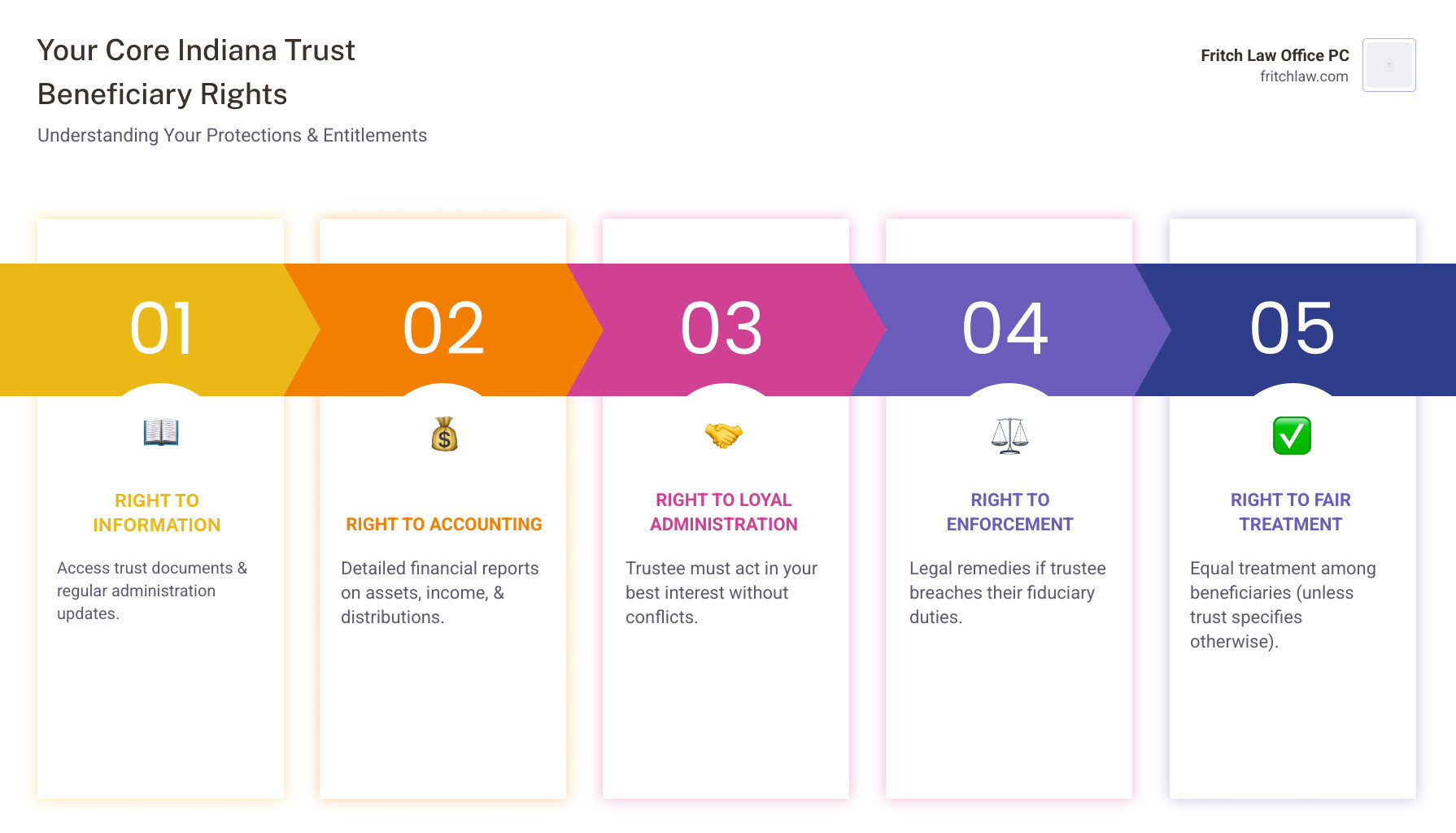
As a trust beneficiary in Indiana, you have comprehensive legal protections to ensure you receive proper treatment and information from your trustee. These fundamental Indiana trust beneficiary rights include:
- Right to Information: Access to trust documents and regular updates.
- Right to Accounting: Detailed financial reports on trust assets, income, and distributions.
- Right to Loyal Administration: The trustee must act in your best interest without conflicts.
- Right to Enforcement: Legal remedies if the trustee breaches their duties.
- Right to Fair Treatment: Equal treatment among beneficiaries unless the trust specifies otherwise.
Being a beneficiary means you are entitled to benefit from assets held in a trust, but you depend on the trustee to administer it properly. The trust’s creator (the settlor) establishes this legal arrangement where a trustee holds property for your benefit.
Understanding these rights is crucial because trustees hold significant power. Beneficiaries often don’t know what they’re entitled to or when they can act. Indiana Code Title 30, Article 4, Chapter 3 outlines the rules governing all parties to a trust.
I’m David Fritch. With 40 years of experience in law and financial planning, I’ve helped many clients steer complex trust matters. My dual background provides a unique perspective on how trusts operate and how beneficiaries can protect their interests.
Your Core Indiana Trust Beneficiary Rights Explained
A trust creates a legal relationship where the trustee has a fiduciary duty to you, the beneficiary—the highest standard of care under the law. This means your trustee must always act in your best interests, not their own. This duty of loyalty prevents them from using trust assets for personal gain. They must also follow the prudent investor rule, managing assets as a careful, knowledgeable person would. Finally, unless the trust specifies otherwise, a trustee must maintain impartiality among all beneficiaries, avoiding favoritism.
What Are My Fundamental Indiana Trust Beneficiary Rights?
Your Indiana trust beneficiary rights are legally enforceable protections. Here’s what you are entitled to:
- Your right to distributions means the trustee must follow the trust’s instructions on when and how much you receive. They cannot ignore these terms.
- Your right to be informed ensures you’re not left in the dark. The trustee must keep you reasonably updated on important decisions and changes affecting your interests.
- Your right to an accounting gives you access to financial details. You can request a clear report of the trust’s assets, income, expenses, and distributions.
- Your right to enforce the trust means you have legal recourse if the trustee fails their duties.
- Your right to a loyal and prudent trustee ensures the trust is managed carefully, with your interests first, according to the trust’s terms and Indiana law.
Can I Influence Trustee Decisions?
While you have strong rights, you don’t get a vote on every trustee decision. The trustee typically has discretion over day-to-day management, like selling property or making investments.
However, communicating your preferences can make a difference. Smart trustees want to hear from beneficiaries. If you have concerns about a potential decision, speak up. Putting your thoughts in written requests creates a record and shows you’re engaged. While the trustee has ultimate discretion, your input can influence their choices. Proactive communication builds better relationships and often leads to better outcomes.
How Are Minor or Incapacitated Beneficiaries Protected?
Indiana law provides special safeguards for beneficiaries who cannot advocate for themselves, such as minors or incapacitated adults.
- In legal proceedings, a court may appoint a guardian ad litem to represent their interests.
- The trustee’s duty to manage assets for minors often means holding their inheritance until they reach maturity. Many trusts use age of majority provisions to distribute assets gradually (e.g., at ages 25, 30, and 35).
- For ongoing needs like education or healthcare, trustees can make distributions to a guardian or pay for approved expenses directly. The Uniform Transfers to Minors Act (UTMA) offers additional guidelines for managing funds for minors.
These protections ensure vulnerable beneficiaries receive the full benefit of their inheritance.
The Trustee’s Duty to Inform: What You’re Entitled to Know
Indiana trust beneficiary rights are built on transparency. The law requires trustees to keep you reasonably informed about the trust’s administration and any material facts needed to protect your interests. You can’t protect what you don’t know about, so this duty to inform is a legally enforceable requirement, not just a courtesy.
Getting a Copy of the Trust and Regular Updates

You have a fundamental right to see the trust document governing your inheritance. Once a trust is irrevocable, you can make a written request for a complete copy. This document is your roadmap, outlining the trust’s purpose, the trustee’s powers, and your rights.
You are also entitled to regular updates about material facts concerning the trust’s administration, such as a major investment or property sale. However, the trust document itself might limit your right to information, for example, while the trust’s creator is still alive.
Even with such restrictions, you are not powerless. If you find material information from other sources, you can still demand an accounting and petition for statements. This safety valve, detailed in Indiana Code § 30-4-3-6, ensures you can act to protect your interests if problems arise.
The Process for Requesting a Trust Accounting
An accounting is a financial report card for the trust and a key beneficiary right. The process begins with a written request to your trustee, which creates a clear record. While Indiana law doesn’t set a strict deadline, the trustee must provide the accounting within a reasonable timeframe, depending on the trust’s complexity.
A proper accounting provides a complete financial picture, including:
- Beginning and ending assets
- Liabilities or debts
- All receipts (income)
- All disbursements (expenses and distributions)
- A detailed record of all transactions, like property sales.
If your trustee ignores your request or unreasonably delays, you can petition the court to compel an accounting. This legal remedy enforces your right to information and promotes responsible trust management.
Revocable vs. Irrevocable Trusts: How Your Rights Differ
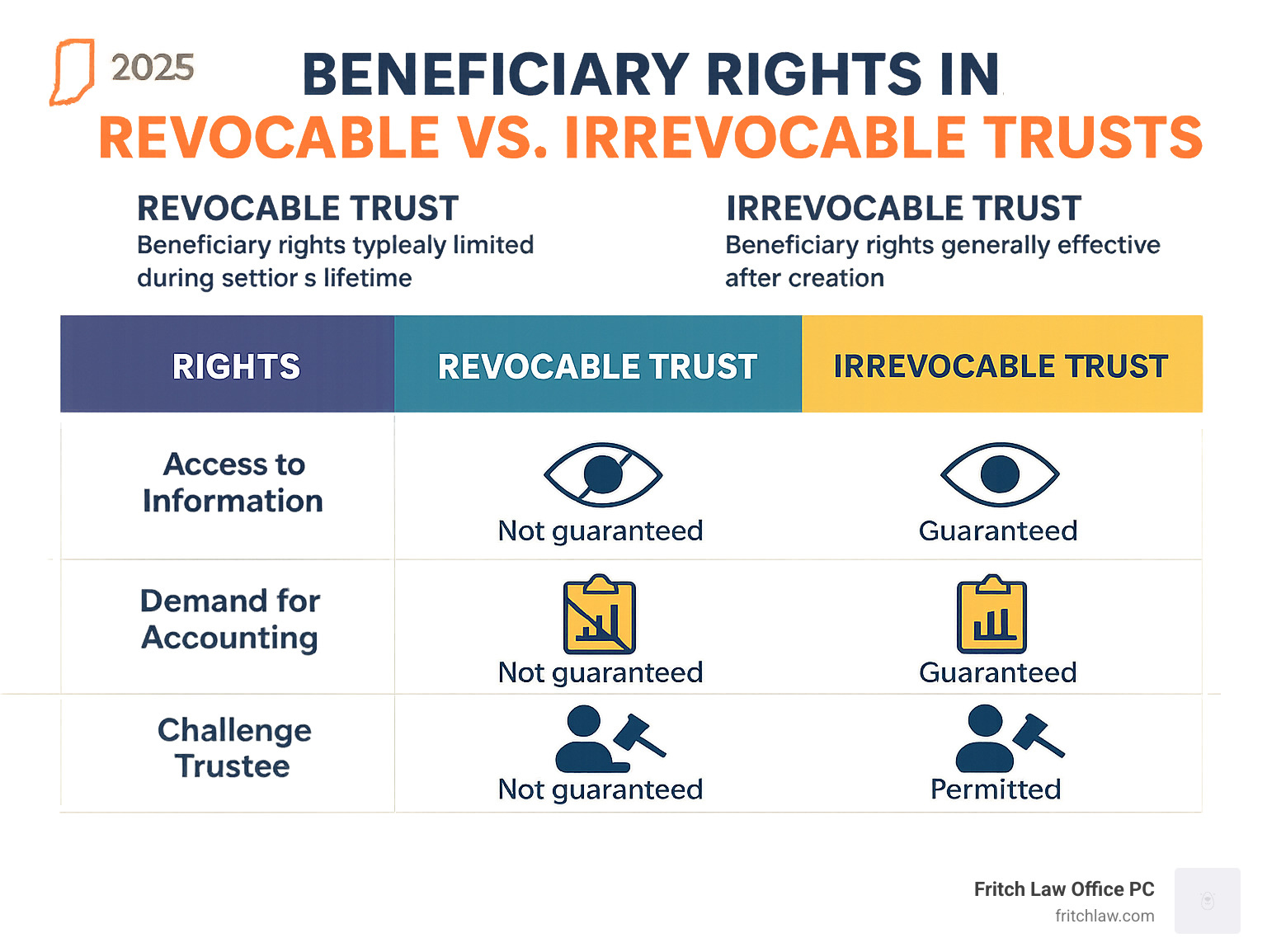
The type of trust—revocable or irrevocable—significantly impacts your rights, especially while the settlor (the trust’s creator) is alive. Generally, the more control the settlor retains, the fewer rights you have. This distinction is vital for understanding your Indiana trust beneficiary rights.
Rights in a Revocable Living Trust
A revocable living trust is flexible; the settlor can change beneficiaries, alter terms, or dissolve the trust entirely while they are alive and competent.
Because the settlor retains complete control, beneficiaries of a revocable trust typically have limited or no enforceable rights during the settlor’s lifetime. Your interest is “contingent” and not guaranteed. You generally cannot demand an accounting or challenge the trustee’s actions while the settlor is alive.
However, when the settlor passes away or becomes incapacitated, the trust usually becomes irrevocable. At that point, your rights become effective, and you gain the full suite of beneficiary rights.
Rights in an Irrevocable Trust
With an irrevocable trust, the settlor gives up control over the assets permanently once the trust is created and funded.
This lack of settlor control translates into stronger, more immediate rights for you as a beneficiary. Your rights are typically vested upon the trust’s creation, giving you a concrete interest from day one.
In an irrevocable trust:
- You have stronger standing to demand information and hold the trustee accountable.
- The inability to change beneficiaries works in your favor, as your designation is typically permanent.
- You have stronger enforcement rights to challenge a trustee’s actions against the trust’s fixed terms.
For more detailed information on this type of trust, you can explore more info about irrevocable trusts. Understanding your trust’s type is crucial for knowing what rights you can exercise and when.
When Things Go Wrong: Enforcing Your Rights and Seeking Remedies
When trustees fail their duties—through poor investments, lack of communication, or misusing funds—it can be financially damaging. Fortunately, Indiana law provides powerful tools to protect your interests. Your Indiana trust beneficiary rights include legal remedies to hold trustees accountable.
Grounds for Removing a Trustee

Removing a problematic trustee is a serious step, but it may be necessary to protect the trust. Common grounds for removal include:
- Mismanagement of assets: Making risky investments or allowing trust property to deteriorate.
- Self-dealing: Using trust funds for personal expenses or selling trust property to oneself at a low price. This violates the duty of loyalty.
- Conflict of interest: A situation that prevents the trustee from acting impartially.
- Failure to follow trust terms: Ignoring instructions in the trust document regarding distributions, investments, or administration.
- Hostility: Severe hostility between the trustee and beneficiaries that makes proper administration impossible.
- Other “good cause”: Indiana law gives courts flexibility to remove a trustee for other valid reasons.
To pursue removal, you must petition the court with evidence. An experienced attorney can help build a strong case.
Legal Remedies for a Breach of Trust
When a trustee breaches their duties, you have several powerful remedies. Common breaches include failing to make distributions, improper investments, mixing personal and trust funds, refusing to provide accountings, or theft. Your options include:
- Compelling the trustee to act: A court can order a negligent trustee to perform their duties, such as making a required distribution or providing an accounting.
- Enjoining the trustee from acting: You can ask a court for an injunction to stop a trustee from taking a harmful action, like selling property for far below its value.
- Redressing a breach: Trustees can be held personally liable for financial losses they cause to the trust. They may have to repay losses from their own pocket.
- Recovering damages and lost profits: A trustee may owe the trust any profits they made from their breach, plus any profits the trust lost due to mismanagement.
Under Indiana Code § 30-4-3-22, you have access to these remedies. Importantly, if you successfully prove a breach, you can typically recover reasonable attorney’s fees, ensuring you aren’t penalized for protecting your inheritance.
Frequently Asked Questions about Indiana Trust Beneficiary Rights
We understand that trust law can be complex. Here are answers to common questions about Indiana trust beneficiary rights.
How do the rights of a trust beneficiary compare to the rights of an heir in a will (under an executor)?
While both transfer assets, the rights of beneficiaries and heirs differ:
- Process: Trusts are administered privately by a trustee and generally avoid the public court-supervised probate process required for wills. An executor manages a will through probate.
- Duties: An executor’s role is temporary—they gather assets, pay debts, and distribute property, then their job is done. A trustee’s duties can be ongoing for years, involving long-term investment management and distributions.
- Rights: As an heir, your rights are tied to the probate process. As a trust beneficiary, your rights to information and enforcement are continuous for the life of the trust, often creating a more direct, long-term relationship with the person managing your inheritance.
Can a trustee also be a beneficiary in Indiana?
Yes, a trustee can also be a beneficiary in Indiana, a common setup in family trusts. However, this arrangement requires heightened scrutiny to prevent conflicts of interest. The trustee must uphold their duty of impartiality and prioritize the interests of all beneficiaries, not just their own. They cannot favor themselves when making decisions about distributions or asset management. The trust document should be very clear about the trustee’s powers in this situation.
What is the statute of limitations for suing a trustee in Indiana?
Indiana generally has a three-year statute of limitations to sue a trustee for a breach of trust. The clock typically starts after you receive a “final account or statement” that fully discloses the matter related to the alleged breach.

There are exceptions. The time limit may be extended for cases involving fraud or intentional misrepresentation by the trustee. If the report did not adequately disclose the breach, the statute of limitations might not start until the breach is or should have been finded.
The key takeaway is to act promptly. If you suspect a breach, seek legal advice without delay to avoid losing your right to pursue a claim.
Navigating Your Trust Rights with Confidence
You now have a comprehensive understanding of your Indiana trust beneficiary rights – from your fundamental entitlements to information and accounting, to the powerful legal remedies available when things go wrong. This knowledge isn’t just academic; it’s your toolkit for ensuring the trust serves its intended purpose and protects your financial future.
The journey of being a trust beneficiary doesn’t end with understanding your rights – it begins there. Whether you’re dealing with a revocable trust that will soon become irrevocable, or you’re already benefiting from an established irrevocable trust, your rights form the foundation of a healthy trustee-beneficiary relationship.
Proactive communication is often your first and most effective tool. Don’t wait for problems to arise before engaging with your trustee. Ask questions, express preferences in writing, and stay informed about the trust’s administration. Most trustees appreciate beneficiaries who are engaged and informed rather than those who remain silent until a crisis emerges.
Understanding your trust document is equally crucial. This isn’t just legal jargon – it’s your roadmap to understanding what you’re entitled to receive, when you can expect distributions, and what standards your trustee must meet. If certain terms seem unclear, don’t hesitate to seek clarification.
Trust administration can span years or even decades. The relationship you build with your trustee today will impact your financial well-being for years to come. When trustees fulfill their duties properly, the trust system works beautifully. When they don’t, your knowledge of Indiana law and your willingness to enforce your rights becomes your protection.
Trust law can feel overwhelming, especially when you’re dealing with family dynamics, significant assets, or suspected breaches of duty. That’s where experienced legal guidance makes all the difference. At Fritch Law Office PC, located in Jasper, Indiana, we understand that every trust situation is unique, and we provide personalized, client-focused legal representation custom to your specific circumstances.
Whether you need help understanding your trust document, communicating effectively with your trustee, or taking action when your rights have been violated, we’re here to guide you through the process. Don’t let uncertainty or intimidation prevent you from protecting your interests – your Indiana trust beneficiary rights are there for a reason.
Contact us for help with an irrevocable trust or any other trust-related concerns you may have. Taking that first step toward understanding and protecting your rights is an investment in your financial future that pays dividends for years to come.