
Business court cases: Complete 2026 Guide
Fritch Law Office handles business court cases cases for Indiana residents every day. First, our attorneys examine your situation carefully. Next, we identify your strongest legal options. Furthermore, we explain every step in plain language. Therefore, you make confident decisions from day one.
Key Facts About Business court cases in Indiana
Indiana courts apply strict 2026 rules to business court cases matters. Moreover, experienced attorneys win better outcomes for clients. Additionally, early legal advice prevents costly mistakes. Consequently, clients who hire Fritch Law gain a clear advantage. However, waiting too long weakens your position significantly.
Take Action on Business court cases Today
Do not delay your business court cases case. First, call our Jasper office directly. Next, we schedule your free consultation immediately. Then, we build a winning strategy for you. Additionally, we represent you at every court hearing. Finally, we resolve your case as fast as possible.

Visit the Indiana Courts website for official legal information. Contact Fritch Law for your free consultation today.
Business court cases handle complex commercial disputes that require specialized knowledge and streamlined procedures. These cases range from intellectual property conflicts to shareholder disputes and non-compete agreements.
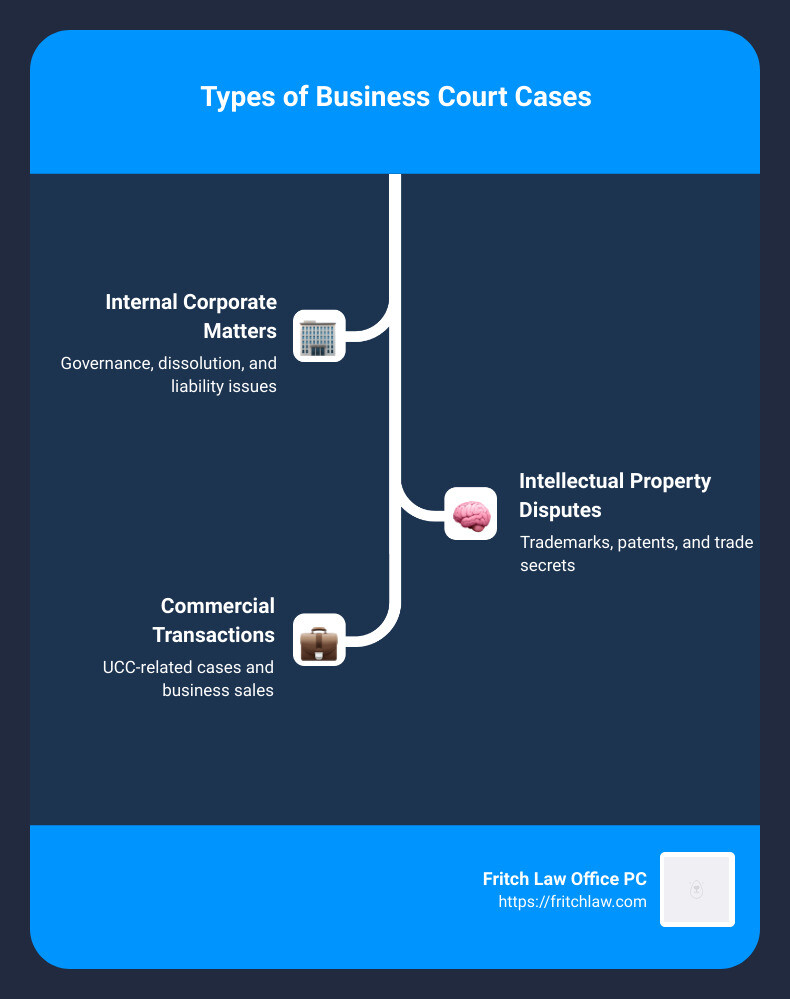
Here’s a quick overview of common types of business court cases:
– Internal corporate matters: Governance, dissolution, and liability issues
– Intellectual property disputes: Trademarks, patents, and trade secrets
– Commercial transactions: UCC-related cases and business sales
– Non-compete and trade secret violations
– Securities and antitrust issues
Business court cases are important because they offer specialized courts designed to manage these complex disputes efficiently. They ensure consistency in rulings, help reduce the backlog in general civil courts, and make legal outcomes more predictable for businesses. This, in turn, attracts businesses to states with well-established business courts, boosting local economies.
I’m David Fritch, an experienced lawyer with over 40 years in the legal field and a background in both law and business management. My expertise includes navigating the intricacies of business court cases, ensuring favorable outcomes, and helping clients resolve their commercial disputes efficiently.
Learn more about the specifics of business court cases in the next section.
What Are Business Court Cases?
Business court cases handle complex commercial disputes that require specialized knowledge and streamlined procedures. These cases range from intellectual property conflicts to shareholder disputes and non-compete agreements.
Types of Business Court Cases
Business court cases can cover a wide range of issues, but here are some of the most common types:
- Antitrust Suits: These involve disputes over anti-competitive practices. For example, a company might sue another for monopolistic behavior that stifles competition.
- Intellectual Property: This includes cases about trademarks, patents, copyrights, and trade secrets. Companies often sue to protect their intellectual property from unauthorized use.
- Franchise Cases: These disputes can arise between franchisors and franchisees, often involving issues like breach of contract or misrepresentation.
- Unfair Competition: This can include a range of unethical business practices like false advertising, trademark infringement, and trade libel.
Examples of Business Court Cases
To better understand the types of cases that business courts handle, let’s look at a few examples:
-
Doe Company v. Doe Law Firm: This case involved a breach of fiduciary duty where a law firm was accused of not acting in the best interest of its corporate client. The business court efficiently managed the complex legal issues, leading to a fair resolution.
-
Humanicom v. National Capital: This case centered around a non-compete agreement. Humanicom sued a former executive who joined a competitor, alleging that he violated the terms of his non-compete clause. The business court’s expertise in handling such agreements ensured a swift and predictable outcome.
-
Burton v. Oscar de la Hoya: This case was about intellectual property. Burton accused Oscar de la Hoya of using a trademarked slogan without permission. The business court’s specialized knowledge in intellectual property law helped resolve the dispute effectively.
By focusing on these specific types of disputes, business courts can offer more consistent and predictable rulings, which is crucial for businesses planning their legal strategies.

In the next section, we’ll dig into the benefits of business courts, such as standardized procedures and economic stimulus.
Benefits of Business Courts
Standardized Procedures
One of the key benefits of business courts is their standardized procedures. These courts follow specific guidelines custom for handling complex business disputes, which leads to greater efficiency and predictability.
When legal disputes involve multiple parties, such as in construction defect cases with 10 to 15 parties, standardized procedures can streamline the process. Judge Gill Freeman, who served as Miami-Dade County’s first business court judge, noted that these cases can take weeks to resolve and can wreak havoc on a regular civil calendar. By having a dedicated business court, these complex cases are managed more effectively, freeing up the general civil docket for other matters.
Consistency of Rulings
Business courts also offer the advantage of consistency in rulings. When a single judge presides over similar types of cases, businesses can better predict outcomes. This consistency helps litigants narrow their disputes and focus on the most critical issues.
Judge Freeman shared that over time, as business court rulings accumulate, litigants learn to anticipate decisions. “There were lawyers who told me that we had issues and motions that we simply didn’t bring because we knew how you would rule on them,” she said. This predictability not only speeds up the resolution process but also promotes fairness.
Economic Stimulus
Another significant benefit is the potential for economic stimulus. A well-functioning business court system can make a state more attractive to businesses. Jon Polenberg, co-chair of the Business Courts Task Force, emphasized that an efficient business court system makes businesses more comfortable having their disputes resolved locally. This can lead to more businesses willing to locate in that state, boosting the local economy.
For instance, New York features its business courts in economic development videos to attract businesses. A state that can settle business disputes in 18 to 24 months is more appealing to companies, as it ensures a quicker resolution to their legal issues.

By offering streamlined procedures, consistent rulings, and economic benefits, business courts provide a valuable service to the business community and the broader economy.
In the next section, we’ll explore which states have established business courts and how they operate.
States with Business Courts
Florida Business Courts
Florida is home to several business courts designed to handle complex business litigation. Notably, these courts are located in Orange County and Osceola County. They specialize in cases like antitrust suits, intellectual property disputes, franchise cases, and unfair competition.
Effective January 3, 2023, Business Court was expanded to Osceola County, making it the fifth county in Florida to have a formal Business Court. Jury trials for business cases in Osceola County are held at the Osceola County Historical Courthouse in Kissimmee, Florida’s oldest continuous operating courthouse since 1890.
In these courts, a judge from the Circuit Civil division is assigned to handle business cases. This ensures that cases move more smoothly through the system, and parties have a better understanding of what is expected by the judge. This specialization is aimed at making Florida a more attractive place for businesses.
Other States
Florida isn’t alone in having business courts. Several other states have established similar courts to handle complex business disputes. Here are some examples:
- Michigan
- Ohio
- Iowa
- Maine
- New Hampshire
- Georgia
- Delaware
- Tennessee
- Wisconsin
- Indiana
- Arizona
- Kentucky
Each of these states has set up business courts to streamline the resolution of business disputes, ensuring efficiency and consistency. For example, Delaware is well-known for its Court of Chancery, which specializes in corporate law cases and is a model for business courts nationwide.
By having specialized courts, these states aim to attract and retain businesses by providing a reliable and efficient legal environment. This not only helps businesses resolve their disputes more quickly but also benefits the local economy by making the state a more attractive place to do business.
In the next section, we’ll dig into some famous business court cases that have set significant legal precedents.
Famous Business Court Cases
Notable Cases
Understanding business court cases can be easier by looking at some notable examples. These cases have set significant legal precedents and shaped business law.
Connelly v. United States
In a landmark decision on June 6, 2024, the Supreme Court upheld the IRS’s position on how life insurance proceeds should be treated for federal estate tax purposes. The case, Connelly, As Executor of the Estate of Connelly v. United States (602 US _____), involved the valuation of a small, family-owned business. The ruling emphasized the importance of strategic estate planning for business owners. The court decided that a corporation’s obligation to redeem shares using life insurance proceeds does not reduce the corporation’s value for estate tax purposes. This decision had significant implications for business owners, highlighting the need for careful structuring of buy-sell agreements and life insurance policies.
Andrews v. Marriott
Another significant case is Andrews v. Marriott, where Greene Broillet & Wheeler (GB&W) obtained a $55 million verdict for FOX Sports reporter Erin Andrews. Andrews sued the Nashville Marriott hotel for its misconduct that led to her being secretly filmed in her hotel room. This case highlighted the responsibilities of hotels to protect their guests’ privacy and set a precedent for future privacy invasion cases in the hospitality industry.
Cedars Sinai Medical Center v. Mitchell, Silberberg & Knupp
In this case, Cedars Sinai Medical Center sued the law firm Mitchell, Silberberg & Knupp for professional malpractice. The case revolved around alleged negligence by the law firm in handling legal matters for the medical center. This case underscores the importance of professional responsibility and the potential consequences of malpractice in legal practice.
These landmark cases not only highlight the complexities involved in business litigation but also illustrate how business court cases can lead to significant legal precedents that shape future legal and business practices.
Frequently Asked Questions about Business Court Cases
What is an example of a business case in state court?
A common example of a business case in state court is a defrauding case. For instance, in Iowa, such cases often fall under the state’s purview. One notable example might involve a business owner accused of defrauding investors by misrepresenting the company’s financial health. The state court would handle the prosecution, focusing on the alleged deceit and financial misconduct.
What are cases in business law?
Business law encompasses a wide range of cases. Here are some common types:
-
Partnership Disputes: When business partners disagree on the management or financial aspects of the business, it can lead to legal action.
-
Negligence: This involves a business failing to exercise reasonable care, resulting in harm or loss to another party.
-
Breach of Fiduciary Duty: Occurs when someone in a position of trust, like a company executive, acts against the interests of the company or its shareholders.
-
Misappropriation of Assets: This involves illegally using company assets for personal gain.
These cases can be complex and often require specialized legal knowledge to steer.
Does Florida have a business court?
Yes, Florida has specialized business courts to handle complex business cases. For example:
-
Orange County and Osceola County both have business courts. These courts handle cases like antitrust suits, intellectual property disputes, and franchise cases.
-
Jury trials for business court cases in Osceola County are held at the Osceola County Historical Courthouse in Kissimmee, which is Florida’s oldest continuously operating courthouse.
These courts aim to handle business litigation efficiently and effectively, providing a higher degree of consistency in rulings and standardized procedures. This specialized approach helps in managing the complexities of business cases.
Conclusion
Business court cases can be complex, but understanding them doesn’t have to be. We’ve walked through what these cases are, the types of disputes they involve, notable examples, and the benefits of having specialized business courts.
Business court cases include everything from antitrust suits to intellectual property disputes. Specialized courts, like those in Florida, streamline these processes, ensuring fair and consistent rulings. This not only helps businesses but also boosts local economies by attracting more companies to the area.
At Fritch Law Office PC, we understand the challenges that come with business litigation. Our experienced lawyers are dedicated to providing personalized legal representation custom to your specific needs. Whether you’re dealing with a partnership dispute or a breach of fiduciary duty, we’re here to guide you every step of the way.
If you need help navigating the complexities of business court cases, contact us today. Let us help you protect your business and achieve the best possible outcome.