Why Business Court Rules Are Important
Business court rules are essential guidelines that govern how specialized courts handle complex business disputes. These rules ensure that cases involving large sums of money, intricate corporate structures, governance issues, and other high-stakes matters are resolved efficiently and fairly.
Key Points:
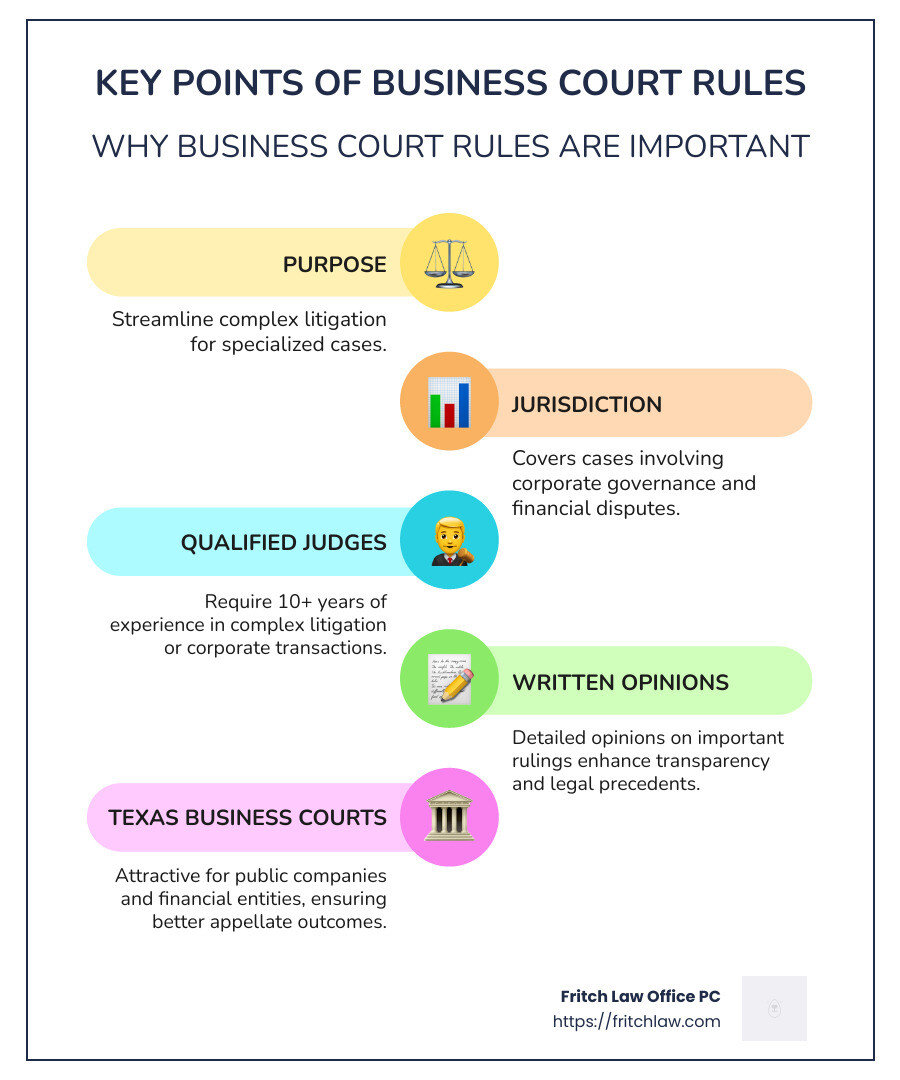
1. Purpose: Business court rules streamline complex litigation, making it easier for courts to handle specialized cases.
2. Jurisdiction: They specify the types of cases business courts can hear, such as those involving corporate governance and significant financial disputes.
3. Qualified Judges: Judges in business courts need at least ten years of experience in complex litigation or corporate transactions, ensuring knowledgeable decision-making.
4. Written Opinions: Judges are required to write detailed opinions on important rulings, providing transparency and a solid legal precedent.
The establishment of business courts in Texas is a noteworthy step. They make the state a more attractive option for public companies and financial entities. The requirement for judges to issue written opinions in pivotal cases ensures better appellate outcomes and greater certainty for litigants. Plus, remote appearances and suspension of statutes of limitations add to the efficiency and fairness of the process.
As someone deeply rooted in the legal field, I can affirm the significance of understanding these rules. My name is David Fritch, and with 40 years of experience managing my law firm, I specialize in navigating complex legal issues, including business court rules.
Next, we’ll dig into what these rules entail and why they matter for your business.
Understanding Business Court Rules
Business court rules are the backbone of specialized courts designed to handle complex business disputes. These rules ensure that high-stakes cases are managed efficiently and fairly, benefiting both the courts and the litigants involved.
Definition
Business court rules are a set of guidelines and procedures that govern how business courts operate. They cover everything from the types of cases these courts can hear to the qualifications of judges presiding over them.
Purpose
The primary purpose of business court rules is to streamline the litigation process for complicated business matters. These rules:
- Ensure Efficiency: By providing a clear framework, business court rules help speed up the resolution of cases.
- Promote Fairness: They ensure that both parties have equal opportunities to present their cases.
- Improve Transparency: Judges must issue written opinions on key rulings, making the decision-making process more transparent.
Scope
The scope of business court rules is extensive. They cover:
- Types of Cases: These rules specify the kinds of disputes business courts can handle, such as those involving corporate governance, significant financial transactions, and internal corporate affairs.
- Jurisdiction: They outline the jurisdictional boundaries, ensuring that only cases meeting certain criteria (like the amount in controversy or the involvement of publicly traded companies) are heard.
- Procedures: They detail the procedural aspects, including initial filings, removal and remand processes, and remote appearances.
Business Judgment Rule
A key component within these rules is the business judgment rule. This rule provides immunity to directors and officers of a corporation from liability for decisions made in good faith and in the best interest of the company. It has three main elements:
- Duty of Care: Directors and officers must make informed decisions.
- Duty of Loyalty: They must act in the best interest of the corporation, avoiding conflicts of interest.
- Good Faith: Decisions must be made honestly and with the corporation’s best interests in mind.
This rule is crucial for protecting corporate leaders from undue litigation, allowing them to make bold decisions without the constant fear of lawsuits.
Example
Consider a case where a corporate board decides to invest in a new technology. If the investment fails, shareholders might want to sue the board for the loss. Under the business judgment rule, as long as the board made the decision with due care, loyalty, and good faith, they are protected from liability.
Why It Matters
Understanding business court rules can be a game-changer for your business. They provide a clear path for resolving disputes and ensure that your case is handled by experienced judges. Plus, with the requirement for written opinions, you gain valuable insights into the legal reasoning behind decisions, helping you better steer future legal challenges.
Next, we will explore the jurisdiction of business courts, focusing on specific categories and the types of cases they handle.
Jurisdiction of Business Courts
Business courts are specialized forums designed to handle complex commercial disputes. In Texas, these courts have specific jurisdictional boundaries, ensuring that only certain types of cases are heard. Let’s break down the key aspects of their jurisdiction.
Texas Business Courts
Texas has recently expanded its court system to include business courts, thanks to House Bill 19 signed by Governor Greg Abbott. These courts will start operating on September 1, 2024, initially in five major cities: Austin, Dallas, Fort Worth, Houston, and San Antonio. This specialized court system aims to make Texas a more attractive forum for public companies and financial institutions.
Specific Categories
Business courts in Texas have civil jurisdiction concurrent with district courts in specific categories of cases. These include:
- Derivative Proceedings: Lawsuits brought by shareholders on behalf of the corporation.
- Corporate Governance: Disputes involving the governance, governing documents, or internal affairs of an organization.
- Securities and Trade Regulation: Cases involving state or federal securities laws, or trade regulations against organizations and their officials.
- Ownership and Managerial Disputes: Actions brought by or against owners, controlling persons, or managerial officials of an organization.
Commercial Cases
The business court handles various commercial cases, especially those involving significant financial transactions. For example, cases arising out of the Business Organizations Code or those involving qualified transactions fall under its jurisdiction.
Amount in Controversy
The amount in controversy is a crucial factor in determining the jurisdiction of business courts. Generally, the court handles cases where the amount in controversy exceeds $5 million, excluding interest, statutory damages, exemplary damages, penalties, attorney’s fees, and court costs. However, for publicly traded companies, the business court has jurisdiction regardless of the amount in controversy.
Corporate Governance
Corporate governance disputes are a significant part of the business court’s docket. These cases often involve allegations of breaches of duty by corporate directors or officers. The court ensures these complex disputes are handled by judges with expertise in corporate law, providing a fair and informed resolution.
Internal Corporate Affairs
Internal corporate affairs, such as disputes over the internal management of a corporation, also fall under the jurisdiction of business courts. These cases can involve conflicts between shareholders, issues with corporate bylaws, or disputes over the roles and responsibilities of corporate officers.
Example Case
Consider a scenario where a shareholder sues the board of directors for breach of fiduciary duty, claiming they acted against the corporation’s best interest. If the amount in controversy exceeds $5 million, this case would fall under the business court’s jurisdiction. The specialized judges in the business court, with their experience in corporate governance, would be well-equipped to handle such a complex dispute.
Next, we will dig into the key components of business court rules, including governing documents, governing law, and the roles of managerial officials.
Key Components of Business Court Rules
Understanding the key components of business court rules is essential for navigating legal disputes within these specialized courts. Here are the main elements you need to know:
Governing Documents
Governing documents are the foundational texts that outline the formation and internal affairs of an organization. These include:
- Certificate of Formation or Articles of Incorporation
- Bylaws
- Partnership Agreements
- Operating Agreements
- Shareholder Agreements
- Voting Trust Agreements
These documents dictate how an organization operates and are crucial in legal disputes involving corporate governance.
Governing Law
Governing law refers to the legal framework that regulates an organization’s formation and internal operations. This can vary based on where the organization is incorporated. For instance, a company incorporated in Texas will be governed by Texas law, while a corporation based in Delaware will follow Delaware law.
Governing Person
A governing person is someone with the authority to manage and direct an organization’s affairs. This includes:
- Board Members of a corporation
- General Partners in a partnership
- Managers or Members of a limited liability company (LLC)
- Trust Managers in a real estate investment trust
These individuals play a crucial role in decision-making and are often central to disputes in business courts.
Managerial Official
A managerial official can be either a governing person or an officer elected or appointed to manage an organization. Their actions and decisions are often scrutinized in legal disputes, especially those involving breaches of duty or corporate governance issues.
Ownership Interest
Ownership interest refers to an individual’s stake in an organization. This can include:
- Shareholders in a corporation
- Partners in a partnership
- Members in an LLC
Ownership interests often come with economic, voting, and management rights, which can become focal points in legal disputes.
Publicly Traded Company
A publicly traded company is one whose voting equity securities are listed on a national securities exchange. These companies are subject to specific regulations and their disputes often involve significant amounts of money, making them prime candidates for business court jurisdiction.
Qualified Transaction
A qualified transaction involves significant financial dealings, such as:
- Transactions where a party pays or receives at least $10 million
- Loans or advances of at least $10 million
These transactions are often complex and require the specialized knowledge of business court judges to resolve disputes effectively.
In the next section, we will explore the procedures involved in business courts, including initial filings, appeals, and the role of judicial authority.
Business Court Procedures
Navigating business court procedures can be complex, but understanding the steps involved can help you manage your case more effectively. Here’s a breakdown of the key procedures:
Initial Filing
Initial filing in business courts involves submitting your case to the court that has jurisdiction. For a case to be filed in the business court, it must meet specific criteria related to the nature of the dispute and the amount in controversy. The party filing must also establish venue in a county within the court’s division.

Removal and Remand
Removal and remand are processes that transfer a case between courts. If the business court finds it doesn’t have jurisdiction, it can either transfer the case to a district or county court or dismiss it without prejudice. This ensures that cases are heard in the appropriate venue.
Appeals
Appeals in business courts follow the same procedures as those from a district court. This means that any party dissatisfied with a business court’s decision can appeal to a higher court, following the standard appellate procedures.
Judicial Authority
A business court judge has the same powers, duties, and immunities as a district judge. This includes the authority to make rulings, issue orders, and manage cases within the court’s jurisdiction.
Supplemental Jurisdiction
Supplemental jurisdiction allows business courts to hear claims related to a case already within their jurisdiction, provided all parties agree. If there’s no agreement, related claims may proceed in another court concurrently.
Venue
Venue refers to the geographic location where a case is heard. In business courts, venue is established based on the county specified in a written contract or as provided by law. If a case is filed in an improper venue, the court can transfer it to the correct division or another appropriate court.
Remote Appearances
Remote appearances are allowed in business courts, making it easier for parties to participate without being physically present. This can be especially useful for complex cases involving parties from different locations.
Written Opinions
Written opinions are required for dispositive rulings and significant legal issues. These opinions provide transparency and help build a body of precedent that can guide future cases. For example, Texas business court judges must issue written opinions in connection with dispositive rulings and on issues important to the state’s jurisprudence, enhancing clarity and predictability.
Next, we will dive into the qualifications and appointment process for business court judges and how the court’s divisions are structured.
Business Court Judges and Divisions
Understanding the structure and appointment process of business court judges is essential for navigating the court system effectively. Here’s a breakdown of the key elements:
Qualifications
Business court judges must meet specific qualifications to ensure they can handle complex commercial litigation. Judges are typically required to have substantial experience in business law and a strong background in civil litigation. This ensures they have the expertise needed to manage intricate legal issues.
Appointment
The appointment of business court judges is a critical process. In many states, judges are appointed by the Governor. Each judge serves a term that varies by state. For example, in Texas, Governor Abbott recently appointed two judges to each division, ensuring that each division has experienced legal professionals at the helm.
Divisions
The business court system is divided into multiple divisions, each covering specific geographic areas. For instance, in Texas, there are five initial divisions with two judges each, covering major cities like Dallas, Austin, San Antonio, Fort Worth, and Houston. These divisions help manage the caseload and ensure that cases are heard in a timely manner.
Counties
Each division of the business court covers a particular set of counties. For example, the Eleventh Business Court Division includes the counties in the Eleventh Administrative Judicial Region. This regional approach allows the court to serve businesses across a wide area while maintaining local relevance.
Legislative Appropriations
The establishment and operation of business courts require legislative appropriations. This funding is essential for hiring judges, clerks, and other staff, as well as for maintaining court facilities. Adequate appropriations ensure that the court can function smoothly and handle its caseload efficiently.
Expiration Dates
Certain provisions related to the business court system have expiration dates. For instance, some subsections of the Texas business court rules are set to expire on September 1, 2026. These expiration dates are important for reviewing and potentially renewing or amending the rules based on their effectiveness.
Next, we will explore frequently asked questions about business court rules, such as the business judgment rule, jurisdiction, and the role of the court in business law.
Frequently Asked Questions about Business Court Rules
What is the business judgment rule in a court case?
The business judgment rule is a legal principle that protects company directors and officers from personal liability for decisions made in good faith and in the best interests of the company.
- Immunity: Directors and officers are generally immune from liability if they act in good faith, with due care, and within their authority.
- Liability: They can still be held liable if their actions are proven to be fraudulent, illegal, or grossly negligent.
- Duty of Care: This rule reinforces the duty of care, requiring directors to make informed and rational decisions that benefit the company.
What is the jurisdiction of the business courts in Texas?
Business courts in Texas have specific jurisdiction over certain types of commercial cases. Here’s a quick rundown:
- Specific Categories: Business courts handle cases involving corporate governance, internal corporate affairs, and large commercial disputes.
- Commercial Cases: These courts deal with disputes like breaches of contract, business torts, and shareholder issues.
- Amount in Controversy: For most cases, the amount in controversy must exceed $5 million. However, if a party is a publicly traded company, the court can hear the case regardless of the amount.
What does court mean in business law?
In business law, a court is an official tribunal that resolves legal issues and claims. Here’s what that entails:
- Official Tribunal: A formal judicial body with the authority to adjudicate disputes.
- Legal Issues: Courts handle a wide range of legal issues, from contract disputes to regulatory compliance.
- Claims: Parties bring claims to court seeking legal remedies, such as damages or injunctions.
Understanding these aspects of business court rules can help you steer the legal landscape more effectively. Whether you’re dealing with corporate governance or large commercial disputes, knowing the rules and jurisdiction of business courts is crucial for any business entity.
Conclusion
Navigating the business court rules can be challenging, but understanding them is essential for any business involved in commercial disputes. These rules provide a structured framework for resolving complex business issues, ensuring that cases are handled efficiently and fairly.
Summary
Business courts in Texas have specific jurisdiction over commercial cases, focusing on corporate governance, internal corporate affairs, and large commercial disputes. These courts offer specialized knowledge and experience, which can lead to more informed and consistent rulings.
Benefits
Understanding and leveraging business court rules can offer several benefits:
- Specialized Expertise: Business court judges have experience in complex litigation and corporate transactions, ensuring knowledgeable and fair adjudication.
- Efficient Resolution: These courts are designed to handle intricate commercial disputes swiftly, reducing the time and cost involved in litigation.
- Predictable Outcomes: The requirement for written opinions in certain situations provides a substantial body of reasoned precedent, leading to better-informed appellate decisions and greater certainty for litigants.
Fritch Law Office PC
At Fritch Law Office PC, we are committed to providing personalized and effective legal representation. Our experienced lawyers understand the intricacies of business court rules and are dedicated to helping you steer the legal landscape with confidence. Whether you’re dealing with corporate governance issues, commercial disputes, or other business-related legal matters, our team is here to support you every step of the way.
Personalized Legal Representation
We believe in a client-focused approach, offering clear communication and responsive service. Our goal is to understand your unique needs and provide custom legal solutions that achieve the best possible outcomes.
By choosing Fritch Law Office PC, you can trust that your business is in capable hands. Contact us today to schedule a consultation and learn more about how we can help you master the complexities of business court rules.