

Foster care indiana: Complete 2026 Guide
Fritch Law Office handles foster care indiana cases for Indiana residents every day. First, our attorneys examine your situation carefully. Next, we identify your strongest legal options. Furthermore, we explain every step in plain language. Therefore, you make confident decisions from day one.
Key Facts About Foster care indiana in Indiana
Indiana courts apply strict 2026 rules to foster care indiana matters. Moreover, experienced attorneys win better outcomes for clients. Additionally, early legal advice prevents costly mistakes. Consequently, clients who hire Fritch Law gain a clear advantage. However, waiting too long weakens your position significantly.
Take Action on Foster care indiana Today
Do not delay your foster care indiana case. First, call our Jasper office directly. Next, we schedule your free consultation immediately. Then, we build a winning strategy for you. Additionally, we represent you at every court hearing. Finally, we resolve your case as fast as possible.

Visit the Indiana Courts website for official legal information. Contact Fritch Law for your free consultation today.
Navigating Indiana’s Foster Care System: A Comprehensive Guide
If you’re searching for information about foster care Indiana, here are the key points you need to know:
| Foster Care Indiana Quick Facts | Details |
|---|---|
| Current Need | Approximately 10,000 children need placement across Indiana |
| Eligibility | Adults 21+ years (25+ for some agencies), stable income, clean background check |
| Timeline | Typically 3-4 months to complete licensing process |
| Support | Per diem financial assistance based on child’s needs, training, and 24/7 support |
| Process | Complete application, training (20 hours), home study, background checks |
| Contact | Indiana DCS: 888-631-9510 or visit IndianaFosterCare.org |
Foster care Indiana is a system designed to provide temporary, safe homes for children who cannot live with their biological parents due to safety concerns, abuse, or neglect. While the primary goal is reunification with birth families whenever possible, foster parents play a crucial role in providing stability, healing, and support during a challenging transition period.
In Indiana, the foster care system is managed by the Department of Child Services (DCS) in partnership with Licensed Child Placing Agencies (LCPAs). These organizations work together to recruit, train, and support foster families while ensuring the safety and well-being of vulnerable children.
Many Indiana children—from infants to teenagers—need temporary homes. Most children in the system are over two years old, and many are over eight. They come from diverse backgrounds and have varying needs, but all share one thing in common: they need a safe, nurturing environment to thrive.
As David Fritch, I’ve spent decades helping Indiana families steer complex legal matters, including those related to foster care Indiana and adoption processes, through my work at Fritch Law Office PC where we guide families through the legal aspects of fostering and adoption.
Foster care indiana terms to know:
– adoption services indiana
– indiana dcs post adoption services
Foster Care Indiana: System Overview & Key Stats
When we talk about foster care Indiana, we’re really talking about a safety net that catches children when they need it most. At its heart, foster care isn’t meant to be forever—it’s a temporary solution while families heal. The primary goal is always reunification with birth parents whenever it’s safe and possible. This focus on keeping families together comes from years of research showing children typically do best when they can safely return to their biological families.
Right now, nearly 10,000 Indiana children need homes outside their own. That’s 10,000 individual stories, 10,000 unique little people with their own personalities, challenges, and dreams. While you might picture mostly babies needing foster care, the reality is different—most children in the system are over two years old, with many being eight or older. These school-aged kids and teenagers need loving homes just as much as the little ones do.
The Indiana Department of Child Services (DCS) oversees this whole system, working to ensure every child has a safe place to land while also developing permanent solutions. These permanent paths include:
Reunification with birth parents after safety issues are addressed, adoption when returning home isn’t possible, guardianship (often with relatives), or preparing older teens for independent living as adults.
As one experienced foster parent puts it: “Every child, regardless of age, needs a loving, committed, safe, and permanent family.” This simple truth guides everything in the foster care Indiana system.
The need for foster parents stretches across our entire state—from Indianapolis to small rural communities, from Evansville to South Bend. Every county needs more caring adults willing to open their homes and hearts.
How the System Protects Children
Child safety drives every decision in the foster care Indiana system. Children only enter foster care after trained professionals determine they face significant risks at home. This isn’t done lightly—the process includes thorough investigation, careful safety assessment, court approval (a judge must sign off on every removal), and ongoing oversight through regular court hearings.
Every child and family receives an individualized case plan that outlines specific goals and services. Think of it as a roadmap showing exactly what needs to happen for a child to return home safely.
One of the most powerful tools in this system is the Child and Family Team Meeting (CFTM). These gatherings bring everyone together—birth parents, foster parents, case managers, service providers, and sometimes the children themselves—to make decisions collaboratively. This team approach ensures that multiple perspectives shape each child’s journey through foster care.
Key Agencies & Acronyms
The foster care Indiana world comes with its own language of abbreviations and organizations. Understanding these key players helps you steer the system more confidently:
DCS (Department of Child Services) is Indiana’s state agency responsible for child welfare. They investigate reports of abuse or neglect, oversee foster care, and coordinate services for vulnerable children and families.
LCPAs (Licensed Child Placing Agencies) are private organizations like Firefly Children and Family Alliance or The Villages that partner with the state to recruit, train, and support foster families.
CASAs (Court Appointed Special Advocates) are volunteer champions appointed by judges to advocate specifically for a child’s best interests in court.
NYTD (National Youth in Transition Database) tracks outcomes for young people aging out of foster care, helping improve services for this vulnerable group.
CFTM (Child and Family Team Meeting) brings together everyone involved in a child’s case to collaborate on decisions.
TPR (Termination of Parental Rights) is the legal process that ends a parent’s rights to their child, typically occurring before adoption.
Knowing these terms helps you communicate effectively with professionals and better understand the paperwork you’ll encounter as a foster parent in Indiana.
Eligibility & Licensing: Steps to Become a Foster Parent
Thinking about opening your home to a child in need through foster care Indiana? The journey begins with understanding what’s required of you. While the process might seem daunting at first, thousands of Hoosiers have successfully steerd it—and you can too.
Indiana has established clear requirements to ensure children enter safe, nurturing environments. These standards aren’t meant to create barriers but rather to protect vulnerable children who’ve already experienced significant disruption in their lives.
To qualify as a foster parent in Indiana, you’ll need to meet several basic requirements. You must be at least 21 years old to foster through DCS, though some private agencies set their minimum age at 25. Your home will need to pass safety inspections, and you’ll need to demonstrate financial stability—meaning you can meet your family’s needs without depending on foster care payments.
Space matters too. Each foster child needs their own personal space, including at least 50 square feet of bedroom space and storage for their belongings. This helps give children a sense of belonging and security during a turbulent time. Foster children can’t displace your biological children from their beds, and temporary sleeping arrangements like futons or pull-out couches don’t meet the requirements.
“When we first started fostering, we were worried about the bedroom space requirements,” shares Sarah, a foster mom from Indianapolis. “But our licensing worker helped us rearrange furniture to create a welcoming space that met the guidelines while still feeling like home.”
Transportation reliability is another must-have. You’ll need a dependable, insured vehicle and valid driver’s license to transport children to medical appointments, family visits, therapy sessions, and school activities. For couples who aren’t married, most agencies want to see at least a year of relationship stability before approving your application.
The licensing process typically takes 3-4 months from start to finish, though your timeline may vary depending on how quickly you complete requirements and your agency’s current workload. Being proactive about completing paperwork and training can help move things along.
In Indiana, you have two main paths to becoming licensed:
| DCS Direct Licensing | LCPA Licensing |
|---|---|
| Licensed directly through the state | Licensed through a private agency |
| Regional team provides support | Agency case manager provides support |
| Standard foster homes | Often specialized in therapeutic foster care |
| State handles reimbursements directly | Agency often manages reimbursements |
| Free training provided | Free training provided |
| Support varies by region | Often more intensive support and training |
Many families find it helpful to attend information sessions with both DCS and at least one LCPA before deciding which path feels right. Each offers distinct advantages, and your choice often comes down to the type of support system you prefer and the children you hope to serve.
“Foster Care Indiana” Pre-Service Checklist
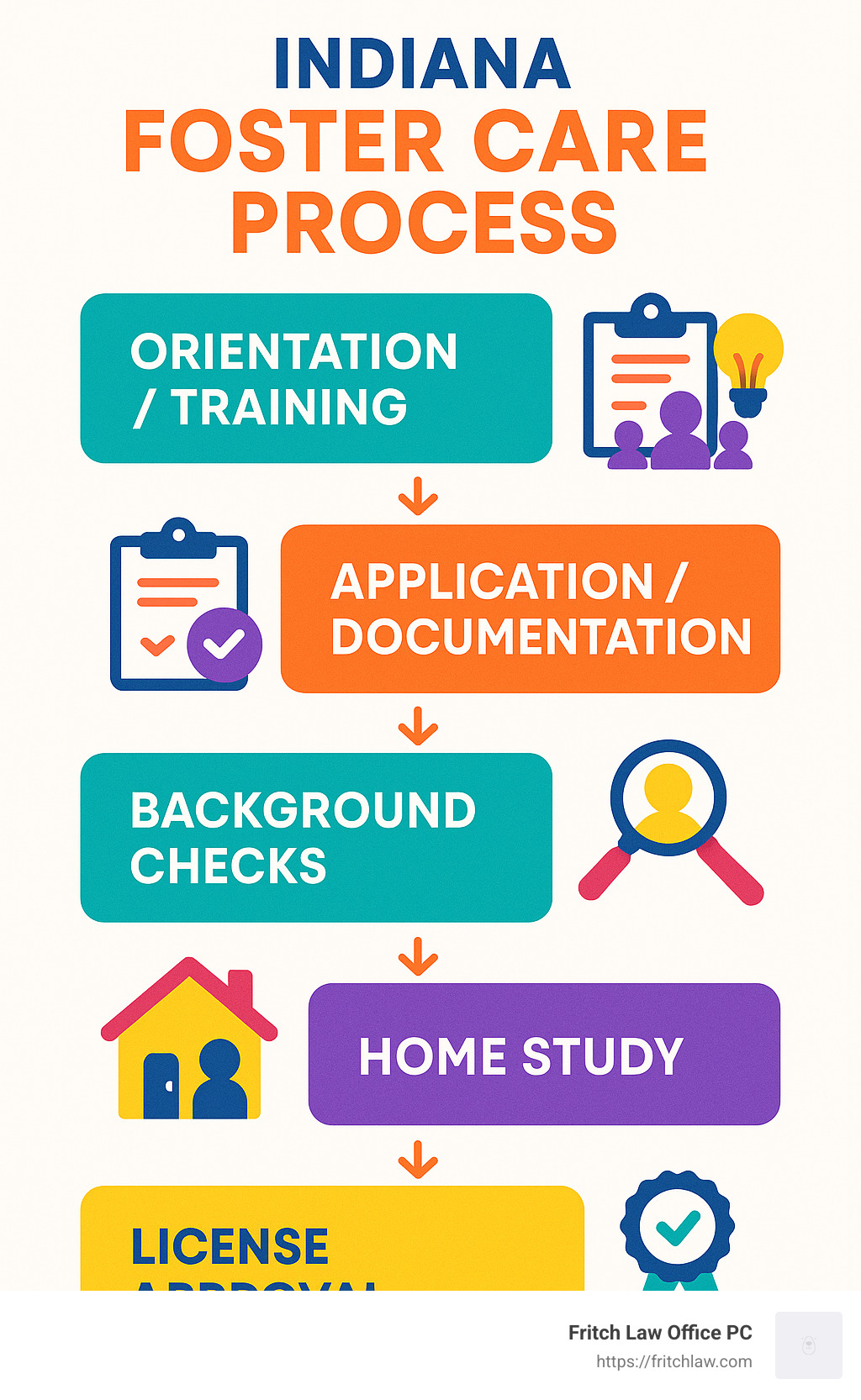
Once you’ve decided to move forward, several key steps stand between you and your foster parent license. Think of this checklist as your roadmap:
First, you’ll complete an application packet documenting your personal history, family dynamics, and motivation for fostering. Be honest and reflective—this helps agencies understand your strengths and potential challenges.
Next comes pre-service training—20 hours covering essential topics like child development, trauma effects, healthy attachment, behavior management, and navigating the child welfare system. This training isn’t just a checkbox; it’s crucial preparation for the realities of fostering.
You’ll also need First Aid, CPR, and Universal Precautions certifications, which many agencies provide at no cost. These skills ensure you’re prepared for everyday bumps and bruises as well as emergencies.
The home study process forms the heart of your licensing journey. This thorough assessment includes multiple interviews with everyone in your household, a detailed home safety inspection, review of your financial stability (including budget submission), personal and professional references, and medical statements confirming your physical and mental health.
Finally, all household members over a certain age must complete fingerprinting and comprehensive background checks. This includes local, state, and FBI criminal history checks, sexual offender registry checks, and child protective services checks.
While this process might seem exhaustive, each component serves an important purpose in ensuring children are placed in prepared, safe homes. As one foster dad put it, “Looking back, I appreciate how thoroughly we were vetted. It gave us confidence that the system really does prioritize child safety.”
Licensing Day to First Placement
The day your license is approved marks an exciting milestone—but it’s just the beginning of your foster care Indiana journey. Here’s what happens next:
Once approved, you’ll receive official notification of your foster home license. This is a moment worth celebrating! You’ve already invested significant time and effort to reach this point.
You’ll then have the opportunity to specify your placement preferences. Be thoughtful about the number of children you can realistically care for, age ranges you feel equipped to handle, genders you’re comfortable with, and types of needs you’re prepared to address. Being honest about your capabilities isn’t a limitation—it’s setting yourself up for successful placements.
The waiting period varies widely from family to family. Some receive placement calls within hours of being licensed, while others might wait weeks or months depending on their preferences and current needs in their area. This waiting period can be challenging, but it’s important to use this time to prepare your home and family.
When a potential match is identified, you’ll receive a referral call with information about the child and their situation. You’ll learn about their background, behaviors, needs, and why they’re entering care. This information helps you decide if the placement seems like a good fit for your family.
“When we got our first call, my heart was racing,” remembers Miguel, a foster parent from Fort Wayne. “We had so many questions, but our caseworker was patient and gave us all the information she could. We said yes, and three hours later, we welcomed a brother and sister into our home.”
If you accept the placement, arrangements will be made to transition the child into your home. This includes completing necessary paperwork and gathering any available belongings. Sometimes this happens with very little notice, so having a basic “welcome kit” prepared can be helpful.
The matching process aims to find the best fit for both the child and your family. Never feel pressured to accept a placement that doesn’t feel right—it’s better to wait for a good match than to set everyone up for a difficult experience.
Foster care Indiana is about providing safe, loving homes for children during difficult transitions. Your patience and preparation will help make that transition as smooth as possible for the vulnerable child entering your care.
Support, Training, Financial Assistance & Pathways to Permanency
The journey as a foster care Indiana parent doesn’t end once you welcome a child into your home. In fact, that’s just the beginning! Indiana recognizes that successful fostering requires ongoing support, which is why the system provides multiple layers of assistance to help both children and foster families thrive.
Ongoing Training and Support
Every licensed foster parent in Indiana needs to complete 20 hours of training each year to keep their license active. This isn’t just a bureaucratic requirement—it’s an investment in your fostering skills. These training opportunities help you develop specialized approaches for the unique challenges foster children face.
“The training was actually one of the most valuable parts of our fostering journey,” shares Maria, a foster mom from Indianapolis. “Learning about trauma-informed care completely changed how I responded to my foster daughter’s behaviors.”
Training sessions typically cover essential topics like trauma-informed parenting techniques, strategies for managing challenging behaviors, building healthy attachment, and understanding the complexities of the child welfare system. Many also address cultural competency and ways to support your foster child’s connections with their birth family.
Beyond formal education, you’re never left to figure things out alone. Foster parents receive regular home visits from supportive case managers, have access to 24/7 emergency support lines, and can connect with other foster families through local support groups. Children in your care will also have access to therapy services, and you’ll be able to arrange respite care when you need a well-deserved break.
Financial Assistance
While no one becomes a foster parent for financial gain, Indiana understands that adding children to your household impacts your budget. The state provides several forms of financial support to help offset the costs:
Per diem payments form the foundation of financial assistance. These daily reimbursement rates vary based on each child’s assessed needs, with higher rates for children requiring more intensive care. Children with significant medical, behavioral, or emotional challenges qualify for higher per diem rates to cover their additional care requirements.
Foster parents also receive paid respite care for up to one day per month (maximum 12 days annually). This gives you essential breaks to recharge—something every foster parent needs occasionally.
Every foster child receives Medicaid coverage for their medical, dental, and mental health services, ensuring they get necessary healthcare without straining your family finances. Additionally, you’ll receive clothing allowances to help with initial and seasonal clothing needs.
Many agencies also provide funding for extracurricular activities, camps, and special occasions. And when you’re driving to medical appointments, family visits, or other required activities, you can typically claim mileage reimbursement to help cover transportation costs.
Pathways to Permanency
Foster care is designed to be temporary, but it often leads to permanent family connections. There are several ways this can happen:
Reunification remains the primary goal whenever possible. As a foster parent, you play a crucial role in supporting this process by maintaining positive relationships with birth families and supporting visitation schedules. When families successfully reunify, foster parents often describe the mixed emotions of joy for the family while missing the child they’ve cared for.
When reunification isn’t possible and parental rights are terminated, adoption becomes an option. Foster parents typically have the first opportunity to adopt children in their care. Indiana supports these transitions with adoption subsidies that may include monthly maintenance payments, continued Medicaid coverage until age 18, and college tuition assistance through the Evan B. Lindsey scholarship.
Sometimes, a permanent guardianship arrangement makes more sense, particularly with relatives or long-term foster parents who may not wish to pursue formal adoption.
For older youth who don’t achieve reunification or adoption, programs focus on developing independent living skills to prepare them for successful adulthood.
At Fritch Law Office PC, we’ve guided many families through the legal aspects of these permanency options, particularly the adoption process when foster care transitions to forever families.
“Foster Care Indiana” Resources at Your Fingertips
Indiana foster parents have access to a wealth of resources designed to support their journey:
Need immediate help? The Foster Parent Support Helpline at 888-631-9510 provides 24/7 assistance for questions or concerns that arise at any hour (and foster parenting questions don’t always conveniently happen during business hours!).
Connecting with others who understand your experience is invaluable. Both in-person and online support groups connect foster parents for mutual encouragement and shared wisdom.
Agencies like Firefly Children and Family Alliance maintain comprehensive training calendars with both required and specialized training opportunities to help you build your fostering toolkit.
Working foster parents can access CCDF Vouchers (Child Care Development Fund) to help offset childcare costs, making it more feasible to balance fostering with employment.
When you need a short break, respite networks connect you with qualified providers who can temporarily care for your foster children, giving you time to recharge.
From Foster to Forever – Adoption Steps
When reunification isn’t possible and a child becomes legally free for adoption, the journey from foster care to adoption follows a structured path:
Before adoption can occur, Termination of Parental Rights (TPR) must happen, either voluntarily or through court proceedings. This legal process ends the birth parents’ rights and responsibilities toward the child.
Once a child is legally free for adoption, the team determines the best permanent plan. Current foster parents or relatives are often given priority consideration as adoptive resources, recognizing the importance of existing attachments.
Both children and prospective adoptive families receive services to prepare for the transition to permanency. This preparation is crucial for helping everyone adjust to the new family structure.
For children not adopted by current caregivers, the Indiana Adoption Program works to match them with appropriate adoptive families. One tool used in this process is the Indiana Adoption Program Digital Photo Listing, which helps connect waiting children with potential forever families.
Before finalization, there’s a supervised pre-adoption placement period to ensure the match is successful. The legal adoption process typically completes after at least six months of placement.
Even after finalization, families can access continued support through Indiana DCS Post Adoption Services, which provides resources to help families thrive long-term.
Adoption subsidies are available for many children adopted from foster care, particularly those with special needs. These subsidies help ensure families have the resources needed to meet children’s ongoing needs.
At Fritch Law Office PC in Jasper, Indiana, we guide families through the legal aspects of adoption from foster care, helping transform temporary relationships into permanent family bonds. We understand the emotional and legal complexities involved and work to make the process as smooth as possible for everyone involved.
Challenges, Rewards, Community Support & FAQs
The journey through foster care Indiana brings both heartwarming victories and difficult moments. Understanding both sides of the experience helps families prepare realistically for what lies ahead.
Common Challenges
Fostering isn’t always easy. Many children who enter foster care Indiana have experienced trauma that affects their ability to trust and form attachments. Just when you think you’re making progress, a child might push you away – testing whether you’ll stick around when things get tough.
Court proceedings can test your patience too. The legal system moves at its own pace with hearings that get rescheduled, decisions that sometimes feel confusing, and processes that seem to drag on forever. One foster mom told me, “I learned to bring a good book and snacks to court – you never know if you’ll be there for one hour or five!”
Juggling relationships with birth families can feel like walking a tightrope. You’re supporting reunification while also protecting your foster child’s wellbeing. Add in coordinating with therapists, teachers, case managers, and CASA volunteers, and your calendar fills up quickly.
Children’s behaviors often reflect their past experiences. Tantrums, lying, hoarding food, or difficulty sleeping aren’t unusual. These behaviors make sense given what many children have been through, but they still require patience, consistency, and sometimes specialized parenting approaches.
The emotional toll is perhaps the biggest challenge. Loving a child deeply while knowing they may return to their birth family creates a unique kind of vulnerability. As one foster parent shared, “My heart breaks a little with each goodbye, but it would break more if I never said hello.”
Meaningful Rewards
Despite these challenges, foster parents consistently report profound rewards that make the journey worthwhile.
Witnessing healing happens in small moments – when a child who flinched at every loud noise starts to relax, or when nightmares become less frequent. These glimpses of recovery remind foster parents why they opened their homes in the first place.
Many foster parents develop lifelong connections with children who’ve lived in their homes. Even after reunification or other permanent placements, these relationships often continue through birthday cards, occasional visits, or social media connections.
Biological children in foster families often experience remarkable growth in empathy and perspective. They learn about privilege, resilience, and the importance of family bonds. Many grow up to become helping professionals or foster parents themselves.
Foster parents make a direct community impact by helping break cycles of trauma and neglect. Each stable placement increases a child’s chances for long-term success, affecting not just that child but potentially generations to come.
The personal development that comes from fostering surprises many parents. They find strengths they never knew they had, develop creative problem-solving skills, and often find deeper purpose in their daily lives.
“The day our foster daughter finally felt safe enough to fall asleep without checking all the doors and windows was the day I knew we were making a difference,” shared one foster dad. “Those moments make everything worthwhile.”
Community Support
The foster care Indiana system works best when communities rally around foster families. Here’s how neighbors, businesses, and organizations make a difference:
Donations of clothing, school supplies, and essential items help foster families manage the practical aspects of welcoming children, often with little notice. Many communities organize “closets” where foster families can access needed items at no cost.
Respite providers offer foster parents vital breaks. These specially trained caregivers step in for a weekend or even just an evening, allowing foster parents to recharge, attend to their own families, or simply catch their breath.
Indiana offers a Foster Care Support Tax Credit for qualifying organizations that provide services to foster children. This incentivizes businesses and nonprofits to develop programs supporting the foster care community.
Volunteer mentors make a tremendous difference for foster youth. These consistent, caring adults provide additional support, particularly for older children and teens who may struggle with trust and attachment.
Wrap-around services address specific needs of foster children and families. These might include tutoring programs, therapeutic recreation, cultural connection activities for children of color, or support groups specifically for teens in care.
Research consistently shows that trauma-informed parenting approaches make a significant difference in outcomes for children who’ve experienced early adversity. Scientific research continues to improve our understanding of how to best support children healing from trauma.
FAQ: Becoming & Thriving as a Foster Parent
Q: What financial help do foster parents receive in Indiana?
A: Foster parents receive daily reimbursement based on each child’s needs. In 2023, basic rates typically range from $20-$40 per day, with higher rates for children requiring more intensive care. You’ll also receive clothing allowances, medical coverage through Medicaid for the child, mileage reimbursement for required transportation, and sometimes funds for activities. These payments are meant to cover the child’s expenses, not serve as income for your family.
Q: How long does the licensing process typically take?
A: Most families complete licensing in 3-4 months, though your timeline may vary. You can speed things up by promptly completing paperwork, attending all scheduled training sessions, and responding quickly to home study questions. Some families sail through in 10 weeks, while others might take 6 months, depending on their circumstances and the agency’s workload.
Q: Can I choose what types of children are placed in my home?
A: Absolutely. During licensing, you’ll discuss your preferences regarding age ranges, genders, and types of needs you feel equipped to handle. While being open to various placements increases your chances of receiving calls, it’s important to be honest about your family’s capabilities. You always have the right to decline a specific placement that doesn’t feel like a good fit.
Q: Can I adopt a child I’m fostering?
A: Potentially, but foster care Indiana prioritizes reunification with birth parents whenever safely possible. If reunification efforts are unsuccessful and parental rights are terminated, foster parents often receive priority consideration for adoption. However, this outcome isn’t guaranteed. The best approach is supporting reunification wholeheartedly while remaining open to adoption if it becomes the child’s permanency plan.
Q: What support is available for foster parents?
A: Indiana foster parents receive support through regular case manager visits, 24/7 emergency assistance hotlines, support groups, training opportunities, respite care, and specialized services for children with specific needs. Support levels may vary between DCS direct licensing and private agencies, with many LCPAs offering more intensive support, particularly for therapeutic foster homes.
Q: How many children can I foster at one time?
A: Indiana typically limits foster homes to a maximum of 5 children total (including biological and adopted children), with no more than 4 foster children at once. Exceptions sometimes happen to keep sibling groups together. The right number for your family depends on your experience, resources, home size, and the specific needs of the children.
Q: What happens if a placement isn’t working out?
A: If you’re struggling with a placement, first talk with your case manager about additional supports or interventions. Sometimes extra services, respite care, or specialized training can turn things around. If these efforts don’t resolve the issues, a placement change may be necessary. While such changes are difficult for everyone involved, sometimes they’re the best choice for both the child and family.
Conclusion
The foster care Indiana system serves as both a vital safety net for vulnerable children and a meaningful opportunity for caring adults to make lasting differences in young lives. While fostering certainly comes with its challenges, the potential impact—both on children and the families who welcome them—runs deeper than words can express.
Throughout this guide, we’ve emphasized that foster care is designed as a temporary solution, with reunification being the primary goal whenever safely possible. That said, when reunification isn’t achievable, foster care often becomes the first step on the path to permanent family connections through adoption or guardianship.
The need for foster families across Indiana remains significant. Those approximately 10,000 children requiring placements aren’t just statistics—they’re individual children with unique stories, specific needs, and limitless potential. Each one deserves a safe, nurturing home where healing and growth can happen.
At Fritch Law Office PC in Jasper, Indiana, we’re fortunate to witness how foster care and adoption transform lives. Our team provides straightforward legal guidance for families navigating the sometimes confusing foster care system, particularly when those temporary relationships evolve toward permanent adoption. We understand the legal complexities involved and work alongside families to help formalize their forever bonds through the adoption process.
You don’t have to steer this journey alone. Whether you’re just considering becoming a foster parent, are actively fostering, or are exploring adoption from foster care, numerous resources exist to support you every step of the way—from state and private agencies to legal professionals and support groups.
For those feeling that gentle tug to open your heart and home to a child in need, we encourage you to take that first step. Attend an information session, reach out to DCS or a local LCPA, or contact our office to learn more about the legal aspects of fostering and adoption. While the journey isn’t always smooth sailing, countless foster and adoptive families will tell you—it’s absolutely worth it.
For more information about our adoption services, please visit our Adoption Services page or contact our Jasper office to schedule a consultation. Together, we can help transform foster care Indiana relationships into forever families for children waiting for their place to belong.