

Attorney fees for power of attorney: Complete 2026 Guide
Fritch Law Office handles attorney fees for power of attorney cases for Indiana residents every day. First, our attorneys examine your situation carefully. Next, we identify your strongest legal options. Furthermore, we explain every step in plain language. Therefore, you make confident decisions from day one.
Key Facts About Attorney fees for power of attorney in Indiana
Indiana courts apply strict 2026 rules to attorney fees for power of attorney matters. Moreover, experienced attorneys win better outcomes for clients. Additionally, early legal advice prevents costly mistakes. Consequently, clients who hire Fritch Law gain a clear advantage. However, waiting too long weakens your position significantly.
Take Action on Attorney fees for power of attorney Today
Do not delay your attorney fees for power of attorney case. First, call our Jasper office directly. Next, we schedule your free consultation immediately. Then, we build a winning strategy for you. Additionally, we represent you at every court hearing. Finally, we resolve your case as fast as possible.

Visit the Indiana Courts website for official legal information. Contact Fritch Law for your free consultation today.
Understanding the Cost of Power of Attorney
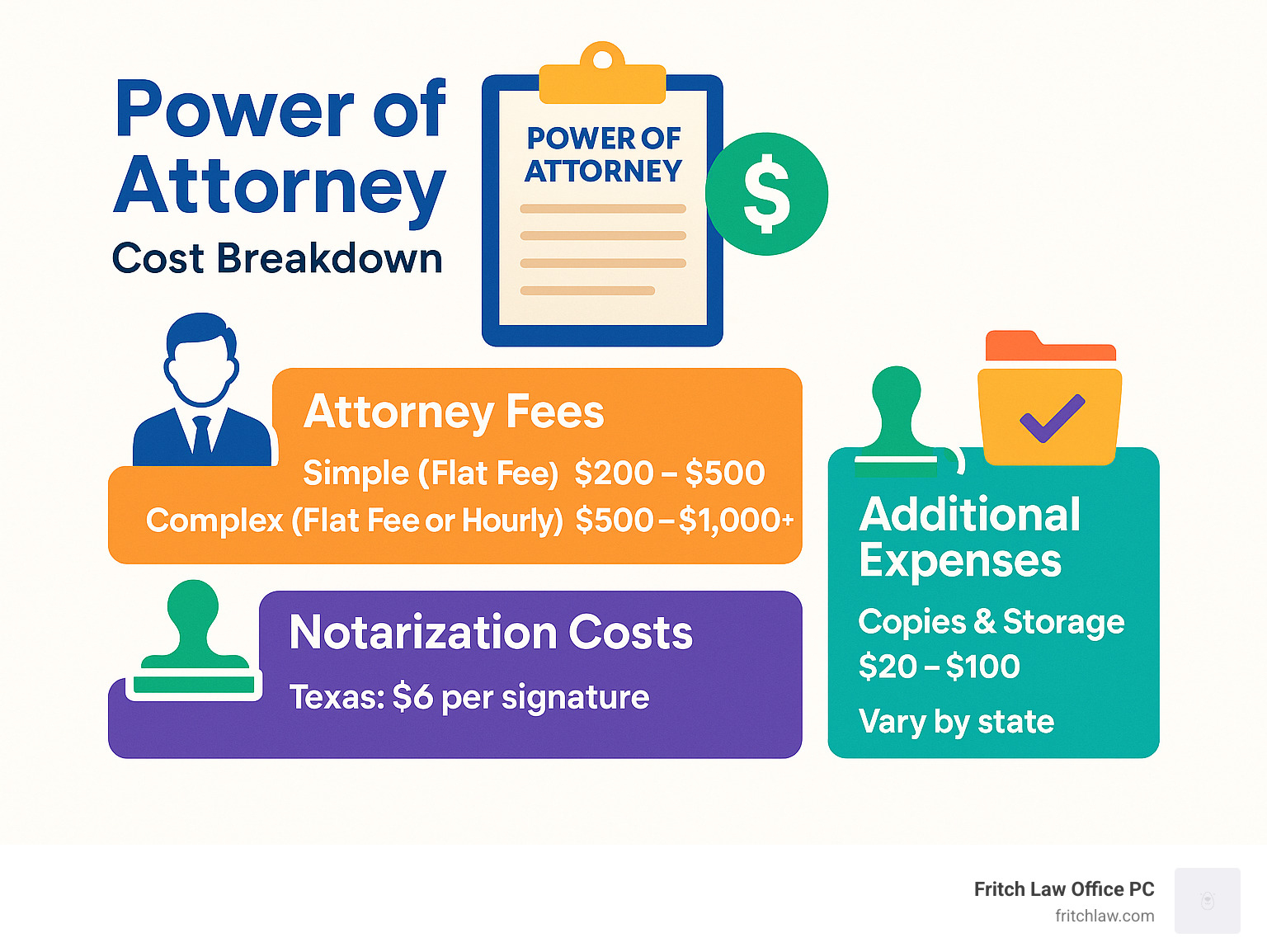
Attorney fees for power of attorney typically range from $200 to $1,000, depending on complexity and location. Here’s what you need to know about the costs:
| Type of Fee | Typical Cost Range |
|---|---|
| Attorney flat fee | $200-$500 |
| Attorney hourly rate | $250-$350/hour |
| DIY online forms | $0-$50 |
| Notarization fee (Texas) | $6 per signature |
| Copies and storage | $20-$100 |
Planning for incapacity is something many people postpone, often due to uncertainty about the costs involved. A power of attorney (POA) is a crucial legal document that grants someone else the authority to make decisions on your behalf if you become unable to do so. While the peace of mind is invaluable, understanding attorney fees for power of attorney documents can help you budget appropriately for this essential protection.
The cost of creating a power of attorney varies based on several factors: the type of POA you need, your location, the complexity of your situation, and whether you choose an attorney-drafted document or a DIY approach. In Texas, a straightforward POA may cost as little as $200, while more complex arrangements involving business assets or Medicaid planning can exceed $600.
I’m David Fritch, an attorney with over 40 years of experience helping clients steer attorney fees for power of attorney documents and other estate planning needs at Fritch Law Office PC. My background as both an attorney and CPA gives me unique insight into creating cost-effective legal solutions.
Simple attorney fees for power of attorney glossary:
– average cost of estate planning attorney
– estate planning attorney fees
– how much does it cost to make a will
Power of Attorney Basics & Why Costs Vary
A power of attorney is a legal document that authorizes another person (your “agent” or “attorney-in-fact”) to make decisions on your behalf. Think of it as passing the baton of authority to someone you trust when you can’t—or don’t want to—handle certain matters yourself.
The legal definition might sound intimidating, but the concept is straightforward: you (the “principal”) are giving someone permission to step into your shoes for specific decisions. This becomes especially important during times when you can’t communicate or make decisions, whether due to illness, injury, or absence.
Powers of attorney follow state-specific rules. In Texas, they’re governed by the Texas Estates Code, while Indiana has its own legal framework. These local regulations directly influence what you’ll pay for a properly prepared POA, since your attorney needs to ensure your document complies with all the relevant laws.
Attorney fees for power of attorney documents reflect the expertise needed to create something that works for your unique situation. Your attorney isn’t just filling in blanks—they’re crafting a document that:
Meets all your state’s legal requirements, includes appropriate safeguards to prevent misuse, clearly outlines what powers you’re granting, addresses your specific needs, and anticipates potential issues before they arise.
Common Reasons You Might Need a POA
Understanding when you might need a power of attorney helps explain why costs can vary. Here are some real-life scenarios where having a POA makes all the difference:
When Sarah needed major surgery with a lengthy recovery, she created a temporary POA so her sister could handle banking, bills, and childcare logistics while she focused on healing.
Captain James established a durable POA before his 18-month military deployment, giving his wife authority to manage their property and handle financial matters while he served overseas.
After Robert’s Parkinson’s diagnosis, he worked with an attorney to create a “springing” POA that would only activate if his doctor certified he could no longer manage his affairs—giving him peace of mind without sacrificing immediate independence.
A business executive who frequently travels internationally set up a limited POA allowing her partner to sign specific contracts during times when she might be unreachable in different time zones.
Each situation requires different provisions in the document, which directly affects the attorney fees for power of attorney preparation.
Key Legal Requirements in Texas & Indiana
The legal requirements for creating a valid power of attorney vary depending on where you live, which influences what you’ll pay for proper preparation.
In Texas, your power of attorney must be notarized, with fees capped at $6 per signature under state law. While witnesses aren’t generally required for financial POAs, you might need them for medical directives. Recording your POA with the county clerk is optional in most cases but mandatory for real estate transactions. And of course, you must have sufficient mental capacity when signing.
Indiana has slightly different requirements. Durable powers of attorney must be notarized, while healthcare POAs need either two witnesses OR notarization. Like Texas, you must have sufficient mental capacity when signing. Indiana also requires specific language for certain powers, like the authority to make gifts on your behalf.
Both states offer statutory forms (standardized templates), but these one-size-fits-all documents often need customization to address your specific needs. This is where working with an experienced attorney becomes valuable—they can tailor the document to your unique circumstances while ensuring it meets all legal requirements.
These state-specific requirements mean attorneys must take care to ensure proper execution according to local law, which contributes to the overall attorney fees for power of attorney preparation. The peace of mind that comes from knowing your document is legally sound, however, is well worth the investment.
Looking for more comprehensive guidance on planning for your future? Learn more about our estate planning services.
Breaking Down Attorney Fees for Power of Attorney
When it comes to attorney fees for power of attorney documents, understanding the different fee structures helps you budget appropriately and avoid surprises. Attorneys typically charge for POA documents in one of three ways, and knowing what to expect can make a significant difference in your planning.

Average Attorney Fees for Power of Attorney: Flat vs Hourly
Most attorneys offer powers of attorney for a flat fee, especially for straightforward situations. Based on our research and experience, simple POA documents typically range from $200 to $500, with the average flat fee hovering around $380. If you’re just looking to have an existing POA reviewed, you might pay around $160 on average.
John, a client from Jasper, Indiana, recently shared his experience: “I was relieved when Fritch Law Office quoted me a clear flat fee for my financial POA. No surprises, no hourly billing anxiety—just a straightforward price for exactly what I needed.”
For more complex situations, some attorneys prefer charging by the hour. Family and probate attorneys typically bill between $250 and $350 per hour. A simple POA might take just 1-2 hours to prepare and execute, while complex POAs involving business interests or special provisions might require 3-5 hours of work.
Location matters too. In Texas, hourly rates tend to be slightly higher in metropolitan areas like Dallas or Houston compared to rural communities. Similarly, in Indiana, rates in Indianapolis typically exceed those in smaller communities like Jasper.
Many attorneys also offer discounted package deals when bundling a POA with other estate planning documents. Will + POA packages often range from $500 to $1,000, while comprehensive estate plans including wills, trusts, and multiple POAs might cost $1,500 to $3,000. These bundles typically save you 15-30% compared to purchasing documents individually.
Factors That Drive Up Attorney Fees for Power of Attorney
Several factors can significantly increase the attorney fees for power of attorney documents. The type of POA matters—durable POAs (those effective during incapacity) may cost more than non-durable versions. Springing POAs that activate only upon specific conditions require additional drafting and typically cost 20-30% more. Medical POAs may require additional provisions to comply with HIPAA and state healthcare laws.
Complexity is another major factor. Multi-agent provisions (naming co-agents or successors), business ownership interests, real estate in multiple states, and Medicaid planning provisions all add layers of complexity that require additional time and expertise.
Maria, a business owner in Texas, explains: “I needed a POA that covered both my personal finances and my business interests. The complexity meant higher attorney fees, but having a document that accurately addressed both aspects of my life was worth the investment.”
Attorney experience and location also play significant roles in determining fees. Senior attorneys with specialized estate planning expertise command higher rates. Geographic location significantly impacts fees, with metropolitan areas generally charging more than rural areas. And if you need emergency or rush drafting, expect to pay premium fees for the expedited service.
The American Bar Association provides helpful guidance on How Do I Settle on a Fee with a Lawyer? that can help you steer fee discussions.
State Snapshot: How Texas Fees Stack Up
Texas offers an interesting case study for attorney fees for power of attorney documents. A straightforward POA in Texas typically costs around $200-$300, while complex POAs involving business interests or Medicaid planning may cost $600 or more. Notary fees are capped at $6 per signature by state law, which helps keep execution costs predictable.
Geography plays a role within the state too—rural areas tend to have fees 15-25% lower than major metropolitan areas. Houston and Dallas typically have the highest rates due to higher overhead costs for law practices in those cities.
The Texas Estates Code provides statutory forms that can reduce drafting time, potentially lowering attorney fees. However, these forms may not address all individual needs, and customization increases costs. Compared to national averages, Texas fees tend to be slightly below the median for similar services in other states.
When comparing attorney-drafted POAs to DIY options, the price difference is substantial, but so is the value you receive:
| Feature | Attorney-Drafted POA | DIY Power of Attorney |
|---|---|---|
| Cost | $200-$1,000 | $0-$50 |
| Legal advice included | Yes | No |
| State-specific compliance | Guaranteed | Uncertain |
| Customized to your situation | Yes | Limited |
| Execution guidance | Included | Not included |
| Future support if challenged | Often available | None |
While the upfront cost is higher with an attorney, the peace of mind and legal protection often justify the investment for such an important document.
Additional Expenses & Cost-Cutting Tips
Beyond the basic attorney fees for power of attorney, several additional expenses may arise that many people don’t anticipate. Understanding these costs upfront can help you budget more effectively for your complete estate planning needs.

Hidden Costs to Budget For
When I sit down with clients to discuss their power of attorney needs, I always make sure they understand the full financial picture – not just my fees.
Execution expenses often catch people by surprise. While notarization in Texas is capped at $6 per signature (varies in Indiana), circumstances sometimes require a traveling notary if you’re homebound, which can cost $25-$75 plus mileage. Some clients now prefer remote online notarization services, which typically run $25-$50.
Distribution and storage costs are another consideration. Many financial institutions require certified copies of your POA, which cost $2-$15 per copy depending on your county. You’ll also want to think about secure storage – whether that’s a digital solution ($20-$100 annually) or a safe deposit box ($40-$100 annually) for your original documents.
Robert from Jasper shared a common oversight: “I never considered that my sister might need compensation for managing my affairs while I was incapacitated. My attorney helped me include fair compensation terms in my POA, which prevented awkwardness later.” Indeed, agent compensation is something many people forget to factor in – while family members often serve without pay, agents are typically entitled to reasonable fees unless your POA specifies otherwise.
Potential future costs might include amendment fees if your circumstances change ($50-$300), revocation filings if you need to terminate the POA ($50-$200), or court costs if your POA’s validity is ever challenged (potentially thousands of dollars).
Smart Ways to Trim Your POA Budget Without Risk
Being cost-conscious doesn’t mean cutting corners on something as important as your power of attorney. There are legitimate ways to reduce attorney fees for power of attorney documents without compromising quality.
Bundling your estate planning documents is perhaps the smartest approach. By combining a POA with a will and healthcare directives, you can typically reduce overall costs by 15-30%. Most attorneys, including our office, offer package pricing that makes comprehensive planning more affordable than purchasing each document separately.
Limited-scope services can be another money-saver. Some attorneys offer “unbundled” services where they review documents you’ve drafted yourself or help you complete statutory forms. This approach typically costs 40-60% less than full-service drafting, while still giving you professional guidance.
Being prepared saves both time and money. Come to your initial consultation with clear goals and information about your assets and wishes. Respond promptly to requests for additional information, and minimize revisions by carefully reviewing drafts. As Sarah from Texas shares: “I was worried about costs spiraling with hourly billing. When I requested a flat fee, my attorney was willing to accommodate, and I ended up saving about $200 compared to the estimated hourly rate.”
Consider timing as well. Non-emergency POAs allow attorneys to work during less busy periods, and some offer discounts during traditionally slower months. You might also explore legal aid resources – legal aid societies often provide free or low-cost POA services for qualifying individuals, and pro bono programs through state bar associations can connect eligible clients with volunteer attorneys.
For more information about legal fees and finding affordable representation, the Fees and Hiring a Lawyer guide from Texas Law Help provides excellent guidance. And if you’re interested in understanding the full scope of estate planning costs, our article on Estate Planning Attorney Fees offers a comprehensive breakdown.
The goal isn’t just to find the cheapest option – it’s to get the protection you need at a fair price. A well-drafted power of attorney is an investment in your future security and your family’s peace of mind.
Frequently Asked Questions about Attorney Fees for Power of Attorney
How often should I update or revoke my POA, and what does it cost?
Life changes, and your legal documents should keep pace. As a general rule of thumb, review your power of attorney every 3-5 years. But certain life events should trigger an immediate review: tying the knot (or untying it), welcoming a new child, experiencing significant financial changes, moving to a different state, or if your named agent can no longer serve.
Updating your POA typically costs between $50 and $300, with simpler changes landing on the lower end. For example, swapping out your agent might cost around $75, while more extensive revisions could approach $300.
“After my mother moved in with me, I needed to update my POA to reflect my new caregiving responsibilities,” shares Jennifer from Jasper. “The attorney charged $125 for the amendment, which was money well spent for the peace of mind it brought.”
Complete revocations generally run $50 to $200, plus any costs for notifying your bank or other institutions. If your original POA was recorded with the county, you’ll need to record the revocation too—another small but necessary expense.
Does the losing party ever pay attorney fees in POA disputes?
The short answer? Usually not. In most POA disputes, you’ll need to budget for your own legal expenses regardless of outcome. However, there are three notable exceptions where the other side might end up footing your legal bill:
Judicial discretion allows judges to award attorney fees in cases involving truly egregious behavior or frivolous claims. I’ve seen this happen when someone challenges a POA purely out of spite or personal gain.
State laws sometimes permit fee-shifting in specific situations. These might include cases where an agent has clearly misused their power or when a bank unreasonably refuses to honor a valid POA.
The POA document itself might contain provisions requiring the losing party to pay. This is something to discuss with your attorney during drafting—though such clauses aren’t always enforceable.
Since fee-shifting remains relatively uncommon, it’s wise to view legal fees as a necessary investment in protecting your interests rather than a recoverable expense.
Are attorney fees negotiable, and what should be in my fee agreement?
Attorney fees for power of attorney documents absolutely have wiggle room—especially for returning clients, bundled services, or straightforward situations. Many attorneys also offer sliding scales or reduced fees based on financial need.
A thoughtful client from Indiana once told me, “I was nervous about bringing up fees, but when I finally did, my attorney immediately suggested a package deal that saved me nearly $300 compared to pricing each document separately.”
Your fee agreement should spell out exactly what you’re getting for your money. Look for these seven key elements:
Scope of services that clearly defines what documents will be prepared and what support is included. Will the attorney help explain the document to your agent? Will they store the original?
Fee structure detailing whether you’re paying a flat fee or hourly rate. For POAs, flat fees typically offer better value and certainty.
Payment terms specifying when payment is due and what methods are accepted. Some attorneys require full payment upfront, while others allow installments.
Additional costs beyond the attorney’s time, such as notary fees, copies, or recording fees.
Revision policy outlining how many rounds of changes are included before additional charges kick in.
Termination provisions explaining what happens if either party needs to end the relationship mid-process.
Refund policy clarifying under what circumstances you might get money back if things don’t go as planned.
Don’t hesitate to ask questions about anything in the agreement that seems unclear. A good attorney welcomes these conversations—they’d rather address concerns upfront than deal with misunderstandings later.
While cost matters, the value of a properly drafted POA that actually works when needed far outweighs the initial attorney fees for power of attorney documents. As we often say at Fritch Law Office, “The most expensive legal document is the one that fails when you need it most.”
Conclusion
Understanding attorney fees for power of attorney documents is an essential part of planning for your future. While costs vary based on complexity, location, and attorney experience, the protection these documents provide makes them one of the most valuable investments you can make for your peace of mind.

At Fritch Law Office PC, we believe in transparent pricing that reflects the personalized nature of our services. We understand that your situation is unique – you’re not just another file on our desk. Your power of attorney should reflect your specific needs, not a generic template that might leave gaps in your protection.
Think of a power of attorney as an insurance policy for your decision-making ability. The one-time cost of proper preparation pales in comparison to the potential expense and heartache of having no protection in place when you need it most.
When considering the attorney fees for power of attorney documents, remember you’re paying not just for paperwork, but for:
Peace of mind knowing your affairs will be handled according to your wishes if you become unable to manage them yourself. As one client told me, “I sleep better knowing my son won’t have to fight through court proceedings if something happens to me.”
Legal expertise that ensures your document complies with Indiana or Texas state requirements and addresses your specific circumstances. Those DIY forms might save money upfront, but they often lack crucial state-specific provisions that can make all the difference.
Personalized guidance on selecting the right agent, defining appropriate powers, and integrating your POA with your broader estate plan. We take the time to understand your family dynamics and financial situation to create documents that truly work for you.
Long-term value that extends far beyond the initial cost. A properly drafted power of attorney can save your loved ones thousands in court costs and attorney fees if you become incapacitated without one.
While online templates might seem cost-effective, they often create a false sense of security. I’ve seen too many families find too late that their loved one’s DIY document was insufficient or improperly executed – exactly when they needed it most.
At Fritch Law Office PC, we view our role as not just document drafters but as guides through important life planning. We take the time to understand your unique circumstances and create solutions that provide real protection when it matters most.
Ready to discuss how we can help you prepare for whatever life brings? Contact Fritch Law Office PC for a consultation where we’ll explore your options with clarity and without pressure. Your future security is too important to leave to chance.
More info about comprehensive estate planning services