
Average cost of a trust and will: Complete 2026 Guide
Fritch Law Office handles average cost of a trust and will cases for Indiana residents every day. First, our attorneys examine your situation carefully. Next, we identify your strongest legal options. Furthermore, we explain every step in plain language. Therefore, you make confident decisions from day one.
Key Facts About Average cost of a trust and will in Indiana
Indiana courts apply strict 2026 rules to average cost of a trust and will matters. Moreover, experienced attorneys win better outcomes for clients. Additionally, early legal advice prevents costly mistakes. Consequently, clients who hire Fritch Law gain a clear advantage. However, waiting too long weakens your position significantly.
Take Action on Average cost of a trust and will Today
Do not delay your average cost of a trust and will case. First, call our Jasper office directly. Next, we schedule your free consultation immediately. Then, we build a winning strategy for you. Additionally, we represent you at every court hearing. Finally, we resolve your case as fast as possible.

Visit the Indiana Courts website for official legal information. Contact Fritch Law for your free consultation today.
Understanding the True Cost of Estate Planning
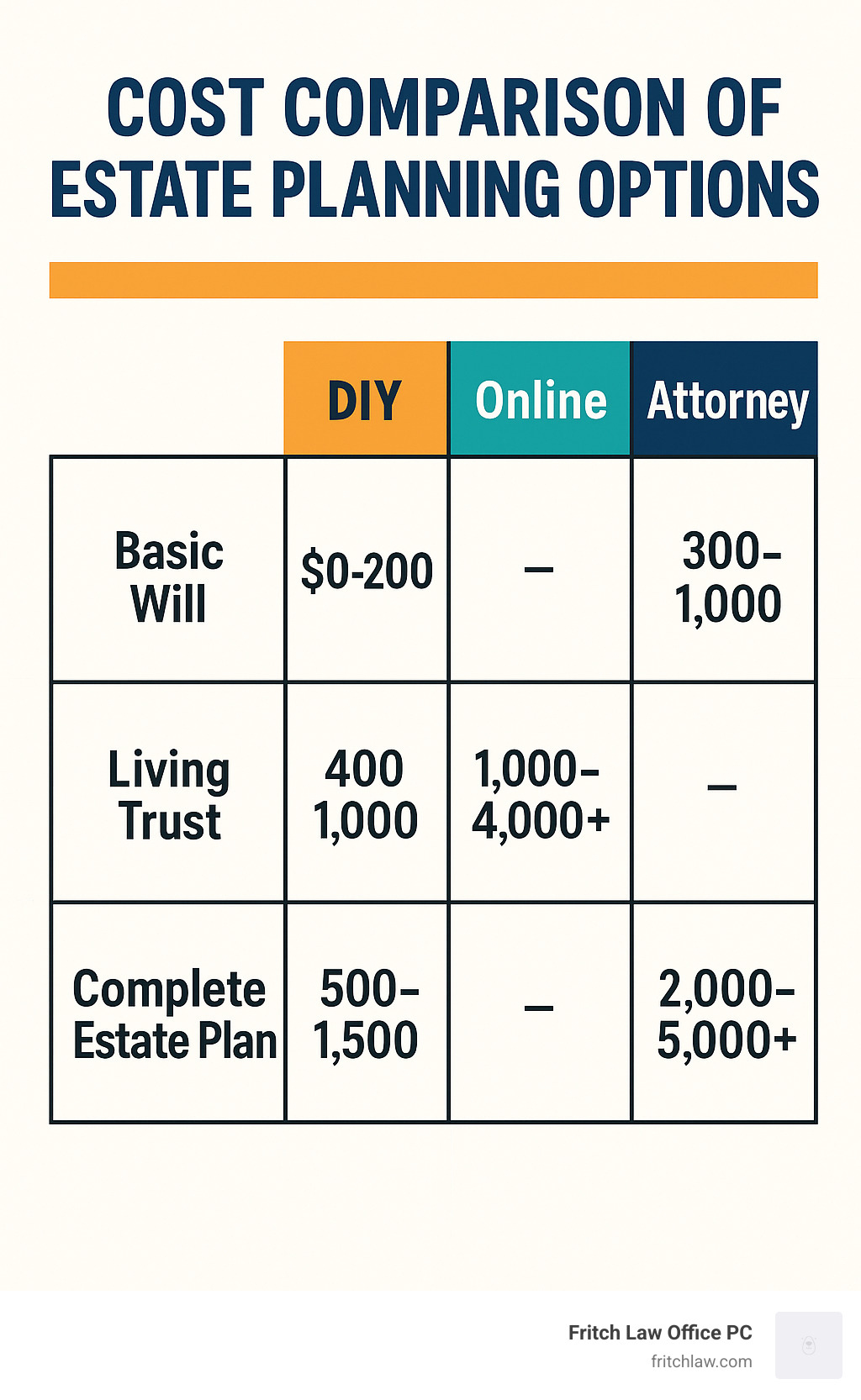
The average cost of a trust and will can range widely based on your approach and needs. Here’s a quick breakdown to address your search:
| Document Type | DIY/Online | Attorney-Drafted |
|---|---|---|
| Basic Will | $0-200 | $300-1,000 |
| Living Trust | $400-1,000 | $1,000-4,000+ |
| Complete Estate Plan | $500-1,500 | $2,000-5,000+ |
Many people put off estate planning because they’re concerned about costs—but failing to plan can be far more expensive for your loved ones in the long run. When comparing wills and trusts, it’s important to understand not just the upfront costs, but also the long-term financial implications.
A will is a legal document that directs your asset distribution after death, while a trust is a separate legal entity that can manage assets during your lifetime and distribute them privately afterward, typically avoiding the public probate process.
The difference in cost reflects their complexity and the benefits each provides. While a simple will might cost just a few hundred dollars, a comprehensive trust can run into thousands—but may save your heirs significant money in probate fees (typically 4-8% of estate value) and time.
I’m David Fritch, with over 40 years of experience helping clients steer the average cost of a trust and will while ensuring their estate planning needs are met effectively and efficiently. My background as both an attorney and CPA gives me unique insight into balancing legal protection with financial practicality.
Decoding the Average Cost of a Trust and Will
When folks walk into our Jasper office, they often have one burning question: “What’s the average cost of a trust and will?” It’s a great question, but the answer isn’t one-size-fits-all. Estate planning costs exist on a spectrum—ranging from practically free DIY options to several thousand dollars for comprehensive attorney-drafted packages.
According to research from the National Council on Aging, you might spend anywhere from $0 to $7,000 on estate planning tools, depending on your situation’s complexity, where you live, and whether you choose the DIY route or professional help. This wide range can make it tough to budget without understanding what drives these costs.
Quick Stat Snapshot: average cost of a trust and will
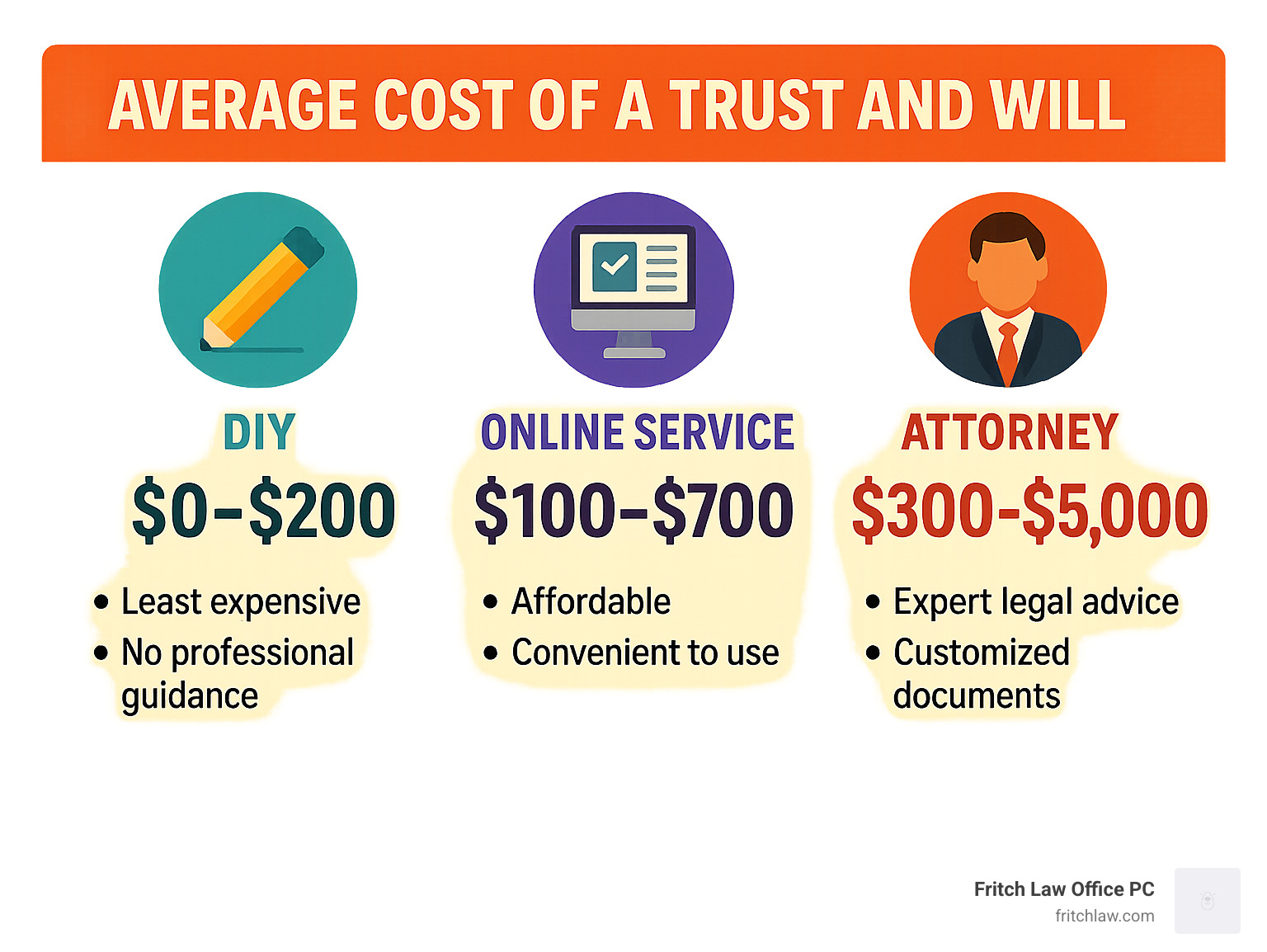
Let me break down the average cost of a trust and will by preparation method in a way that makes sense:
DIY options typically run $20-200 for basic templates and software. Online services usually charge $100-600 for wills and $250-1,500 for trusts. When you work with an attorney like myself, expect to invest $300-1,000 for a will and $1,000-7,000 for a trust, depending on complexity. And without proper planning? Probate costs often reach 4-8% of your total estate value—a sobering thought.
Here’s something many folks don’t realize: the cheapest option upfront isn’t always the most economical long-term. A poorly drafted will or trust might lead to legal challenges, tax complications, or probate expenses that dwarf what you initially “saved.” Think of estate planning as an investment rather than an expense—one that protects your family’s future.
State-by-State Price Swings
Living in Indiana directly affects what you’ll pay for estate planning. Geographic location significantly impacts legal fees, with attorney hourly rates varying dramatically across the country. For perspective, hourly rates can be as low as $80 in parts of Illinois while reaching a whopping $550 in California, according to Contracts Counsel data.
Here in Indiana, our rates typically fall in the middle range, making professional estate planning more accessible than in major metropolitan areas. Rural communities like Jasper often offer more competitive pricing than you’d find in Indianapolis or other large cities.
When comparing costs, don’t overlook the value of local knowledge. Understanding Indiana’s specific probate laws and procedures adds significant value that generic online services simply cannot match. We know the local courts, judges, and procedures—familiarity that can save you both time and money in the long run.
The average cost of a trust and will represents more than just documents; it’s an investment in peace of mind and family security. While budget considerations are important, the true value comes from having the right plan for your unique situation.
Will 101: Purpose, Process, Price
A will is a legal document that outlines how you want your assets distributed after death, names an executor to manage the process, and can designate guardians for minor children. Unlike trusts, wills must go through probate—the court-supervised process of validating the will and distributing assets.
The average cost of a will varies based on complexity and creation method:
- Handwritten (holographic) will: $0-20 (cost of notarization)
- Online will creation: $100-200
- Attorney-drafted simple will: $300-500
- Complex will with special provisions: $500-1,000+
Creating a Will on a Shoestring
If you’re working with a tight budget, you don’t have to forgo this essential document. Handwritten wills (also called holographic wills) are valid in Indiana when properly executed, though they do carry a higher risk of being contested later. The only cost might be the $10-20 for notarization, which isn’t legally required but adds credibility.
Free or low-cost templates are available online, but they must be customized to meet Indiana’s specific requirements. Many public libraries and senior centers offer free resources for basic estate planning too. The key is ensuring whatever method you choose complies with state law – including proper witnessing and execution.
While saving money upfront is tempting, I’ve seen many families find the hard way that an invalid will can cost heirs significantly more in legal fees and emotional stress than what would have been spent on proper preparation.
Attorney-Drafted Wills: When to Spend More
In my four decades of practice, I’ve found that professional assistance becomes particularly valuable in certain situations. If you have minor children requiring guardianship provisions, own a business, or have assets exceeding $100,000, the investment in professional help often pays dividends.
Other situations where attorney guidance proves worthwhile include blended family considerations, specific conditions on inheritances, or when you own property in multiple states. These complexities require careful navigation of legal requirements that DIY solutions simply can’t address adequately.
At Fritch Law Office PC, we offer both flat-fee and hourly billing options. Our basic wills typically range from $300-500 as a flat fee, while more complex estate planning may be billed hourly at standard attorney rates. Many clients find that the peace of mind from knowing their will is legally sound and properly reflects their wishes is worth the additional investment.
The Average Cost of a Will and Trust varies considerably, but the value of having a properly executed will that truly protects your family is difficult to overstate. The lowest cost option isn’t always the most economical in the long run, especially when your family’s future is at stake.
Trust 101: How It Works & What It Costs
A trust is a powerful legal arrangement where someone (the trustee) holds and manages assets for the benefit of others (your beneficiaries). Unlike wills, trusts can spring into action during your lifetime if you create a living trust, and they neatly sidestep the public probate process after you’re gone.
When looking at the average cost of a trust and will, you’ll notice trusts typically command a higher price tag:
- Online trust creation: $400-1,000
- Attorney-drafted simple trust: $1,000-3,000
- Complex trusts for large estates: $3,000-7,000+
These figures cover creating the trust document itself, but not the equally important process of funding your trust—actually moving your assets into it.
Funding Your Trust Without Breaking the Bank
Creating your trust document is just the first step in your journey—like building a beautiful safe without putting anything valuable inside. The real magic happens when you transfer your assets into the trust, a process we call “funding.”
This crucial step comes with its own set of costs that many folks don’t anticipate:
Recording new deeds for your real estate typically runs about $100-200 per property. The good news? Retitling your bank accounts usually costs nothing but a bit of paperwork and your signature. Investment accounts might involve some administrative fees, but they’re generally minimal.
One of the most common mistakes we see at Fritch Law Office PC is clients who create a beautiful trust but leave it empty. That’s why we include detailed funding instructions with every trust we create—we want your trust to actually work for you!
Here’s a warm tip from our experience: Consider adding a “pour-over will” to your plan. Think of it as a safety net that catches any assets you might have missed transferring to your trust during your lifetime and directs them into your trust after you’re gone.
Ongoing & Hidden Costs to Monitor
When calculating the average cost of a trust and will, don’t forget these potential ongoing expenses that might sneak up on you:
Making changes to your trust through amendments typically costs $200-500 each time life circumstances change. If your trust requires separate tax filings, annual trust tax preparation might run $500-2,000 depending on complexity. And if you choose not to serve as your own trustee, professional trustee fees generally range from 0.5-2% of trust assets annually.
While these numbers might make your eyes widen, consider what you’re saving: probate fees (typically 4-8% of your estate value), potential estate taxes, plus the privacy and control a trust provides. For many families, these benefits far outweigh the costs.
According to research from SmartAsset, trusts tend to be more cost-effective for estates valued over $150,000, especially when considering the long-term savings on probate fees and court costs. If you’re curious about specific living trust costs, we’ve covered that in detail in our article about the Average Cost for a Living Trust.
DIY, Online, or Attorney? Choosing the Right Path
With such a wide range in the average cost of a trust and will, how do you decide which approach is right for you? The answer depends on your estate’s complexity, your comfort with legal matters, and your budget.

Cost-Benefit Matrix for Every Approach
When weighing your options, consider both the immediate costs and long-term benefits of each approach.
The DIY route ($0-200) works best for those with very simple estates and tight budgets. While affordable upfront, this path comes with significant risks – your documents might be invalid, miss crucial provisions, or fail to address Indiana-specific requirements.
Online services ($100-1,500) offer a middle ground for simple to moderate estates. They’re particularly appealing if you’re comfortable with technology and have a straightforward situation. However, these services typically provide limited customization and may lack the state-specific guidance that ensures your documents comply with Indiana law.
A growing trend is the hybrid approach ($500-2,000), where you create documents online and then have an attorney review them. This gives you some legal oversight while keeping costs lower than full attorney preparation. Many of our clients find this balances cost and peace of mind effectively.
For complex situations, full attorney service ($1,000-5,000+) provides comprehensive protection. While the upfront investment is higher, the personalized guidance and legal certainty often prove invaluable for business owners, blended families, or those with substantial assets.
Did you know many employers offer legal insurance plans that cover basic estate planning? This benefit can dramatically reduce your out-of-pocket costs while still providing professional legal guidance. We’re happy to work with these plans at Fritch Law Office PC.
Minimum Net Worth & Complexity Triggers
When does investing in a more comprehensive approach make financial sense? Watch for these key triggers that often signal it’s time to move beyond a simple will:
The $100,000 asset threshold often marks when a trust becomes financially beneficial. Once your estate exceeds this value, the potential probate savings start to outweigh the upfront costs of trust creation.
Multiple properties create special complications, particularly if you own real estate in different states. Without proper planning, your heirs might face probate proceedings in each state – a costly and time-consuming process.
Special circumstances like having a beneficiary with special needs, owning a business, or navigating blended family dynamics all increase the complexity of your estate plan. These situations benefit tremendously from personalized legal guidance.
Privacy concerns also matter. If you prefer to keep your affairs private, trusts offer significant advantages over wills, which become public record during probate.
At Fritch Law Office PC, we never take a one-size-fits-all approach. Instead, we carefully assess each client’s unique situation before recommending specific documents. This ensures you get exactly what you need – no more, no less – at a fair price that reflects the complexity of your circumstances. Learn more about our flat fee options at our Estate Planning Attorney Flat Fee page.
The average cost of a trust and will in a Larger Estate Plan
When clients visit our Jasper office to discuss estate planning, I often explain that a will or trust is just one piece of a complete protection puzzle. When considering the average cost of a trust and will, it’s important to think about the full ensemble of documents that create comprehensive coverage for your family’s future.
A complete estate plan typically includes these essential components:
- Durable Power of Attorney: Gives a trusted person authority to handle your finances if you become unable to do so
- Healthcare Power of Attorney: Names someone to make medical decisions when you cannot speak for yourself
- Living Will/Advance Directive: Clearly states your preferences for end-of-life medical care
- HIPAA Authorization: Allows doctors to share your medical information with designated loved ones

Here at Fritch Law Office PC, we’ve found that creating these documents together often makes the most financial sense. We offer bundle packages that typically save clients 25-40% compared to creating documents individually over time. These comprehensive packages generally range from $1,500-3,500, depending on whether they include a trust and how complex your situation is.
Probate vs Upfront Fees: The Long Game
When weighing the average cost of a trust and will, I always encourage clients to consider the bigger financial picture. The upfront investment often pales in comparison to what your family might face without proper planning.
Without a trust, your estate will likely go through probate – the court-supervised process of validating your will and distributing assets. This comes with substantial costs:
Court filing fees typically run $200-500, attorney fees can reach 4-8% of your estate’s value, and appraisal fees add another $300-600. For a modest $500,000 estate, probate expenses could total $20,000-40,000 – far exceeding what you’d spend creating a trust now.
Beyond the financial impact, probate also creates significant delays (typically 6-18 months) during which your heirs can’t access assets. Plus, it makes your personal and financial affairs public record – something many families prefer to avoid.
Documents to Bundle for Maximum Value
After helping Indiana families for decades, I’ve found these document bundles provide the most value:
For basic protection, consider packaging your will with powers of attorney (both financial and healthcare), a living will, and HIPAA authorization. This foundation covers the essentials at a more accessible price point.
For more comprehensive coverage, add a revocable living trust, pour-over will, and detailed trust funding instructions. While this package costs more upfront, it typically delivers significant long-term savings by avoiding probate expenses.
I’ve seen how having these documents properly prepared brings families peace of mind that’s truly priceless. At Fritch Law Office PC, we work to make this protection accessible by offering clear, flat-fee packages that help you understand exactly what you’re investing in your family’s security.
If you’d like to learn more about creating a complete estate plan custom to your specific needs, our Estate Planning services provide personalized guidance that goes beyond just calculating the average cost of a trust and will.
Frequently Asked Questions about Costs & Strategy
What is the average cost of a trust and will for a couple?
Good news for married couples! When you create estate planning documents together, you’ll typically enjoy substantial savings compared to creating separate plans. For couples, the average cost of a trust and will looks like this:
Attorney-drafted joint will packages generally run $400-800, while joint trust packages range from $1,500-4,000. Most law firms, including our practice, offer couples discounts of 25-40% off what you’d pay for two individual plans. This makes financial sense since much of the information gathering, family dynamics, and asset details overlap significantly.
At Fritch Law Office PC, we find that creating estate plans for couples not only saves money but often leads to better overall planning as both spouses participate in important decisions together.
How long does it take to create each document?
The timeline for creating your estate plan varies significantly depending on which path you choose:
If you go the DIY route, expect to spend several hours researching requirements, plus additional time gathering information and executing documents properly. Online services typically deliver completed documents within 1-2 days after you’ve provided all necessary information.
With attorney-drafted documents, the process usually begins with an initial consultation (about 1-2 hours) followed by 2-4 weeks for document preparation, review, and signing. While this might seem longer than other options, the time investment ensures your documents are properly custom to your specific situation and comply with Indiana’s particular legal requirements.
Many of our clients tell us they appreciate having time to think through important decisions between our meetings rather than rushing through choices that affect their family’s future.
Are DIY wills and trusts legally valid in every state?
This is where many people encounter unexpected problems. DIY estate planning documents can be legally valid, but only if they comply with your state’s specific requirements—and these requirements vary dramatically across the country.
In Indiana, for example, wills require two witnesses who watch you sign the document. Notarization isn’t technically required for will validity but is strongly recommended. Trust requirements vary based on the type of trust you’re creating.
The challenge with DIY approaches and even some online services is ensuring your documents meet Indiana’s specific legal standards. A document that works perfectly in California or Florida might not satisfy Indiana law, potentially leaving your heirs with an invalid will or trust when they need it most.
When you work with our team at Fritch Law Office PC, we ensure all your documents comply with Indiana’s specific legal requirements, giving you confidence that your estate plan will function exactly as intended when the time comes.
The small difference in cost between generic documents and state-specific, professionally prepared documents can make an enormous difference in how effectively your estate plan protects your family and assets.
Conclusion
The average cost of a trust and will isn’t just another expense—it’s truly an investment in your family’s future security and peace of mind. While costs range from nearly free DIY options to several thousand dollars for comprehensive attorney services, what you get typically reflects what you pay for.
When weighing your estate planning options, take a moment to consider the complete picture:
First, think about your unique family dynamics and estate complexity. A simple situation might need less investment, while blended families or substantial assets benefit from more thorough planning.
Second, remember the potential probate costs your loved ones might face without proper planning—those 4-8% estate fees add up quickly and could far exceed what you’d spend on planning now.
Third, there’s something priceless about the peace of mind that comes from knowing your wishes will be honored and your family protected when you’re no longer here to handle things yourself.
At Fritch Law Office PC in Jasper, we understand that talking about wills and trusts isn’t just a legal transaction—it’s a deeply personal process. That’s why we take the time to listen to your concerns and goals before recommending solutions that balance protection with practicality.
We’ve seen how proper planning prevents family conflict and protects hard-earned assets. Our approach is never one-size-fits-all—we tailor our recommendations to your specific situation, ensuring you don’t pay for more complexity than you need while still getting complete protection.
Whether you need a straightforward will or a sophisticated trust arrangement, we’re committed to providing clear guidance, transparent pricing, and documents that truly work when your family needs them most.
Ready to move beyond just researching the average cost of a trust and will and create an estate plan that fits your unique needs? We’re here to help. Contact our Jasper office today for a personal consultation that focuses on solutions, not just selling services.