

Indiana probate law small estate: Complete 2026 Guide
Fritch Law Office handles indiana probate law small estate cases for Indiana residents every day. First, our attorneys examine your situation carefully. Next, we identify your strongest legal options. Furthermore, we explain every step in plain language. Therefore, you make confident decisions from day one.
Key Facts About Indiana probate law small estate in Indiana
Indiana courts apply strict 2026 rules to indiana probate law small estate matters. Moreover, experienced attorneys win better outcomes for clients. Additionally, early legal advice prevents costly mistakes. Consequently, clients who hire Fritch Law gain a clear advantage. However, waiting too long weakens your position significantly.
Take Action on Indiana probate law small estate Today
Do not delay your indiana probate law small estate case. First, call our Jasper office directly. Next, we schedule your free consultation immediately. Then, we build a winning strategy for you. Additionally, we represent you at every court hearing. Finally, we resolve your case as fast as possible.

Visit the Indiana Courts website for official legal information. Contact Fritch Law for your free consultation today.
Understanding Indiana’s Small Estate Probate Relief
Indiana probate law small estate procedures offer a streamlined way to handle modest inheritances without the time and expense of formal probate court proceedings. Here’s what you need to know:
Quick Reference for Indiana Small Estates:
– Estate Value Limit: $100,000 or less (as of July 1, 2022)
– Waiting Period: 45 days after death
– Process: Small Estate Affidavit (Form 54985) – no court filing required
– Cost Savings: Avoids $177 probate filing fee
– Asset Types: Bank accounts, vehicles, securities, insurance benefits, safe deposit boxes
When someone passes away in Indiana, their loved ones often worry about navigating complex probate procedures. The good news? If the deceased person’s estate is valued at $100,000 or less, you can likely use Indiana’s simplified small estate process.
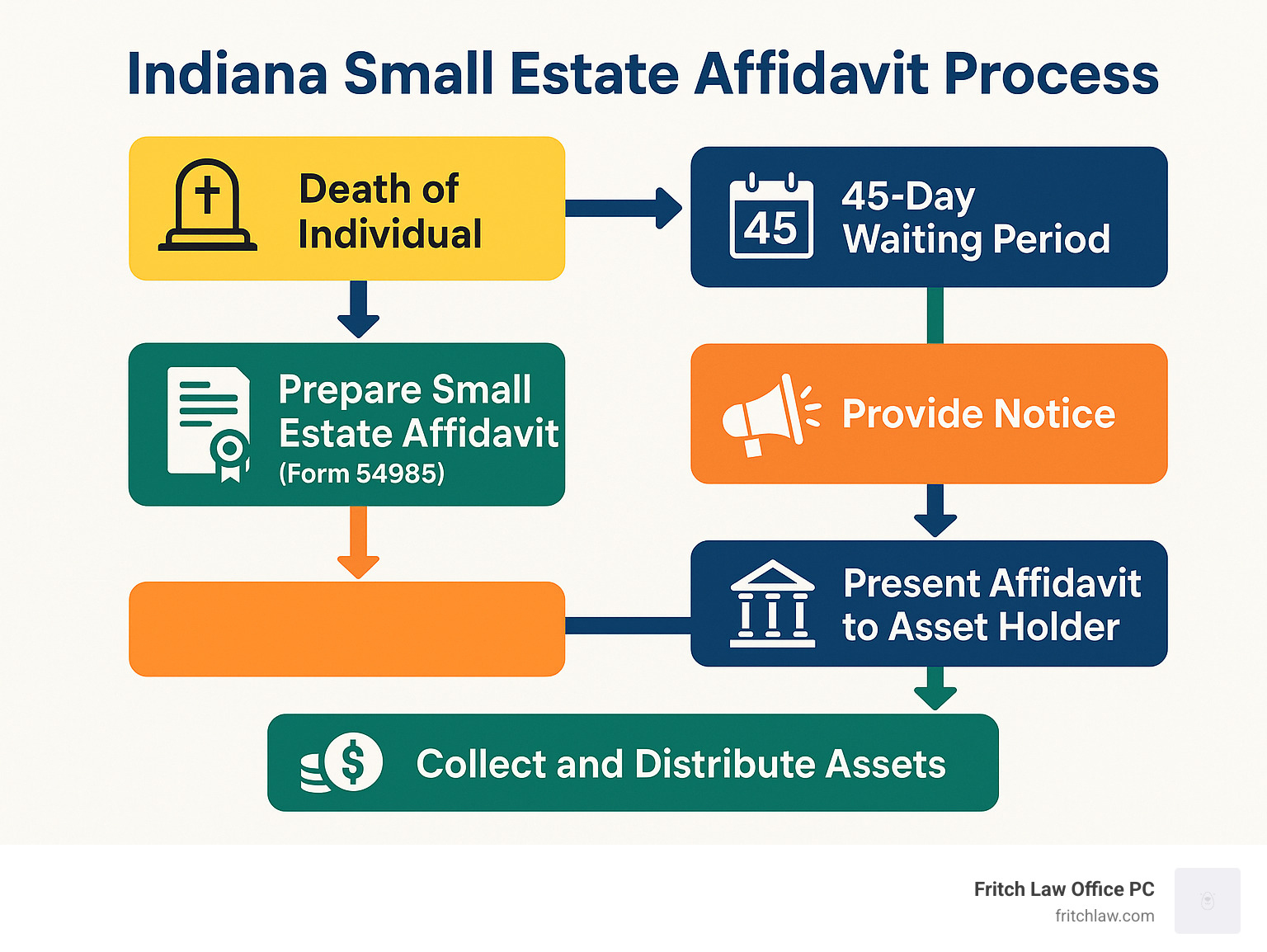
This affidavit-based procedure lets you collect and distribute assets directly through banks, insurance companies, and other institutions – without setting foot in probate court. You’ll need to wait 45 days after the death, prepare a notarized affidavit, and present it to whoever is holding the deceased person’s property.
The small estate threshold has increased significantly over time – from $25,000 before 2006 to today’s $100,000 limit – making this option available to many more families.
I’m David Fritch, and with 40 years of experience managing my own law practice, I’ve helped countless families steer indiana probate law small estate procedures efficiently and cost-effectively. This guide will walk you through each step of the process, helping you determine if you qualify and showing you exactly how to complete the affidavit procedure.
Simple indiana probate law small estate glossary:
– Indiana probate law
– indiana probate law
What Counts as a Small Estate in Indiana?
The first question families ask me is: “Does our loved one’s estate qualify for the simplified process?” Under indiana probate law small estate rules found in Indiana Code § 29-1-8-1, the answer depends on when your loved one passed away and what they owned at death.
For deaths after June 30, 2022, the magic number is $100,000. This represents the gross probate estate value, minus any liens, encumbrances, and reasonable funeral expenses. But here’s where it gets tricky – not every asset your loved one owned counts toward this limit.
The key is understanding the difference between probate assets and non-probate assets. Think of probate assets as property that needs court supervision to transfer ownership. Non-probate assets have built-in instructions for who gets them next, so they bypass probate entirely.
Probate assets that count toward your $100,000 limit include bank accounts owned solely by the deceased without payable-on-death designations, investment accounts in their name only, personal property like vehicles and jewelry, real estate owned individually, and business interests they owned alone. Digital assets and online accounts also fall into this category.
Non-probate assets that don’t count include joint tenancy property that automatically passes to the surviving owner, life insurance with named beneficiaries, retirement accounts like 401(k)s and IRAs with beneficiary designations, and transfer-on-death or payable-on-death accounts. Trust assets and property owned as tenants by the entirety for married couples also transfer outside of probate.
Here’s a real-world example: Your father owned a $90,000 house with a $30,000 mortgage, plus a $40,000 bank account. The house counts as $60,000 (after subtracting the mortgage), and the bank account adds $40,000, totaling exactly $100,000. But if that bank account had a payable-on-death designation to you, it wouldn’t count at all – making this a $60,000 estate that easily qualifies.
Date-of-Death Threshold Table
The indiana probate law small estate limits have grown significantly over the years to help more families avoid formal probate. If your loved one passed away before July 1, 2006, the limit was just $25,000. From July 1, 2006 through June 30, 2022, estates up to $50,000 qualified. For deaths after June 30, 2022, you get the benefit of today’s $100,000 threshold.
This timing matters more than you might think. If your loved one died in 2021, you’d work with the $50,000 limit even though the law has since changed. The date of death locks in which rules apply to your situation.
When calculating your estate value, legitimate liens and reasonable funeral expenses reduce the total. That mortgage on the family home? Subtract it. The $8,000 funeral bill? That comes off too. These deductions often make the difference between qualifying for the simplified process or needing formal probate.
The inflation adjustments reflect the legislature’s recognition that families shouldn’t be forced into expensive probate proceedings for modest estates. What required court supervision in 2005 might be routine paperwork today.
Using the Indiana Probate Law Small Estate Affidavit: Step-by-Step
When you’re ready to move forward with the indiana probate law small estate affidavit, the process is much simpler than formal probate – but timing and accuracy are everything.
The 45-day waiting period is non-negotiable. You absolutely cannot file your affidavit until 45 days have passed since the death. This waiting period exists for good reason – it gives creditors and other interested parties time to come forward with claims. Mark your calendar carefully, because filing even one day early will invalidate your entire affidavit.
Once those 45 days have passed, you’ll use Small Estate Affidavit form 54985 to collect assets directly from banks, insurance companies, and other institutions. No court filing required. You simply present your notarized affidavit along with a death certificate, and most places will transfer the assets to you within a few business days.
Before you can present the affidavit anywhere, though, you need to notify every person entitled to inherit from the estate. This includes anyone named in the will or, if there’s no will, the heirs under Indiana law. You can’t just notify the people you like – everyone with a legal interest must be informed.
The affidavit itself requires you to swear under penalty of perjury that the estate qualifies, that no personal representative petition is pending, and that you’ve properly notified all distributees. This isn’t paperwork to rush through.
Preparing the Paperwork
Getting your documentation right from the start will save you headaches later. Order several certified copies of the death certificate – not photocopies, but official certified copies from the funeral home or vital records office. You’ll need these for every bank, insurance company, and institution you visit.
When listing assets and their values, be conservative and accurate. If you’re unsure about something’s worth, get it appraised. You’re signing this affidavit under penalty of perjury, so guessing isn’t an option. Include all probate assets but don’t count joint accounts, life insurance with beneficiaries, or retirement accounts with designated beneficiaries.
For debts and liens, subtract only legitimate expenses from the gross estate value. Funeral expenses are deductible, as are mortgages and other secured debts. Keep all receipts and documentation for anything you subtract from the estate value.
If there’s a will, follow its terms for who inherits what. Without a will, Indiana’s intestacy laws determine inheritance – typically the surviving spouse and children share the estate, or if there’s no spouse, the children inherit equally.
Presenting the Affidavit & Collecting Assets
Once your affidavit is complete and notarized, you’ll take it directly to whoever is holding the deceased person’s assets. Most financial institutions in Indiana are familiar with small estate affidavits and have procedures in place to handle them efficiently.
Banks and credit unions typically process these requests within a few business days once you present the affidavit and death certificate. Insurance companies will release life insurance proceeds using the affidavit if there’s no named beneficiary or if the original beneficiary has died.
For investment accounts and securities, you’ll present the affidavit to the brokerage firm or transfer agent to change ownership of stocks, bonds, or mutual funds. Most major firms have standard procedures for this.
The Bureau of Motor Vehicles has a special rule that works in your favor – you only need to wait 5 days after death (not the full 45) to transfer vehicle titles using the small estate affidavit. This can be helpful if you need to sell a vehicle quickly to pay funeral expenses.
Safe deposit box access works the same way – present your affidavit and death certificate to the bank, and they’ll allow you to access and remove the contents. Indiana law specifically covers digital assets too, giving you the same access rights to online accounts and digital property that a personal representative would have.

The key to success with the indiana probate law small estate process is patience during the waiting period, accuracy in your paperwork, and thoroughness in notifying all interested parties. Most families find this process much less stressful than formal probate once they understand the steps involved.
Special Asset Rules & Pitfalls
While the small estate process is generally straightforward, certain assets have special rules or common pitfalls to avoid.
Vehicle Transfers: Indiana has a unique 5-day rule for vehicles and watercraft. Unlike other assets that require a 45-day wait, you can transfer vehicle titles just 5 days after death using the affidavit. This can be helpful for families who need immediate access to transportation.
Over-Valuation Risks: One of the biggest mistakes we see is miscalculating the estate value. Remember:
– Use fair market value, not sentimental value
– Subtract liens and mortgages
– Don’t count non-probate assets
– Get appraisals for valuable items if uncertain
Creditor Claims: While the small estate process is faster, it doesn’t eliminate the deceased person’s debts. Creditors can still make claims, and you may be personally liable if you distribute assets knowing about unpaid debts.
Real Estate and the indiana probate law small estate limits
Real estate presents special challenges in indiana probate law small estate procedures. While personal property can be transferred using the small estate affidavit, real estate requires a different approach.
Passage of Title Affidavit: For real estate, Indiana provides a separate “passage of title” or “devolution” affidavit. This has different requirements:
– Must wait 7 months after death (not 45 days)
– No value limit on the real estate
– Cannot be used if a personal representative has been appointed
– Must be recorded with the county recorder
Practical Problems: The real estate affidavit is rarely practical for significant estates because someone usually needs to be appointed as personal representative within the first few months to handle other estate matters.
Combined Approach: Some families use the small estate affidavit for personal property and bank accounts, then handle real estate through formal probate or the passage of title affidavit later.
Disputes Under indiana probate law small estate procedures
While the small estate process avoids court supervision, disputes can still arise:
Heir Disagreements: If family members disagree about asset distribution, the small estate process offers no mechanism for resolution. You may need to pursue formal probate instead.
Creditor Objections: Creditors who believe the estate owes them money can challenge your distributions. This is one reason why careful documentation and conservative valuations are important.
Affiant Liability: The person signing the affidavit (the “affiant”) can be personally liable for false statements or improper distributions. This includes liability for:
– Distributing assets to wrong parties
– Failing to pay legitimate debts
– Making false statements in the affidavit
– Exceeding the statutory value limits
Fraud Penalties: Making false statements in the affidavit is perjury, a criminal offense. Always be truthful and conservative in your valuations and statements.
Advantages, Limitations, and When to Get Help
The indiana probate law small estate affidavit process offers significant advantages, but it’s not right for every situation.
Advantages:
– Cost Savings: Avoid the $177 probate filing fee and ongoing court costs
– Speed: Complete the process in weeks rather than months
– Privacy: No public court records
– Simplicity: No ongoing court supervision or reporting requirements
– Direct Control: Work directly with banks and institutions
Limitations:
– Value Cap: Strict $100,000 limit (including all probate assets)
– Liability Exposure: Personal responsibility for accuracy and proper distribution
– No Court Protection: No judicial oversight if problems arise
– Creditor Risk: Limited protection from unknown creditors
– Family Disputes: No mechanism for resolving disagreements
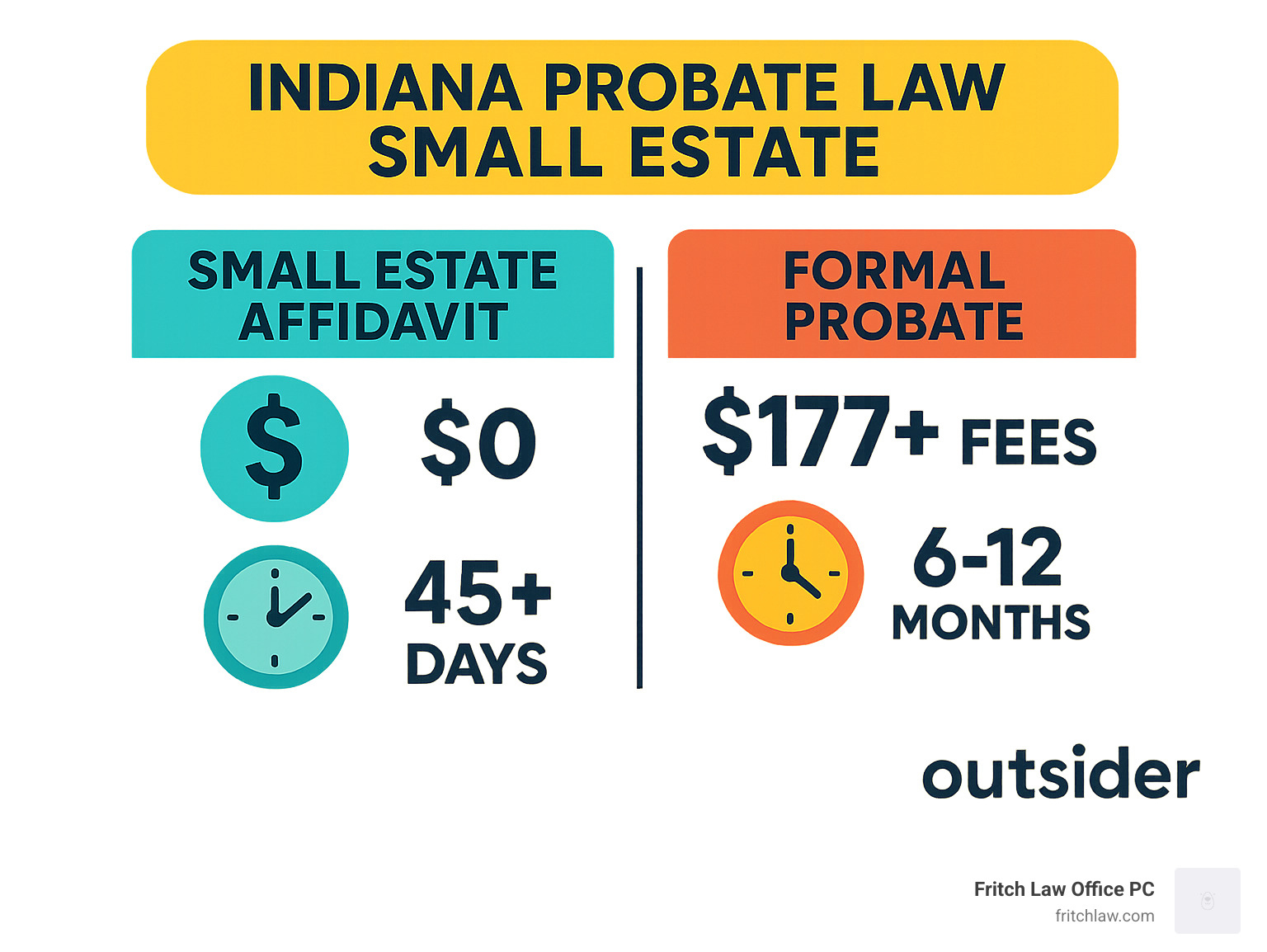
| Feature | Small Estate Affidavit | Formal Probate |
|---|---|---|
| Cost | $0 (plus notary fees) | $177+ filing fee |
| Timeline | 45+ days | 6-12 months |
| Court Supervision | None | Ongoing |
| Value Limit | $100,000 | No limit |
| Creditor Protection | Limited | Comprehensive |
| Dispute Resolution | None | Court-supervised |
When to Consider Getting Help:
– Estate value is close to the $100,000 limit
– Significant debts or creditor claims exist
– Family members disagree about distributions
– Complex assets (business interests, multiple properties)
– Questions about asset valuation
– Concerns about personal liability
At Fritch Law Office PC in Jasper, we often help families evaluate whether the small estate process is appropriate for their situation. Sometimes a brief consultation can save significant time and liability exposure. For more information about our Probate Law Services, we’re here to help guide you through the process.

Frequently Asked Questions about Indiana Small Estates
When families are dealing with indiana probate law small estate procedures, the same questions come up again and again. Here are the answers to the most common concerns we hear at our Jasper office.
How long must I wait after death to use the affidavit?
You must wait exactly 45 days after the date of death before presenting the small estate affidavit to banks, insurance companies, or other institutions. This isn’t a suggestion – it’s a firm legal requirement written into Indiana law.
Filing the affidavit even one day early will invalidate the entire document, forcing you to start over. Mark your calendar carefully and count the days precisely. If your loved one passed away on January 1st, you cannot use the affidavit until February 15th (or February 16th in a leap year).
The one important exception is vehicle titles. The Bureau of Motor Vehicles allows you to transfer car and boat titles using the affidavit after just 5 days. This special rule recognizes that families often need immediate access to transportation.
Can I include jointly owned bank accounts in the $100,000 cap?
No, jointly owned accounts don’t count toward the estate limit at all. This is actually good news for most families because it means more estates qualify for the simplified process.
Joint accounts automatically pass to the surviving owner when someone dies – they’re not part of the probate estate. The same rule applies to accounts with payable-on-death designations, transfer-on-death accounts, life insurance with named beneficiaries, and retirement accounts with beneficiaries.
Only assets owned solely by the deceased person count toward the $100,000 threshold. So if your loved one had a $75,000 joint checking account and $80,000 in individual savings, only the $80,000 individual account counts toward the limit.
This distinction trips up many families, so it’s worth double-checking your asset list before proceeding.
What happens if a creditor shows up after assets are distributed?
This question touches on one of the biggest risks of using the indiana probate law small estate process instead of formal probate. Unlike formal probate, which includes a structured creditor notice period, the small estate affidavit doesn’t provide comprehensive protection from unknown creditors.
If a legitimate creditor appears after you’ve distributed assets to family members, you could be personally liable for the debt up to the amount you distributed. This means if you distributed $50,000 to heirs and a $20,000 medical bill surfaces later, you might have to pay that $20,000 out of your own pocket.
The key word here is “legitimate.” You’re not responsible for fraudulent or invalid claims, but proving a claim is invalid can be expensive and time-consuming.
To protect yourself, research known debts thoroughly before distributing assets. Check for outstanding medical bills, credit card debt, and utility bills. Consider setting aside a portion of the estate for potential claims, especially if the deceased had significant medical care before death.
If you know about substantial debts or suspect there might be unknown creditors, formal probate might be worth the extra time and cost for the creditor protection it provides.
Conclusion & Next Steps
The indiana probate law small estate affidavit process can be an excellent option for families dealing with modest estates. With the increased $100,000 threshold, many more families can now take advantage of this streamlined procedure.
Key takeaways:
– Carefully calculate the estate value, excluding non-probate assets
– Wait the full 45 days before filing (5 days for vehicles)
– Complete Form 54985 accurately and get it notarized
– Notify all distributees before presenting the affidavit
– Be prepared for personal liability for accuracy and proper distribution
Before proceeding, consider:
– Getting asset appraisals if values are uncertain
– Researching potential creditor claims
– Consulting with an experienced attorney if the estate is complex or valuable
The small estate process works best for straightforward situations with cooperative family members and minimal debts. When in doubt, a brief consultation with an experienced probate attorney can help you avoid costly mistakes and determine the best approach for your specific situation.
At Fritch Law Office PC, we’ve helped many Jasper-area families steer both simple and complex estate matters. Whether you need help evaluating your options or guidance through the small estate process, we’re here to provide the personalized legal representation you need during this difficult time.
For more information about probate procedures in Indiana, visit our Probate page or contact us to discuss your specific situation. Every family’s circumstances are unique, and we’re committed to helping you find the most efficient and cost-effective solution for your loved one’s estate.