

Indiana real estate trust: Complete 2026 Guide
Fritch Law Office handles indiana real estate trust cases for Indiana residents every day. First, our attorneys examine your situation carefully. Next, we identify your strongest legal options. Furthermore, we explain every step in plain language. Therefore, you make confident decisions from day one.
Key Facts About Indiana real estate trust in Indiana
Indiana courts apply strict 2026 rules to indiana real estate trust matters. Moreover, experienced attorneys win better outcomes for clients. Additionally, early legal advice prevents costly mistakes. Consequently, clients who hire Fritch Law gain a clear advantage. However, waiting too long weakens your position significantly.
Take Action on Indiana real estate trust Today
Do not delay your indiana real estate trust case. First, call our Jasper office directly. Next, we schedule your free consultation immediately. Then, we build a winning strategy for you. Additionally, we represent you at every court hearing. Finally, we resolve your case as fast as possible.

Visit the Indiana Courts website for official legal information. Contact Fritch Law for your free consultation today.
Why Understanding Real Estate Trusts is Essential for Indiana Property Owners
An Indiana real estate trust is a legal arrangement where a trustee holds property for beneficiaries, providing significant advantages over traditional ownership.
Key Types of Indiana Real Estate Trusts:
- Living Trust – Created during your lifetime, can be revocable or irrevocable
- Land Trust – Specifically for real estate, offers privacy and asset protection
- Revocable Trust – Can be changed or canceled during your lifetime
- Irrevocable Trust – Cannot be changed once established, offers stronger asset protection
Primary Benefits:
- Avoids Indiana’s probate process
- Maintains privacy, as wills become public record
- Provides asset protection from creditors and liens
- Allows control over how and when beneficiaries receive property
- Enables smooth property management during incapacity
Who Should Consider a Trust:
- Property owners with estates over $50,000 (Indiana’s simplified probate threshold)
- Those seeking privacy in property ownership
- Families wanting to avoid probate delays and costs
- Property owners concerned about future creditor claims
Real estate is often a family’s largest asset. Protecting your home, rental properties, or farmland for future generations requires careful planning. With Indiana’s complex probate laws, trusts offer superior protection and flexibility compared to will-based transfers.
As an experienced lawyer with over 40 years in estate planning and property law, I’m David Fritch of Fritch Law Office PC. I’ve helped countless Indiana families structure their Indiana real estate trust arrangements to protect their most valuable assets. My background in both legal practice and financial planning provides unique insight into creating comprehensive property protection strategies.
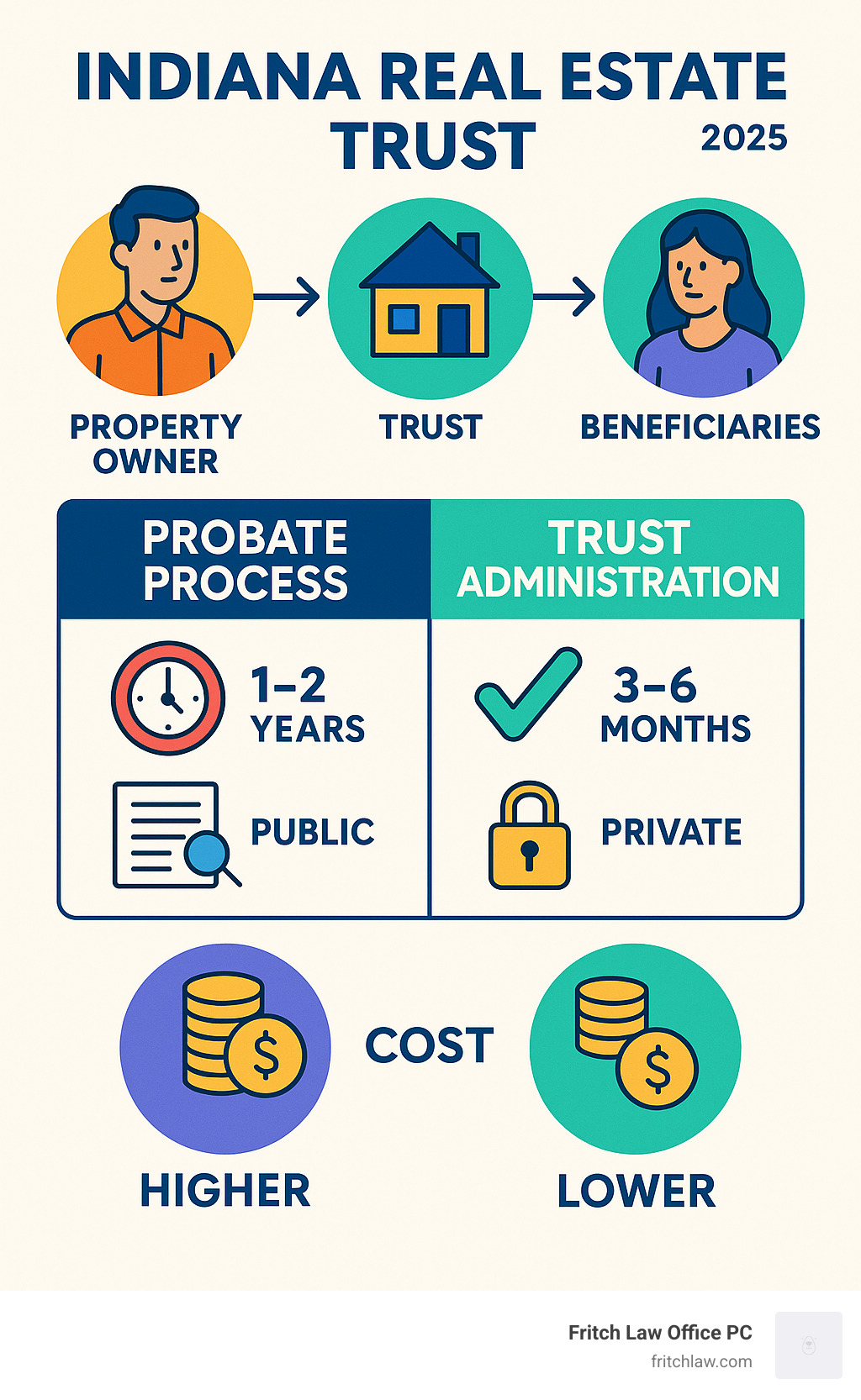
What is an Indiana Real Estate Trust? The Core Concepts
An Indiana real estate trust is a legal arrangement that separates the legal ownership of your property from the beneficial use. You transfer your real estate to a trustee, who manages it for your chosen beneficiaries according to the rules you set in the trust agreement. The trust itself becomes the legal owner.
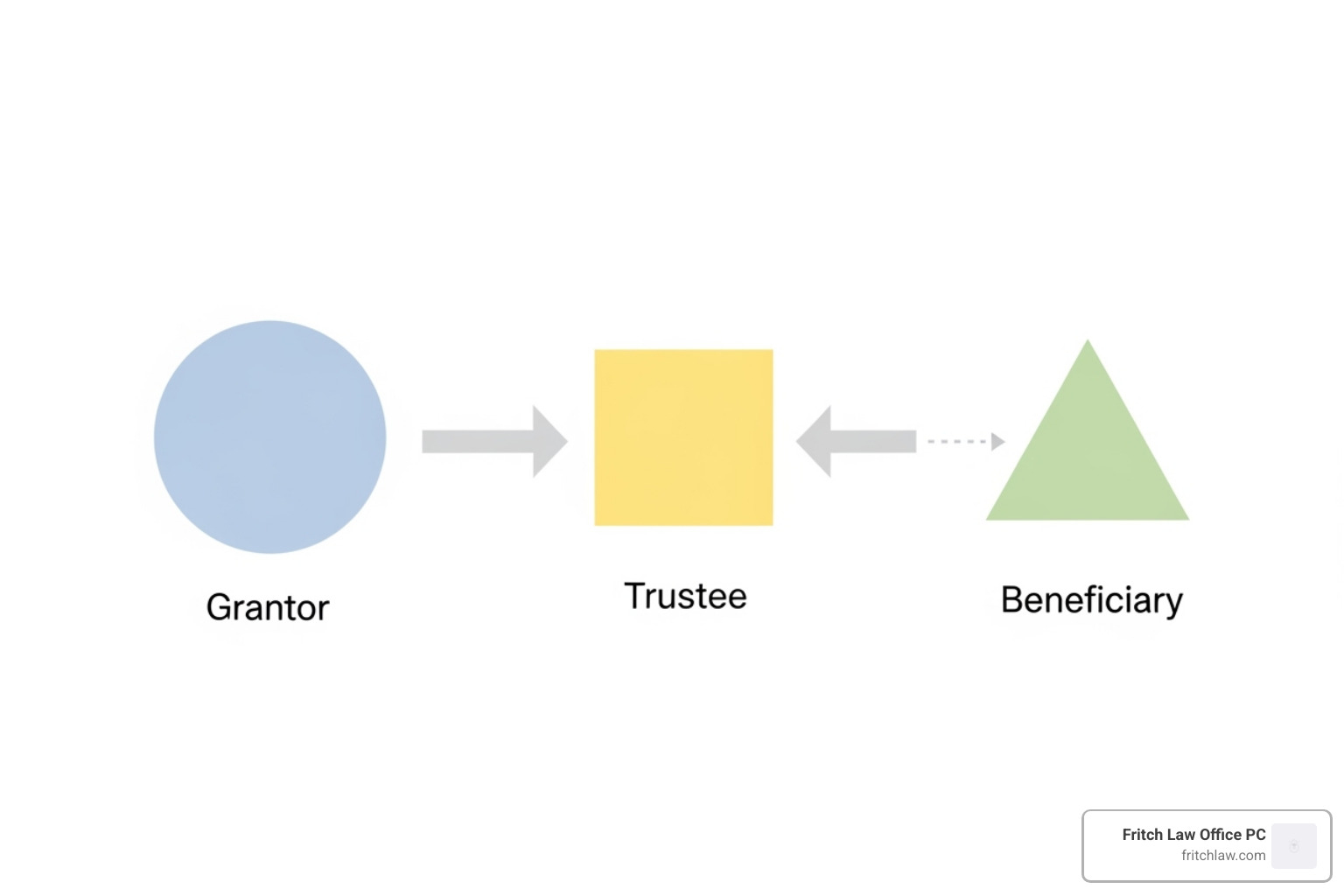
The grantor (you) creates the trust and sets the rules. You also name a trustee to manage the property; many people serve as their own initial trustee. A successor trustee takes over if you become incapacitated or pass away. The beneficiaries are the people who ultimately receive the property’s benefits.
When property is held in trust, the title changes from your name to the trust’s name, such as “The Smith Family Living Trust, dated January 15, 2024.” This change is what enables the trust’s benefits.
Understanding the Living Trust for Real Estate
A living trust is active as soon as you create it. It’s a popular type of Indiana real estate trust for three main reasons:
Probate avoidance is a top benefit. Property in a living trust bypasses Indiana’s probate court system, which can be lengthy and expensive. This allows beneficiaries to receive their inheritance quickly and privately.
Managing assets during incapacity provides peace of mind. If you become unable to handle your affairs, your successor trustee can immediately manage the trust property without court intervention.
Control over distribution offers flexibility. You can set conditions for when and how beneficiaries receive property, such as reaching a certain age or graduating from college. This protects beneficiaries who may not be ready for a large inheritance.
For comprehensive guidance on protecting your assets, explore our Estate Planning services.
What is a Land Trust in Indiana?
A land trust focuses exclusively on real estate and offers unique advantages.
Privacy and anonymity are the land trust’s key features. Only the trustee’s name appears on public records, keeping your identity as the owner private. This is valuable for investors and privacy-conscious owners.
Asset protection from liens is another benefit. A judgment against you personally generally cannot create a lien against property held in a properly structured land trust, shielding it from personal financial issues.
Ease of transfer simplifies transactions. Your beneficial interest in a land trust is considered personal property, not real estate. This means you can transfer ownership by simply assigning the beneficial interest, avoiding the need for new deeds. This concept of beneficial interest as personal property simplifies estate planning and transferring partial interests.
Understanding these trust concepts is part of mastering Real Estate Law in Indiana. The choice between a living trust and a land trust depends on your specific goals.
The Key Benefits of Using a Trust for Your Indiana Property
An Indiana real estate trust acts as a protective shield for your property, protecting it from court proceedings, public scrutiny, and creditors, while giving you control over its management and distribution. Placing your property in a trust is a strategic decision that can save your family money, time, and stress.

Bypassing the Indiana Probate Process
Probate is the court-supervised process of validating a will and distributing property. Indiana’s probate system can be challenging because the state has not adopted the Uniform Probate Code, leading to more complex and older rules. The process can take months or even years, during which the property is in legal limbo while legal fees and other costs accumulate.
An Indiana real estate trust is invaluable because property held within it bypasses probate entirely. Upon your death, your successor trustee can distribute the property according to your wishes without court involvement. This gives your beneficiaries quick and private access to their inheritance.
For more insight into avoiding probate, see our discussion of Indiana Non-Probate Claims Law.
Ensuring Privacy and Protecting Your Assets
When property passes through a will, the details become public record during probate. Trusts operate differently. The terms of your Indiana real estate trust remain private. The only public record is the deed showing the trust as the owner; the trust document itself is confidential.
This privacy extends to asset protection. With an irrevocable trust, assets transferred into it are generally shielded from your future creditors. The trust can also protect property from your beneficiaries’ potential legal or financial troubles, such as divorce or bankruptcy, ensuring your legacy remains intact.
Maintaining Control and Flexibility
A common misconception is that trusts mean losing control. With a revocable living trust, you retain full control.
You set all the rules, from how a vacation home is used to when a beneficiary receives their inheritance. You can set conditions based on age or life milestones.
The flexibility extends to property management. You can provide detailed instructions for maintaining, leasing, or selling property. If you become incapacitated, your successor trustee can immediately take over management without court proceedings, ensuring seamless continuity based on your wishes.
With a revocable trust, you’re never locked in. You can modify the trust, change beneficiaries, or dissolve it entirely as your life circumstances change.
Creating and Funding Your Indiana Real Estate Trust: A Step-by-Step Guide
Creating an Indiana real estate trust involves three main phases: designing the trust, drafting the legal documents, and funding it with your property.
Step 1: Designing Your Trust
This initial phase is a roadmap for your family’s unique situation and goals.
- Choosing your trust type: An individual trust may suit a single person, while a joint trust often works for married couples. Separate trusts might be better for blended families.
- Selecting a successor trustee: This person or institution will manage the trust if you cannot. Choose someone trustworthy and financially responsible.
- Naming your beneficiaries: Decide who will benefit from your real estate and name contingent beneficiaries as a backup.
- Deciding which properties to include: Determine which real estate assets, such as your primary home, rentals, or farm, should be owned by the trust.
An experienced Estate Planning Attorney Indiana can help ensure no important details are missed during this phase.
Step 2: Drafting and Executing the Document
Once the design is set, the official legal document is created according to Indiana law.
- The written agreement requirement: Indiana law requires trusts to be in writing; oral agreements are not valid. The document details the trustee’s powers and beneficiary distributions.
- Signing the document: Your signature as the grantor officially establishes the trust.
- Notarization provides extra protection: While not strictly required by Indiana law, notarization makes the trust harder to challenge later.
The legal framework for trust creation is outlined in Indiana Code § 30-4-2-1 on trust creation.
Step 3: Funding the Trust with Real Estate
This is the most critical step. A trust is ineffective if you don’t transfer your property into it.
- Changing the property title: This legal transfer moves the property from your personal ownership into the trust.
- Preparing and recording a new deed: A new deed, typically a quitclaim or warranty deed, is prepared to transfer the property title from your name to the trust’s name (e.g., “Jane Smith, Trustee of the Jane Smith Living Trust, dated [Date]”).
- The County Recorder’s Office: The new deed must be filed with the recorder in the county where the property is located to make the transfer official.
Proper funding is absolutely essential. An unfunded trust will not avoid probate. An Indiana Property Law Attorney can ensure this process is handled correctly.
Cost Considerations for an Indiana Real Estate Trust
Setting up a trust involves an upfront investment.
- Attorney fees typically range from around $1,000 to several thousand dollars, depending on complexity. While DIY options exist, professional guidance offers greater legal protection.
- The long-term value versus upfront cost usually favors the trust. The cost of setting up a trust is often less than the potential probate fees, court costs, and delays your family might otherwise face. The peace of mind it provides is invaluable.
For a more detailed breakdown, explore How Much Does a Revocable Trust Cost.
Trusts vs. Other Estate Planning Tools in Indiana
While an Indiana real estate trust offers comprehensive protection, it’s useful to compare it to other estate planning tools like a traditional will. They serve different purposes, especially for real estate.
| Feature | Living Trust for Real Estate | Traditional Will |
|---|---|---|
| Probate | Avoids probate for assets held in trust, allowing for private, faster distribution. | Requires probate for all assets, leading to public, often lengthy, and costly court process. |
| Privacy | Remains a private document; details of assets and beneficiaries are confidential. | Becomes a public record once filed with the probate court. |
| Effectiveness | Effective immediately upon creation and funding; provides management during incapacity. | Only effective upon your death and after validation by the probate court. |
| Control | Provides ongoing management and control over assets during your lifetime and after death, with flexible distribution terms. | Primarily dictates asset distribution upon death; no management during incapacity. |
| Incapacity | Trustee can manage assets if you become incapacitated, avoiding guardianship. | Requires a separate power of attorney or court-appointed guardianship for asset management during incapacity. |
| Guardianship | Cannot name guardians for minor children. | Can name guardians for minor children. |
| Executor | No executor needed for trust assets; successor trustee handles administration. | Names an executor to manage your estate through probate. |
| Notarization | Generally requires notarization for validity. | Does not typically require notarization (witnesses are sufficient). |
| Asset Type | Holds various assets, including real estate, investments, bank accounts. | Directs distribution of all assets titled in your individual name. |
The key difference is that a will is only effective after death and probate, while a trust is active immediately, providing continuous protection.
Do I Still Need a Will if I Have a Trust?
Yes. A will is still a crucial part of your estate plan, even with a trust.
A will serves as a “pour-over” safety net, catching any assets you forgot to transfer into your trust and directing them there. This ensures all your assets follow your trust’s distribution rules.
Most importantly, naming guardians for minor children can only be done in a will. A trust cannot handle this vital function. Your will and trust work as a team: the trust manages assets, while the will covers gaps and names guardians. For help coordinating these documents, consult an Anderson Indiana Attorney for Wills, Trust, Estate Planning.
Are There Simpler Options to Avoid Probate in Indiana?
Indiana offers simpler alternatives to a trust for avoiding probate, but they have limitations.
- Transfer-on-Death Deeds (TODD): Under Ind. Code § 32-17-14-11, this deed automatically transfers property to a beneficiary upon your death, bypassing probate. However, it offers no management during incapacity or protection from beneficiaries’ creditors.
- Joint tenancy with right of survivorship: Property owned this way automatically passes to the surviving owner. However, it exposes your property to the other owner’s debts and legal issues.
- Small Estate Affidavit: This can simplify probate for estates with personal property under $100,000. Most real estate values exceed this threshold.
These options can work in simple situations, but a trust offers more comprehensive protection, flexibility, and control for most families with significant real estate.
Frequently Asked Questions about Indiana Real Estate Trusts
Here are answers to common questions about setting up an Indiana real estate trust.
Can an Indiana real estate trust reduce estate taxes?
For most families, estate taxes are not a concern. Indiana has no state estate tax, as it was repealed in 2013.
The federal estate tax only affects very wealthy individuals. The 2024 exemption is $13.61 million per person (over $27 million for a married couple). While these exemptions may decrease after 2026, they will likely remain high. For estates that might exceed these limits, specialized tools like AB (Bypass) trusts can be used.
For most Indiana property owners, the primary benefits of a trust are probate avoidance and asset protection, not tax savings.
Who legally owns the property in a trust?
The trust itself becomes the legal owner of the property. The deed is changed from your personal name to the trust’s name.
As the trustee, you continue to manage the property as you did before. Your beneficiaries hold an “equitable interest,” meaning they have the right to benefit from the property as you’ve instructed. If you create a revocable living trust, you retain complete control and can change the trust or take the property back at any time.
How long does a trust last in Indiana?
The duration of an Indiana real estate trust depends on your goals. You can set it to end on a specific date or when a certain event occurs, such as a beneficiary reaching a specific age.
Indiana law is flexible, following a modern Rule Against Perpetuities that allows trusts to last for up to 360 years in some cases. This makes the state suitable for dynasty trusts, which are designed to preserve wealth for multiple generations by protecting assets from creditors and taxes. However, most family trusts distribute their assets much sooner, often within a few years of the grantor’s death. The key is to design a trust that matches your family’s specific needs.
Conclusion: Securing Your Legacy with the Right Plan

Your real estate is a key part of your legacy. An Indiana real estate trust is a powerful tool to protect and transfer these assets according to your wishes.
We’ve covered the key benefits:
- Probate avoidance saves your family from Indiana’s lengthy court process.
- Privacy protection keeps your financial affairs out of the public record.
- Asset protection shields your property from unexpected creditors.
- Control and flexibility let you care for your loved ones on your terms.
Every family’s situation is unique, and a cookie-cutter solution won’t work. The design of your Indiana real estate trust must be personalized to your family’s circumstances and goals.
At Fritch Law Office PC in Jasper, we help Indiana families steer these important decisions. We understand the personal concerns behind every trust document. Our approach is to listen to your needs and craft solutions that provide legal protection and peace of mind. A trust is only effective if it is properly funded and reflects your true wishes, which is why we guide you through every step of the process.
If you’re ready to protect your Indiana real estate and secure your family’s future, we’re here to help. Let’s discuss how an Indiana real estate trust can serve your specific needs.
Contact an experienced irrevocable trust lawyer for guidance and let’s discuss how we can help you build a plan that truly protects what matters most to you.