Indiana special needs trust: Complete 2026 Guide
Fritch Law Office handles indiana special needs trust cases for Indiana residents every day. First, our attorneys examine your situation carefully. Next, we identify your strongest legal options. Furthermore, we explain every step in plain language. Therefore, you make confident decisions from day one.
Key Facts About Indiana special needs trust in Indiana
Indiana courts apply strict 2026 rules to indiana special needs trust matters. Moreover, experienced attorneys win better outcomes for clients. Additionally, early legal advice prevents costly mistakes. Consequently, clients who hire Fritch Law gain a clear advantage. However, waiting too long weakens your position significantly.
Take Action on Indiana special needs trust Today
Do not delay your indiana special needs trust case. First, call our Jasper office directly. Next, we schedule your free consultation immediately. Then, we build a winning strategy for you. Additionally, we represent you at every court hearing. Finally, we resolve your case as fast as possible.

Visit the Indiana Courts website for official legal information. Contact Fritch Law for your free consultation today.
Navigating Indiana Special Needs Trusts: Your Essential Guide
An Indiana special needs trust is a legal tool that protects the financial future of individuals with disabilities without jeopardizing their government benefits. These trusts hold assets for the beneficiary to pay for supplemental needs not covered by programs like Medicaid and Supplemental Security Income (SSI), ensuring continued eligibility.
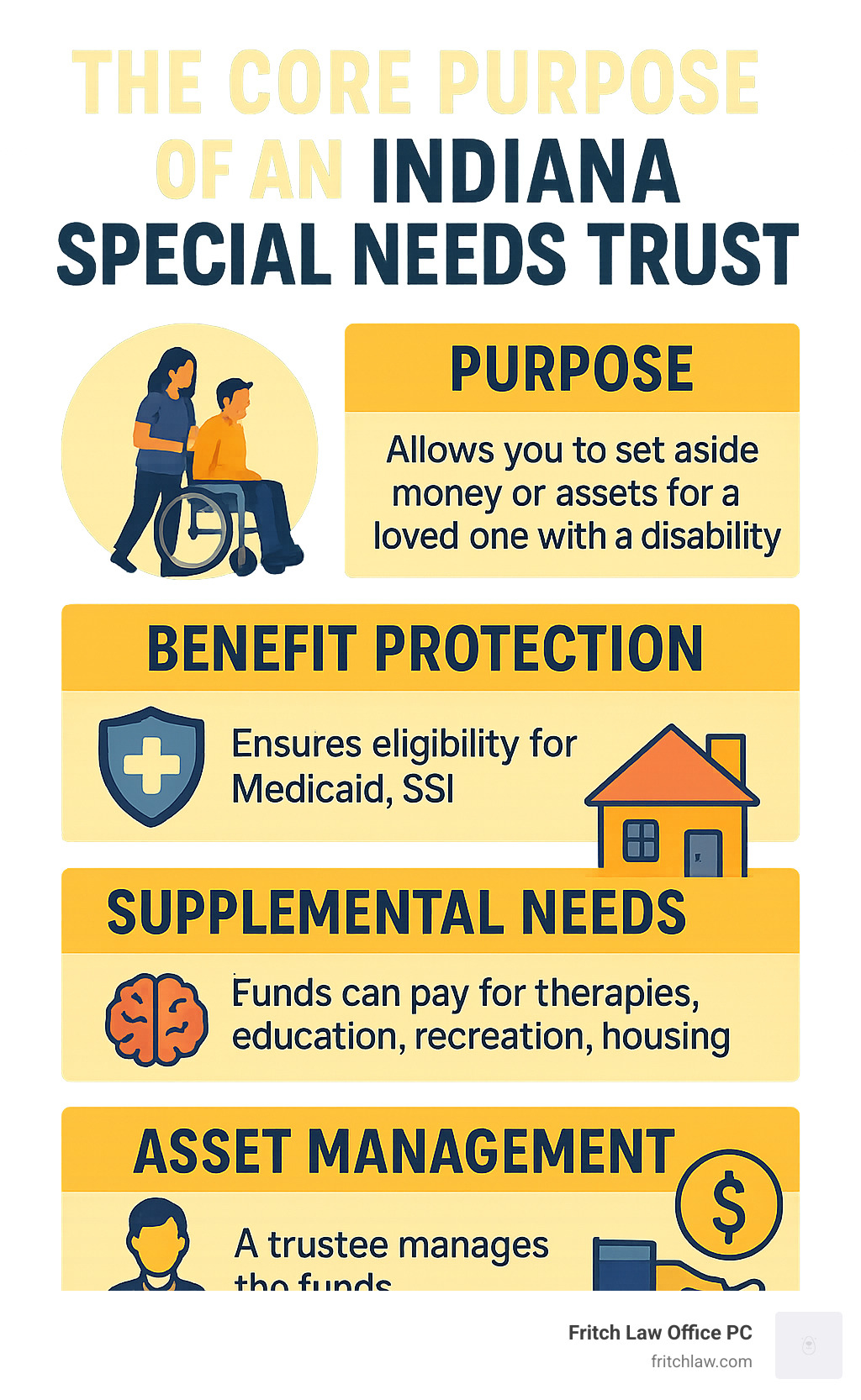
Here’s how an Indiana special needs trust works at a glance:
- Purpose: Allows you to set aside money or assets for a loved one with a disability.
- Benefit Protection: Ensures the beneficiary stays eligible for essential government programs like Medicaid and SSI.
- Supplemental Needs: Funds can pay for things that improve quality of life, like special therapies, education, recreation, or comfortable housing.
- Asset Management: A designated trustee manages the funds responsibly according to the trust’s rules.
Planning for a loved one with special needs can feel overwhelming, but understanding these trusts is a crucial first step. It helps ensure they receive both necessary government support and additional financial resources for a better life.
With 40 years of experience, David P. Fritch helps clients steer complex financial and legal matters, including the intricacies of an Indiana special needs trust. His background as a CPA and former Registered Investment Advisor offers a unique perspective on managing assets and ensuring long-term financial security for families.
Indiana special needs trust terms simplified:
- irrevocable trust indiana
- estate planning indiana
- estate planning and probate attorney indiana indianapolis
Understanding the Basics of a Special Needs Trust

An Indiana special needs trust is a valuable legal tool that provides financial support for a person with a disability while protecting their eligibility for government benefits like Medicaid and Supplemental Security Income (SSI). It improves their life by covering “supplemental needs” without disrupting essential aid.
What is a Special Needs Trust?
A special needs trust (SNT) is a legal arrangement that holds assets for a person with a disability. Instead of giving assets directly to the individual—which could disqualify them from benefits due to asset limits—the trust owns and manages the resources. Since the beneficiary doesn’t technically own the assets, they remain eligible for vital government assistance.
The main purpose is to pay for things the beneficiary needs that government programs don’t cover, improving their overall well-being. It provides access to “extras” that make life more comfortable and fulfilling. The person who sets up and funds the trust is the grantor, the one who manages it is the trustee, and the person who benefits is the beneficiary. For more information on how trusts fit into broader family planning, you might find our insights on a Family Trust Attorney helpful.
Who Can Be a Beneficiary?
The person who benefits from an Indiana special needs trust must have a disability, as generally defined by the Social Security Administration (SSA). This includes people with physical, mental, or chronic health issues that limit their ability to work or care for themselves. There is no age limit for the beneficiary to receive funds from a special needs trust, so it can be for a child, adult, or senior. However, specific age rules apply when setting up certain types of these trusts. To understand more about what the SSA considers a disability, you can refer to the SSA-recognized disabilities guidelines.
What Expenses Can a Special Needs Trust Cover?
The funds in an Indiana special needs trust are for “supplemental needs”—expenses that government benefits like SSI and Medicaid typically do not cover. The trust is generally not meant to pay for basic food and shelter, as government benefits usually cover those.
Here’s a list of common expenses a special needs trust can cover to improve quality of life without risking benefit eligibility:
- Medical and Dental Care: Costs for treatments, therapies, or dental work not fully covered by Medicaid.
- Education and Vocational Training: Expenses for specialized schooling, tutoring, or job training.
- Recreation and Entertainment: Funding for hobbies, vacations, concerts, or other leisure activities.
- Transportation: Costs for accessible vehicles, public transit, or private transportation services.
- Personal Care and Companionship: Payments for caregivers, companions, or personal assistants.
- Home Modifications: Expenses for accessibility renovations or assistive technology.
- Housing-Related Costs: The trust can help with property taxes, utilities, or home maintenance.
- Personal Needs: Items like clothing, electronics, furniture, and other things that improve daily living.
- Legal and Accounting Fees: Costs related to managing the trust itself.
The goal is to provide a fuller, more independent life by ensuring access to resources that enrich well-being, going beyond basic survival needs.
First-Party, Third-Party, and Pooled Trusts: What’s the Difference?

When learning about an Indiana special needs trust, families find there are multiple types. Each serves a similar purpose but works differently depending on the funding source and applicable rules. The three main types are third-party, first-party, and pooled trusts. Understanding their different rules for funding, payback provisions, and what happens to remaining funds is crucial.
Third-Party Special Needs Trusts
A third-party special needs trust is what most people consider when leaving money for a loved one with disabilities. The term “third-party” means the funds come from someone other than the beneficiary, such as parents or grandparents.
Because the beneficiary never owned the assets, there’s no Medicaid payback requirement. When the beneficiary passes away, any remaining money can go to other family members or charities you choose. You can set up a third-party trust during your lifetime or through a will, offering flexibility in estate planning. For families considering this approach, working with an Irrevocable Trust Lawyer can help ensure it’s structured correctly.
First-Party (Self-Settled) Special Needs Trusts
First-party trusts are funded with the beneficiary’s own money, such as from a personal injury settlement, direct inheritance, or other assets that would otherwise make them ineligible for government benefits.
These trusts have stricter rules: the trust must be established before the beneficiary turns 65 and must be irrevocable. The biggest difference is the Medicaid payback provision. When the beneficiary dies, the state is reimbursed for Medicaid benefits they received before any remaining funds can go to other heirs. While this payback is a drawback, these trusts are often the only way to protect a large settlement or inheritance while keeping benefits.
Pooled Special Needs Trusts: A Collaborative Approach
Pooled trusts offer professional management, often at a lower cost than private trustees. They are managed by non-profit organizations that pool funds for investment while keeping separate sub-accounts for each beneficiary.
The Arc of Indiana Master Trust, one of the first pooled trusts in the country, has served families since 1988. They handle both third-party and first-party situations, managing disbursements, investments, and compliance. This option is ideal for families with smaller sums of money or those without a suitable family member to serve as trustee. You can learn more at The Arc Master Trust.
For first-party pooled trust accounts, the beneficiary must be under 65 when joining, and a Medicaid payback is required upon death.
Key Differences at a Glance
| Feature | Third-Party Trust | First-Party Trust | Pooled Trust |
|---|---|---|---|
| Funding Source | Money from family or others | Beneficiary’s own assets | Either source, depending on sub-account type |
| Medicaid Payback | Not required | Required upon death | Required for first-party sub-accounts |
| Age Limit | None | Must establish before age 65 | Must join before age 65 (first-party) |
| Who Sets It Up | Family members | Beneficiary, family, or court | Non-profit organization manages it |
| Remainder Beneficiaries | Family chooses who gets leftover funds | Medicaid gets paid back first | Depends on sub-account type |
Choosing the right Indiana special needs trust depends on your family’s situation, the funding source, and your long-term goals.
Key Considerations When Creating an Indiana Special Needs Trust

Creating an Indiana special needs trust involves important decisions that shape your loved one’s financial future. While the choices may seem overwhelming, breaking them down makes the process clearer. It’s like building a safety net where every part must be strong.
Funding the Trust and Asset Types
How to fund the trust is a key consideration. You can make a lump sum contribution, ongoing contributions, or a combination. Many families start with a modest amount and add to it over time through gifts, inheritance, or life insurance proceeds.
An Indiana special needs trust can hold various assets. Cash is the most straightforward, but other assets like real estate, investments (stocks, bonds), and life insurance policies are also common. Naming the trust as a beneficiary of a life insurance policy can provide a substantial resource. Recent federal law changes have also made it easier to use retirement benefits like an IRA or 401(k) to fund these trusts.
Appointing the Right Trustee
Choosing a trustee is one of the most critical decisions. The trustee has a fiduciary duty to act in the beneficiary’s best interests, manage funds responsibly, and steer complex rules to protect government benefits.
A family member knows the beneficiary well but may lack the financial knowledge or time required. A corporate trustee or financial institution offers professional experience and objectivity but may have higher fees and less personal connection. For more on trustee duties, Investopedia’s guide on the role of a trustee is a useful resource. A well-structured trust can sometimes eliminate the need for other legal arrangements, which we discuss in our Guardianship resources.
The Role of an Estate Planning Attorney
Creating an Indiana special needs trust without experienced legal guidance is risky. The rules are incredibly complex, with federal and state laws intersecting in ways that can easily trip up families. A mistake could cause more harm than good.
An attorney ensures the trust document is drafted with precise language to protect benefits and provide flexibility. They help steer state and federal laws, ensuring compliance with Social Security, Medicaid, and Indiana-specific rules. An experienced lawyer customizes the trust to your family’s unique goals, needs, and financial situation.
At Fritch Law Office PC, we work with you to create a trust that provides security and peace of mind. For more information, visit our Special Needs Trust Attorney page.
Special Needs Trust vs. Miller Trust: Knowing the Difference
When planning for Medicaid, it’s easy to confuse the available trusts. Both an Indiana special needs trust and a Miller Trust (Qualified Income Trust) can help with Medicaid qualification, but they address different financial issues. A special needs trust handles assets, while a Miller Trust manages income. Understanding this difference is key for your Medicaid planning strategy with the Indiana Family and Social Services Administration (FSSA).
Purpose of a Special Needs Trust
An Indiana special needs trust manages a beneficiary’s assets or resources, like savings, investments, or real estate. If a person with a disability owns these assets directly, they may exceed the strict asset limits for programs like SSI and Medicaid. The trust holds these assets outside the beneficiary’s direct ownership, so they don’t count against eligibility limits. The funds are available to pay for supplemental needs that improve the person’s quality of life, serving as a financial safety net for long-term improvements.
Purpose of a Miller Trust (Qualified Income Trust)
A Miller Trust deals with income, not assets. It’s for individuals whose monthly income is too high to qualify for Medicaid, especially for nursing home care or HCBS waivers (Home and Community-Based Services). Medicaid has a monthly income ceiling known as the Special Income Level (SIL). A Miller Trust acts as a financial funnel; excess income is deposited into the trust each month, bringing the person’s “countable income” below the SIL. This allows them to qualify for Medicaid. The funds are used for specific expenses like care costs with little flexibility. For current requirements, check the Indiana FSSA on Miller Trusts website.
The bottom line: if assets are the issue, you likely need a special needs trust. If income is the problem, a Miller Trust may be the solution. Sometimes, both are needed.
Frequently Asked Questions about Indiana Special Needs Trusts
Planning for a loved one with special needs raises many questions. Based on our experience helping Indiana families, certain concerns appear frequently. Here are answers to common questions about Indiana special needs trusts.
What happens to the money in the trust when the beneficiary dies?
This is a common question, and the answer depends entirely on the type of trust. The details are critical.
With a third-party special needs trust (funded with your money), there is no Medicaid payback. You can designate who receives leftover funds, such as other children or a charity. This keeps your legacy in the family.
With a first-party special needs trust (funded with the beneficiary’s money), a “payback provision” is required. When the beneficiary dies, Indiana’s Medicaid program is reimbursed for care costs before any remaining funds go to other heirs.
Pooled special needs trusts follow similar rules. First-party sub-accounts require a Medicaid payback.
How does a special needs trust affect Medicaid Estate Recovery?
Medicaid Estate Recovery is how Indiana recovers money spent on Medicaid services from a person’s estate after death.
Third-party special needs trusts are generally protected from this. Since the beneficiary never owned the assets, they aren’t part of their estate. This is a major advantage of third-party trusts.
First-party special needs trusts and Miller trusts are subject to Medicaid Estate Recovery because they contain the beneficiary’s own assets or income. The state will seek reimbursement from these trusts first.
Can I set up a special needs trust without a lawyer?
We understand that legal fees can be a concern. However, creating an Indiana special needs trust without professional help is extremely risky. The laws are complex, and mistakes can be costly, potentially disqualifying your loved one from essential benefits.
We’ve seen families use online forms only to find their trust was invalid. The cost of fixing these problems far exceeds the initial investment in proper legal guidance. Every family’s situation is unique and requires a customized approach, not a cookie-cutter solution.
We believe in transparency about costs, which is why we provide clear information about Estate Planning Attorney Fees. Consider it an investment in your family’s security.
Secure Your Loved One’s Future with Confidence
Planning for the long-term well-being of a loved one with a disability can be emotional and feel like a huge responsibility. Navigating complex legal and financial rules may seem overwhelming, but it doesn’t have to be. With the right guidance, you can create a plan that provides security and peace of mind.
An Indiana special needs trust is a powerful way to ensure your loved one receives vital government benefits and additional financial support to enrich their life. It builds a bridge between essential aid and an improved quality of life.
Choosing the right type of trust and setting it up correctly is key to protecting assets and eligibility. An experienced legal partner makes all the difference. You don’t have to go it alone. For personalized guidance on creating an Indiana special needs trust that fits your family’s unique situation, the team at Fritch Law Office PC is here to help you steer the process with confidence.
Start your Estate Planning journey today