How much are trusts: Complete 2026 Guide
Fritch Law Office handles how much are trusts cases for Indiana residents every day. First, our attorneys examine your situation carefully. Next, we identify your strongest legal options. Furthermore, we explain every step in plain language. Therefore, you make confident decisions from day one.
Key Facts About How much are trusts in Indiana
Indiana courts apply strict 2026 rules to how much are trusts matters. Moreover, experienced attorneys win better outcomes for clients. Additionally, early legal advice prevents costly mistakes. Consequently, clients who hire Fritch Law gain a clear advantage. However, waiting too long weakens your position significantly.
Take Action on How much are trusts Today
Do not delay your how much are trusts case. First, call our Jasper office directly. Next, we schedule your free consultation immediately. Then, we build a winning strategy for you. Additionally, we represent you at every court hearing. Finally, we resolve your case as fast as possible.

Visit the Indiana Courts website for official legal information. Contact Fritch Law for your free consultation today.
Understanding the True Cost of Trust Setup
When asking how much are trusts, the answer varies significantly based on complexity, location, and who helps you set it up. A trust is a powerful estate planning tool, but it’s not a one-size-fits-all product. Understanding the potential costs is the first step in making an informed decision for your family’s future. Here’s what you can expect to pay:
Quick Cost Overview:
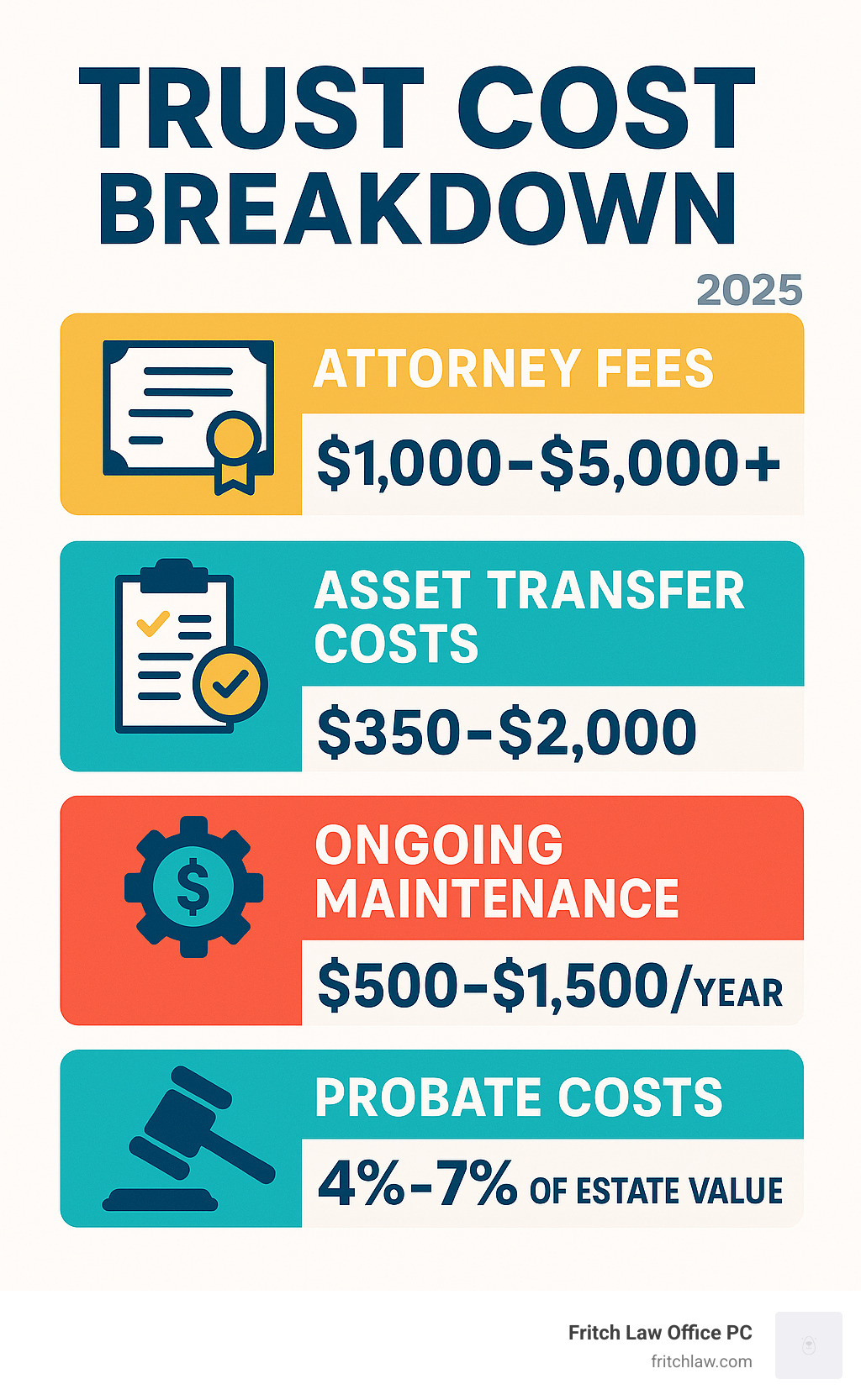
- Simple living trust: $1,000 – $2,500. This is typically a revocable trust designed primarily to help your estate avoid the time and expense of probate for straightforward assets.
- Complex trust: $2,500 – $5,000+. These trusts involve more sophisticated planning, such as for blended families, business succession, asset protection, or special needs beneficiaries.
- High-net-worth estates: $5,000 – $25,000+. These plans often incorporate advanced strategies to minimize estate taxes, protect assets for multiple generations (dynasty trusts), or facilitate charitable giving.
- DIY options: $250 – $1,000. While seemingly cheaper, these template-based solutions carry a high risk of errors that can cost your family far more in the long run.
- Ongoing maintenance: $500 – $1,500 annually. This can include fees for a corporate trustee, costs for tax return preparation, or fees for periodic reviews and amendments with your attorney.
The wide range in trust costs reflects the many variables involved. Attorney fees typically range from $200 to $500 per hour, while flat-fee arrangements can provide more predictable pricing for standard estate plans.
Beyond the initial setup, you’ll face additional costs for transferring assets into the trust (a process called “funding”), ongoing administration, and potential amendments as your life circumstances change. However, these expenses often pale in comparison to the costs of probate. The probate process can easily consume 4-7% of your estate’s total value. For a $750,000 estate, that could mean $30,000 to $52,500 in fees and court costs, an amount that dwarfs the initial investment in a trust.
I’m David Fritch, and with 40 years of experience running my own law firm and CPA practice, I’ve guided countless clients through understanding how much are trusts and whether they’re worth the investment. My background in tax, estate planning, and business ownership gives me a unique perspective on the true costs and benefits of creating a personalized and effective trust plan.
Easy how much are trusts word list:
Breaking Down the Bill: So, How Much Are Trusts?
When people ask “how much are trusts?” they’re usually thinking about a living trust—that powerful legal document that lets your assets skip the lengthy, public probate process and go straight to your loved ones. But the answer isn’t simple, because trust costs vary dramatically based on your unique situation, your assets, and your ultimate goals.
The price range might surprise you. A basic DIY trust kit could cost as little as $50, while a complex, tax-planning trust crafted by an experienced attorney might run $7,000 or more. For most families seeking to avoid probate and organize their affairs, a straightforward living trust prepared by a lawyer falls somewhere in the sweet spot of $1,000 to $2,500.
Three key factors drive these costs: the complexity of your estate, whether you need a flexible revocable trust or a protective irrevocable trust, and most importantly, how you choose to create it. Let’s break down your main options.
| Feature | Attorney-Prepared Trusts | Self-Prepared Trusts (DIY) |
|---|---|---|
| Cost | $1,000 – $5,000+ | $50 – $1,000 |
| Customization | Fully personalized to your family’s specific needs and state laws. | Template-based, with limited ability to handle unique situations. |
| Legal Support | Ongoing guidance, review, and support for funding and amendments. | None or minimal, leaving you to interpret complex legal concepts. |
| Risk | Professional oversight significantly reduces the risk of errors. | Higher risk of costly mistakes, improper funding, or invalid provisions. |
The table tells an important story. While DIY options look tempting on paper, the hidden costs of mistakes can be devastating. I’ve seen families spend thousands in litigation and corrective legal fees to fix trust errors that could have been avoided with proper legal guidance from the start.
Understanding the setup fees is crucial when budgeting for your trust. Attorney fees typically include the initial consultation, document preparation, a review and signing session, and initial funding guidance. The difference between how much does a revocable trust cost versus an irrevocable trust often surprises people—revocable trusts are generally less expensive because they’re more straightforward and primarily used for probate avoidance.
For a complete picture of trust expenses, it’s helpful to understand the average cost for a living trust in your area, as regional differences can significantly impact your final bill.
The Attorney Route: A Personalized Approach
Working with an attorney means getting a trust custom-built for your family’s specific needs and goals. Attorney fees typically range from $200 to $500 per hour, but many attorneys offer flat-fee packages that provide cost certainty upfront.
Flat fees versus hourly rates each have their advantages. Flat fees work well for straightforward estates, giving you a clear, predictable cost from day one. This package usually includes the trust itself, pour-over wills, powers of attorney, and healthcare directives. Hourly billing makes more sense for highly complex situations where the scope of work isn’t immediately clear, such as those involving contentious family dynamics or difficult-to-value assets.
Complex estates—those involving multiple properties, business interests, blended families, or beneficiaries with special needs—require careful legal crafting. The additional cost reflects the time needed to address tax implications, asset protection strategies, and intricate beneficiary arrangements. For example, an attorney can structure a trust to protect a disabled child’s eligibility for government benefits or create a plan for the seamless succession of a family farm.
Perhaps most importantly, attorney-prepared trusts offer peace of mind. You’ll have a trusted advisor to call when questions arise, and you can rest assured that your documents comply with current Indiana laws. This ongoing relationship means that as your life changes—through marriage, the birth of grandchildren, or significant financial shifts—your attorney can help you amend your trust to reflect your new reality.
Understanding estate planning attorney fees helps you budget appropriately, while knowing the typical estate attorney cost ensures you’re getting fair pricing for valuable professional guidance.
Self-Prepared Trusts: Weighing the Pros and Cons
DIY templates and online trust services promise significant savings, with costs typically ranging from $50 to $1,000. The lower initial cost is undeniably attractive, especially for families watching their budget.
However, potential risks lurk beneath the surface. Generic templates can’t account for your state’s specific laws or your family’s unique circumstances. Common errors include failing to properly “fund” the trust by retitling assets, creating contradictory clauses, or using language that is invalid under state law. These mistakes can invalidate the trust entirely, forcing your estate into the very probate process you sought to avoid and potentially sparking family disputes.
Hidden fees often surprise DIY users. You might pay extra for state-specific versions, customer support, document updates, or the forms needed to transfer assets like real estate into the trust. Some services also charge ongoing subscription fees that weren’t clearly disclosed upfront.
Be particularly wary of “living trust mills”—high-pressure sales operations that often use scare tactics to sell overpriced, one-size-fits-all trust packages. These documents may not be legally sound or custom to your specific needs, and many state consumer protection agencies have issued warnings about their deceptive practices. See this warning about living trust mills.
The importance of legal review cannot be overstated. Even if you start with a DIY approach, having an experienced attorney review your documents before signing can catch potentially expensive errors and ensure the trust will function as you intend. When comparing trust costs, also consider how much does it cost to make a will as part of your overall estate planning budget.
How much are trusts for different levels of complexity?
Simple trust costs typically range from $1,000 to $2,500. This is ideal for a married couple with a primary residence in Indiana, a few bank accounts, retirement funds, and adult children as primary beneficiaries. Their main goal is simply to avoid probate and ensure a smooth transfer of assets. A standard revocable living trust is often a perfect fit.
Complex trust costs jump to $2,500 to $7,000 or more. Consider a business owner in a second marriage with children from a previous relationship. They own their business, a vacation property, and want to provide for their current spouse while ensuring their children inherit fairly. This requires a more complex trust, perhaps with special provisions (like a QTIP trust) and careful business succession planning. The cost reflects the sophisticated legal work required.
High-net-worth estates often require trusts costing $5,000 to $25,000 or more. For estates valued in the millions, the focus shifts to minimizing estate taxes and creating a lasting legacy. These sophisticated instruments might include Irrevocable Life Insurance Trusts (ILITs), dynasty trusts to benefit multiple generations, or charitable trusts. The legal strategy is highly specialized, justifying the higher cost.
Business ownership adds layers of complexity. Transferring business interests into a trust requires a deep dive into the company’s operating agreement, addressing buy-sell provisions, and ensuring a smooth leadership transition. An attorney must structure the trust to work in harmony with these existing business documents.
Multiple properties, especially if they are in different states, create additional challenges. Each state has different laws affecting real estate and trusts, so your plan must be coordinated to work seamlessly across state lines. This requires more attorney time and specialized knowledge.
Working with an experienced family trust attorney ensures your trust is not just a document, but a comprehensive plan that matches your family’s specific needs, regardless of complexity level.