Living trust indiana: Complete 2026 Guide
Fritch Law Office handles living trust indiana cases for Indiana residents every day. First, our attorneys examine your situation carefully. Next, we identify your strongest legal options. Furthermore, we explain every step in plain language. Therefore, you make confident decisions from day one.
Key Facts About Living trust indiana in Indiana
Indiana courts apply strict 2026 rules to living trust indiana matters. Moreover, experienced attorneys win better outcomes for clients. Additionally, early legal advice prevents costly mistakes. Consequently, clients who hire Fritch Law gain a clear advantage. However, waiting too long weakens your position significantly.
Take Action on Living trust indiana Today
Do not delay your living trust indiana case. First, call our Jasper office directly. Next, we schedule your free consultation immediately. Then, we build a winning strategy for you. Additionally, we represent you at every court hearing. Finally, we resolve your case as fast as possible.

Visit the Indiana Courts website for official legal information. Contact Fritch Law for your free consultation today.
What You Need to Know About Living Trusts in Indiana
Living trust Indiana residents create is a legal arrangement where you transfer your assets into a trust during your lifetime, allowing you to maintain control while avoiding probate after death. Here’s what makes them valuable for Indiana estate planning:
Key Benefits:
- Avoid probate – Assets transfer directly to beneficiaries without court involvement
- Maintain privacy – Trust details remain confidential, unlike wills which become public record
- Protect against incapacity – Successor trustee manages assets if you become unable to do so
- Control distribution – Specify exactly how and when beneficiaries receive assets
Basic Structure:
- Settlor – You (the person creating the trust)
- Trustee – Initially you, then your chosen successor
- Beneficiaries – People who receive trust assets
In Indiana, you can create either a revocable trust (changeable during your lifetime) or an irrevocable trust (permanent once signed). Most people choose revocable trusts because they offer flexibility while providing the main benefits of avoiding probate and maintaining control over assets.
Indiana’s probate process can be complex since the state doesn’t follow the Uniform Probate Code. While simplified probate exists for estates under $50,000, most homeowners exceed this threshold, making living trusts particularly valuable for avoiding lengthy court proceedings.
About the Author
I’m David Fritch, and I’ve spent 40 years helping Indiana families steer estate planning through my practice at Fritch Law Office PC, including creating countless living trust Indiana documents for clients seeking to protect their legacies. My experience as both an attorney and CPA gives me unique insight into the tax and legal implications of trust planning, ensuring your estate plan works effectively for your specific situation.
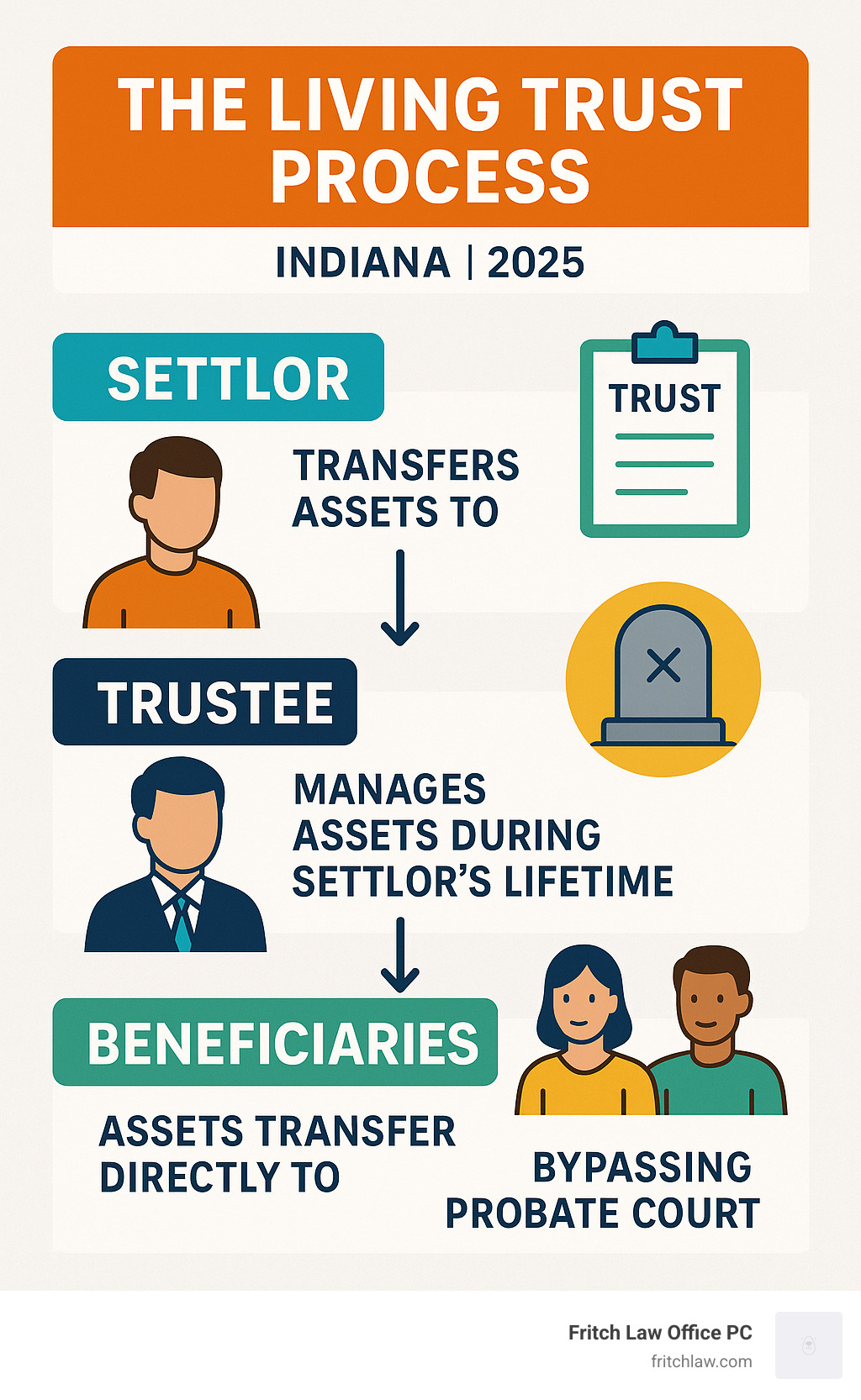
Living trust indiana terms made easy:
The Core Benefits of an Indiana Living Trust
Picture this: you’ve worked hard your entire life, building assets and creating a legacy for your family. Now imagine being able to pass that legacy along smoothly, privately, and without the headaches that often come with traditional estate planning. That’s exactly what a living trust Indiana residents create can accomplish.
Here’s something that might surprise you: only about 20% of Americans currently have a living trust. But those who do often find it’s one of the smartest financial decisions they’ve ever made. Why? Because a well-crafted trust tackles some of the biggest concerns people have about estate planning head-on.
The beauty of a living trust lies in how it addresses multiple challenges at once. Avoiding probate means your family won’t be stuck waiting months or years for asset distribution. Privacy protection keeps your family’s financial details out of public records. Incapacity protection ensures someone you trust can step in immediately if you’re unable to manage your affairs. Plus, you maintain complete control over asset distribution, deciding exactly how and when your beneficiaries receive their inheritance.
Let’s explore why these benefits matter so much, especially here in Indiana.

Why Avoiding Probate in Indiana is a Major Advantage
Let’s be honest – nobody wakes up excited about the prospect of probate court. It’s one of those necessary legal processes that can turn what should be a time of healing into months of paperwork, court appearances, and waiting.
Indiana’s probate system presents some unique challenges. Unlike many states, Indiana doesn’t fully accept the Uniform Probate Code, which means the probate court process can be more complex and time-consuming than you might expect. Everything becomes public record, so your family’s private financial matters end up available for anyone to see.
The time delays can be particularly frustrating. While your loved ones are grieving and potentially facing immediate financial needs, assets remain tied up in court proceedings. Legal fees pile up as attorneys steer the system, eating into the inheritance you intended to leave behind.
Now, Indiana does offer some relief through simplified procedures. There’s a small estate affidavit process available when the estate’s value stays under the $100,000 limit, and an even simpler process for estates under $50,000. You can find the specific details in Indiana’s small estate affidavit law.
But here’s the reality: if you own a home in today’s market, along with retirement accounts, vehicles, and personal belongings, you’ll likely exceed these thresholds. That’s where a living trust Indiana families rely on becomes invaluable – it allows your successor trustee to distribute assets almost immediately, bypassing the entire probate process.
How a Trust Protects You During Incapacitation
Life has a way of throwing curveballs when we least expect them. One day you’re managing your finances perfectly fine, and the next day an illness or accident leaves you unable to make important decisions. Without proper planning, your family faces a difficult situation.
Avoiding conservatorship is one of the most overlooked benefits of a living trust. Without a trust in place, your loved ones might need to petition the court to appoint someone to manage your financial affairs. This conservatorship process involves court hearings, legal fees, and ongoing court supervision – all while your family is already dealing with your health crisis.
The alternative is much more peaceful. With immediate asset management through your trust, your chosen successor trustee steps in seamlessly. No court approval needed – they simply begin handling your financial responsibilities according to your written instructions.
Think about it: your successor trustee can pay your mortgage, manage your investments, cover medical expenses, and handle all the day-to-day managing of financial affairs that keep your life running smoothly. They do this privately, efficiently, and exactly as you would have wanted – because you chose them and gave them clear guidance when you created your trust.
This protection isn’t just about the money; it’s about dignity and peace of mind for both you and your family during what’s already a challenging time.
Key Aspects of a Living Trust in Indiana
When you’re considering a living trust Indiana, it’s helpful to understand how it fits into your overall estate planning picture. Think of it as one powerful tool in your estate planning toolbox, but not the only one you’ll need.
The table below shows how a living trust compares to a traditional will – and you’ll notice they each have their own strengths:
| Feature | Will | Living Trust |
|---|---|---|
| Effective When? | After death | Upon creation (during lifetime) |
| Probate Required? | Yes (for assets in your name) | No (for assets properly funded into trust) |
| Privacy? | Public record (after probate) | Private |
| Incapacity Protection? | No | Yes |
| Asset Control? | No control after death | Control during life, then by successor trustee |
| Challenging? | Easier to contest | More difficult to contest |
| Guardianship for Minors? | Yes (can name guardian) | No (requires a will for guardianship) |
| Cost | Generally lower upfront | Generally higher upfront |
| Long-term Costs | Higher (probate fees) | Lower (avoids probate fees) |
The real magic of a living trust Indiana happens when you properly fund it and understand how it works alongside other estate planning documents. Let’s walk through these essential aspects together.
Funding Your Trust: What Assets to Include (and Exclude)
Here’s where many people get tripped up: creating a trust document is only the first step. If you don’t actually transfer your assets into the trust, it’s like buying a beautiful safe but leaving all your valuables scattered around your house. The trust can’t protect what it doesn’t hold.
Real estate is often the star player in trust funding. When you transfer your home’s deed into your trust, you’re setting up your family to avoid probate entirely for that property. This becomes even more valuable if you own property in multiple states – without a trust, your family could face probate proceedings in each state where you own real estate.
Bank accounts and investment accounts are also excellent candidates for trust funding. Your checking account, savings account, and brokerage accounts can all be retitled into your trust’s name. This means your successor trustee can access these funds immediately if you become incapacitated or pass away, without waiting for court approval.
Business interests deserve special attention. If you own a business or partnership interest, transferring these assets into your trust ensures smooth business continuity and helps avoid disruption during difficult times.
Personal property of significant value – think valuable art, jewelry, or collectibles – can be assigned to your trust through a general assignment document. You don’t need to list every coffee mug, but items with substantial financial or sentimental value benefit from trust protection.
Now, here’s where we need to pump the brakes: retirement accounts like 401(k)s and IRAs should generally stay out of your living trust during your lifetime. Why? Transferring these accounts into a trust can trigger immediate income taxes – ouch! These accounts already have beneficiary designations that allow them to bypass probate, so they’re covered without the tax headache.
Health Savings Accounts fall into the same category. They have their own tax-advantaged structure that you don’t want to mess with by transferring them into a trust.
Some vehicles might be better handled with transfer-on-death designations rather than trust transfers, depending on your specific situation and Indiana’s current rules.
The Process of Transferring Assets to Your Trust
Once you’ve decided what goes into your trust, the actual transfer process varies by asset type. It’s a bit like moving houses – every type of possession requires a different packing and moving strategy.
For real estate, we prepare new deeds that transfer ownership from you as an individual to you as trustee of your trust. So instead of “Sarah Johnson” owning your home, it becomes “Sarah Johnson, Trustee of the Sarah Johnson Living Trust.” These deeds must be properly signed and recorded at your county recorder’s office.
Financial accounts require coordination with your banks and investment companies. Each institution has its own forms and procedures for retitling accounts into trust names. The good news is that most major financial institutions are very familiar with this process.
Personal property without formal titles gets transferred through assignment documents that clearly state you’re moving ownership of specific items from yourself to your trust.
Life insurance policies can be funded into your trust by changing the beneficiary designation to name your trust instead of individuals. This gives you more control over how the insurance proceeds are managed and distributed.
The key is being thorough and precise. A partially funded trust is like a partially built bridge – it might look impressive, but it won’t get you where you need to go.
Do I Still Need a Will with a Living Trust in Indiana?
Absolutely! This might seem counterintuitive, but even with a comprehensive living trust Indiana, you still need a will. They work together like a well-coordinated team, each handling what they do best.
Your pour-over will acts as a safety net, catching any assets that didn’t make it into your trust. Maybe you bought a new car and forgot to update the beneficiary designation, or perhaps you inherited something after creating your trust. The pour-over will directs these “stray” assets into your trust, ensuring they’re distributed according to your trust’s terms.
More importantly, only a will can name guardians for minor children. If you have kids, this alone makes a will essential. Your living trust simply can’t handle this crucial responsibility – it’s a job only a will can do.
Your will also handles the disposition of small personal items that might not be worth formally transferring into your trust. Think of items with sentimental value but little financial worth – your will can direct who gets grandma’s recipe box or dad’s fishing tackle.
Indiana also offers another option worth considering: transfer-on-death deeds for real estate. This allows you to name a beneficiary who automatically inherits your property upon death, bypassing probate for that specific asset. You can learn more about this option through Indiana’s transfer-on-death deed law.
The bottom line? Your living trust and will aren’t competitors – they’re partners working together to ensure every aspect of your estate plan is covered completely and effectively.
Creating Your Trust: Process and Costs
Establishing a living trust Indiana is a significant step in securing your future, and while it might seem daunting at first, the process is more straightforward than many people imagine. Think of it like planning a family vacation – there are several steps involved, but with the right guidance, everything falls into place naturally.

The key to success lies in understanding what’s involved and working with someone who can walk you through each step. Let’s break down the process and talk honestly about the costs, so you know exactly what to expect.
Step-by-Step Guide to Establishing a Trust
Creating your living trust Indiana follows a logical sequence that builds upon itself. We start by getting to know you and your family situation during an initial consultation. This isn’t just about paperwork – it’s about understanding your hopes, concerns, and what you want to accomplish for your loved ones.
Choosing your successor trustee comes next, and this decision deserves careful thought. You’ll serve as your own trustee initially, maintaining complete control over your assets. But who will step into your shoes if you become unable to manage things yourself, or after you’re gone? This person needs to be trustworthy, organized, and ideally someone who understands your values. We always recommend naming a backup successor trustee too, because life has a way of throwing curveballs.
Deciding on property to include involves reviewing everything you own with fresh eyes. We’ll walk through your assets together – your home, bank accounts, investments, and valuable personal property – determining what makes sense to transfer into the trust and what might be better handled differently.
The actual drafting of your trust document is where legal experience really matters. This isn’t a one-size-fits-all form from the internet. Your trust agreement is custom-written to reflect your specific wishes, family circumstances, and Indiana law requirements. Every provision serves a purpose, from how your successor trustee should manage investments to exactly when and how your children or grandchildren should receive their inheritance.
Signing before a notary public makes everything official. This step authenticates your signature and confirms that you’re creating the trust voluntarily and with full understanding of its terms. It’s a moment that many clients find surprisingly meaningful – the point where their estate plan becomes real.
Finally, funding the trust by transferring titles brings everything together. This is where we change ownership of your assets from your individual name to your name as trustee of your trust. Real estate deeds get updated, bank accounts get retitled, and investment accounts get transferred. Without this crucial step, even the most beautifully written trust document won’t accomplish its goals.
Understanding the Costs of a Living Trust in Indiana
Let’s talk money, because we know that’s on your mind. The cost of creating a living trust Indiana varies based on your specific situation, but it’s helpful to think of this as an investment rather than just an expense.
Attorney fees typically range from several hundred to a few thousand dollars, depending on how complex your estate is. A straightforward trust for a couple with a house, some retirement accounts, and basic assets will cost less than a trust designed for someone with multiple properties, business interests, or complicated family dynamics. The more moving parts your estate has, the more time and care goes into crafting the right solution.
Estate complexity plays a big role in determining costs. If you own rental properties in multiple states, have a family business, or want to set up specific distribution schedules for your beneficiaries, these elements require additional attention and expertise. But remember – complexity in your estate often means you have more to protect, making the investment even more worthwhile.
Here’s where the math gets interesting: the upfront cost versus long-term savings equation almost always favors the trust. Probate in Indiana can cost thousands of dollars in court fees, attorney fees, and administrative expenses – often far exceeding what you’d pay to create a trust. Plus, probate costs come out of your estate after you’re gone, reducing what your loved ones inherit. Trust costs are paid once, upfront, by you.
Think of it this way: you can pay a reasonable fee now to ensure your family avoids a potentially expensive, time-consuming legal process later. Most of our clients tell us that the peace of mind alone makes the investment worthwhile, knowing their affairs will be handled exactly as they intended without burdening their loved ones with unnecessary complications.
At Fritch Law Office PC, we believe in transparent pricing and will discuss costs upfront during your consultation. We want you to make an informed decision that’s right for your family’s situation and budget.
Tax Implications for Indiana Residents
When clients ask about creating a living trust Indiana, one of their first questions is usually about taxes. I understand the concern – nobody wants to accidentally trigger a huge tax bill! The good news is that for most Indiana families, the tax implications of a living trust are actually quite straightforward and favorable.
Let me share some reassuring news about Indiana’s tax landscape. Indiana does not impose its own estate tax, which means your estate won’t face a separate state tax when you pass away, regardless of its size. Even better, Indiana also eliminated its inheritance tax back in 2013. This means your children, grandchildren, or other beneficiaries won’t have to pay the state a penny when they inherit from you.
Now, you might be wondering about federal taxes. The federal government does impose an estate tax, but here’s the thing – it only kicks in for truly massive estates. For 2025, the federal estate tax exemption is $13.99 million per person. For married couples, this effectively doubles to nearly $28 million. Unless you’re in that rare category of ultra-wealthy individuals, federal estate taxes simply won’t be a concern for your family.
Here’s where things get interesting with your living trust Indiana and income taxes. During your lifetime, when you’re the trustee of your own revocable living trust, the IRS treats the trust as if it doesn’t exist for tax purposes. All the income from assets in your trust – whether it’s rental income from property, dividends from investments, or interest from bank accounts – gets reported on your regular personal tax return using your Social Security number.
This is actually a huge advantage because it means no extra tax paperwork and no separate tax filings for your trust. You’ll file your taxes exactly the same way you always have. The trust doesn’t need its own tax identification number, and you don’t need to worry about complex trust tax returns.
It’s worth noting that irrevocable trusts work differently. These separate legal entities typically require their own tax identification numbers and must file their own tax returns (Form 1041). But since most people choose revocable living trusts for their flexibility and control, this complexity usually doesn’t apply.
The real tax benefit of your living trust Indiana isn’t about avoiding taxes – it’s about avoiding the costs and delays of probate while keeping your tax situation beautifully simple. Your trust works behind the scenes to protect your family without creating tax headaches during your lifetime or after you’re gone.
At Fritch Law Office PC, we make sure you understand exactly how your trust will affect your taxes, both now and in the future. We want you to feel confident that your estate plan works smoothly with your overall financial picture, giving you one less thing to worry about.
Conclusion: Secure Your Legacy with Confidence
Planning for the future doesn’t have to feel overwhelming. When you understand what a living trust Indiana can do for you and your family, it becomes less about paperwork and more about peace of mind. Throughout this guide, we’ve walked through the many ways this powerful estate planning tool can protect what matters most to you.
The benefits we’ve discussed aren’t just legal concepts – they’re real advantages that make a genuine difference in people’s lives. Probate avoidance means your family won’t spend months or years waiting for courts to sort through your affairs. Privacy protection keeps your financial business out of public records where anyone can access it. Incapacity protection ensures someone you trust can step in immediately if you can’t manage your own affairs, without needing court approval. And perhaps most importantly, control over your legacy means your wishes are followed exactly as you intended.
Yes, setting up a living trust requires an upfront investment and some effort to get it right. But think about what you’re really buying: confidence that your family will be taken care of, your assets will go where you want them to go, and the people you love won’t have to steer complicated legal processes during difficult times.
The key to making any living trust Indiana work effectively lies in two critical elements: having it properly drafted to meet Indiana’s legal requirements and your specific needs, and ensuring it’s completely funded with all the right assets transferred into it. Skip either step, and you might not get the protection you’re counting on.
At Fritch Law Office PC here in Jasper, we’ve helped countless Indiana families create estate plans that actually work. We take the time to understand your unique situation, explain your options in plain English, and guide you through every step of the process. Our goal isn’t just to create documents – it’s to give you genuine peace of mind about your family’s future.
Your legacy is too important to leave to chance. Don’t wait until it’s too late to put proper protections in place for yourself and the people you care about most.
Get started with your estate plan today