Understanding the Basics of a Will Contest
Contesting a will Indiana means challenging the validity of a deceased person’s Last Will and Testament in probate court. If you suspect a will doesn’t reflect your loved one’s true wishes, you have legal options, but they involve strict deadlines and specific legal grounds.
Quick Answer for Contesting a Will in Indiana:
- Who can contest: Interested parties like heirs, beneficiaries, or creditors.
- When to file: Within 3 months after the will is admitted to probate.
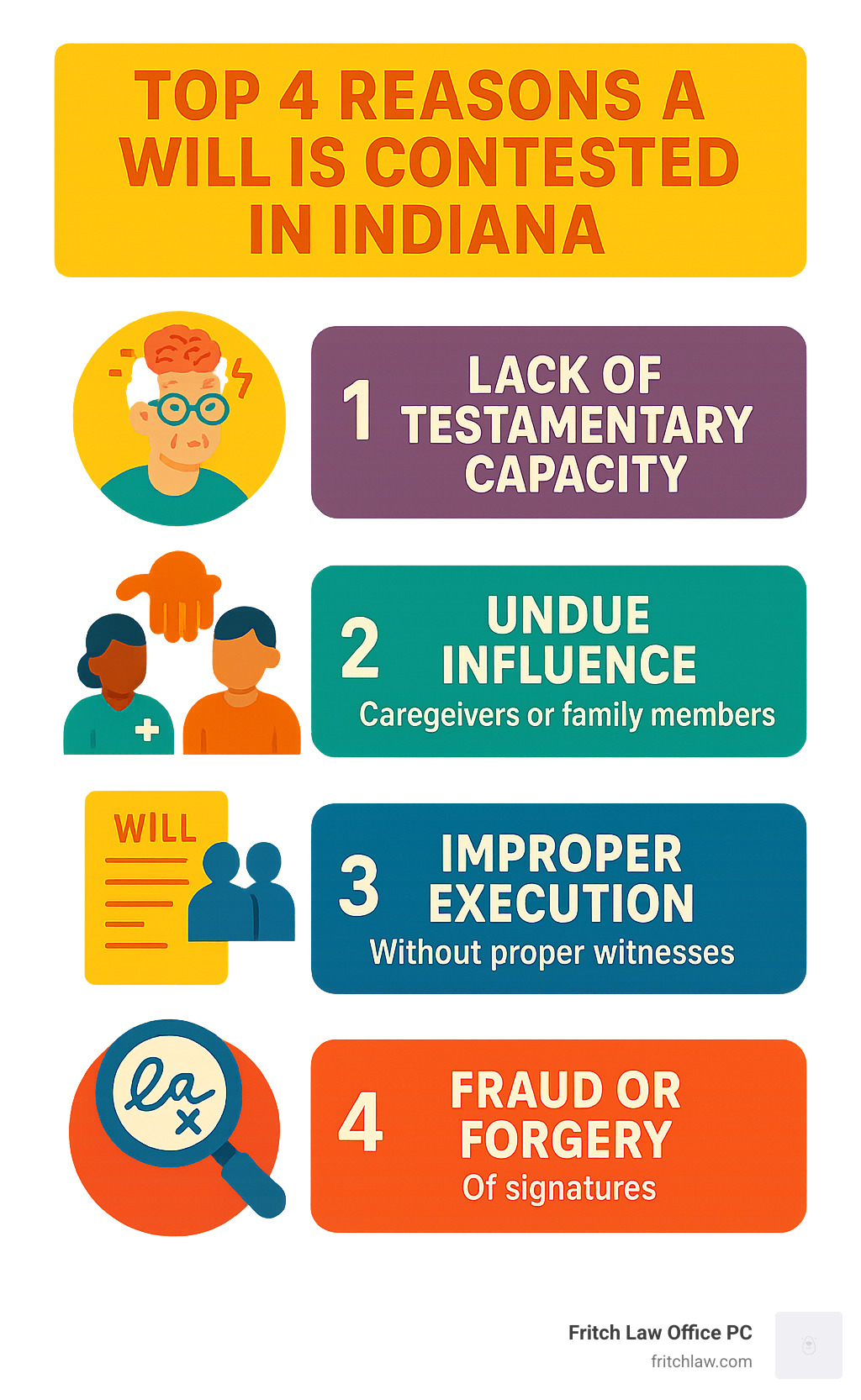
- Valid grounds: Lack of capacity, undue influence, improper execution, fraud, or duress.
- Process: File a petition, engage in findy, and proceed to trial or settlement.
- Outcomes: The will is either invalidated (reverting to a previous will or state law) or upheld.
Will contests are emotionally charged and legally complex, pausing the entire probate process while the court determines the will’s validity. A successful contest can completely change how an estate is distributed.
I’m David Fritch, an experienced lawyer at Fritch Law Office PC. For 40 years, I have helped families with complex legal matters, including estate planning and probate. I have guided many clients through the challenging process of contesting a will Indiana when they believed their loved one’s final wishes were not properly reflected.
Contesting a will Indiana basics:
What is a Will Contest?
A will contest is a formal legal challenge to a will’s validity. The focus isn’t on whether the will seems fair, but whether it is legally sound. When a will is contested, the probate court examines the circumstances of its creation. Until the court rules on its validity, the estate distribution process is halted.
Why Do Will Contests Happen?
Will contests often arise from a mix of grief, surprise, and a sense of injustice. A person might challenge a will due to suspicions of wrongdoing, such as manipulation or fraud, or if they were unexpectedly disinherited. Often, the person contesting the will believes they are fighting to uphold what their loved one truly intended, rather than what an invalid document states. It becomes a fight for justice, not just for an inheritance.
The First Problems: Standing and Deadlines in Indiana

Before contesting a will Indiana, you must clear two initial problems: proving you have the legal right to sue (standing) and filing your case within the state’s strict time limits. Missing either of these can end your case before it begins. These rules exist to prevent frivolous lawsuits and ensure that only those with a genuine financial stake can challenge a will.
Who Has the Legal Right (Standing) to Contest a Will?
In Indiana, you must be “an interested party” to contest a will, meaning you have a direct financial interest in the outcome. If the will were invalidated, you would stand to inherit more money or property. According to Indiana law on an interested party, this generally includes:
- Heirs at law: Individuals who would inherit under state law if no will existed (e.g., spouses, children).
- Beneficiaries in the current will: A person named in the will who might have received more in a previous, valid will.
- Beneficiaries from a previous will: Someone who was cut out or had their inheritance reduced by a newer, questionable will.
- Creditors of the estate: In some cases, those owed money by the estate can contest a will if it harms their ability to be repaid.
Are There Strict Time Limits for Contesting a Will in Indiana?
Yes, and they are strictly enforced. Missing a deadline will likely cause you to lose your right to challenge the will, regardless of how strong your case is.
The primary deadline is three months from the date the will is admitted to probate by the court. This is a firm deadline established by Indiana law on time limits.
There is also an earlier opportunity. You can file objections to probate before the will is formally accepted by the court. However, if you file these objections and the will is still offered for probate, you have only thirty days to file a formal action to resist it, per the objections to probate statute.
Acting quickly is critical. Due to these absolute deadlines, you should consult an experienced probate attorney as soon as you have concerns. For guidance on probate matters, see our probate law services Indiana page.
Valid Reasons: The Legal Grounds for Contesting a Will Indiana

Simply being unhappy with a will’s contents is not enough to challenge it. For contesting a will Indiana, you must prove a valid legal reason why the will itself is flawed. The court is not concerned with fairness, but with whether something went wrong during the will’s creation. You, as the challenger, have the burden of proof to convince the court with evidence.
Lack of Testamentary Capacity: Was the Testator of Sound Mind?
Testamentary capacity means the person making the will (the testator) was mentally capable of understanding their actions. To have capacity, the testator must have understood three things at the time of signing:
- The nature and extent of their property (what they owned).
- The natural objects of their bounty (who their close family members were).
- The effect of the will they were signing (how it would distribute their property).
Conditions like advanced Alzheimer’s or dementia can raise questions about capacity. Medical records, doctor’s notes, and testimony from healthcare providers are crucial evidence in these cases. For related issues, our guardianship services can provide guidance.
Undue Influence: Was the Testator Manipulated?
Undue influence occurs when a person is improperly pressured or manipulated into creating a will that reflects the manipulator’s wishes, not their own. Since the deceased cannot testify, courts look for red flags, including:
- A confidential or fiduciary relationship: A relationship of trust existed where one person had significant power over the other (e.g., a caregiver and an elderly person).
- Isolation of the testator: The influencer prevented the testator from seeing other family and friends.
- Suspicious circumstances: The will was changed suddenly and dramatically, especially near the time of death or when the testator was vulnerable.
Proving undue influence requires showing that the will was not the product of the testator’s free will.
Improper Execution: Did the Will Follow Indiana’s Rules?
Indiana has strict technical requirements for how a will must be signed and witnessed. If these rules are not followed precisely, the will can be invalidated. According to Indiana law on will requirements, a valid will must be:
- In writing.
- Signed by the testator (who must be at least 18 years old).
- Signed in the presence of two disinterested witnesses (who cannot be beneficiaries).
- Signed by both witnesses.
Failure to meet any of these requirements can be grounds for a successful will contest.
Fraud, Duress, or Forgery: Was There Deception or Coercion?
These grounds involve serious wrongdoing that invalidates a will:
- Fraud: The testator was tricked by lies or misrepresentation into signing the will or including certain provisions.
- Duress: The testator was forced to sign the will under threat of harm, whether physical, emotional, or financial.
- Forgery: The signature on the will is not the testator’s genuine signature.
Proving these claims requires strong evidence, such as witness testimony or document analysis. These complex cases highlight the importance of working with an experienced probate attorney when contesting a will Indiana.
The Will Contest Process and Potential Outcomes

After confirming you have standing and valid grounds, the formal process of contesting a will Indiana begins. This is a structured litigation process that, while often emotionally difficult, follows a clear path. Many cases are resolved through settlement, avoiding the cost and stress of a trial.
How to Start a Will Contest in Indiana: A Step-by-Step Overview
- File a Petition: The process starts by filing a formal petition in the probate court handling the estate. This document must state your specific legal grounds for the challenge. If you previously filed Objections to Probate, you have only 30 days to file this petition after the will is offered.
- Notify Interested Parties: All heirs, beneficiaries, and the executor must be formally served with notice of the contest.
- Findy: Both sides gather evidence. This involves exchanging written questions (interrogatories), requesting documents (like medical or financial records), and taking sworn testimony (depositions).
- Mediation and Settlement: Often, a neutral mediator helps the parties negotiate a settlement to resolve the dispute without a trial.
- Trial: If no settlement is reached, the case goes to trial. A judge will hear the evidence and decide whether the will is valid. The decision can be appealed.
Throughout this process, the estate’s assets are frozen. An experienced probate litigation attorney is invaluable for navigating these steps.
What Happens if the Will Contest is Successful?
If the court invalidates the will, one of two things happens:
- Revert to a Previous Will: If the deceased had a prior, valid will, that document is revived and controls the estate distribution.
- Intestate Succession: If there is no other valid will, the estate is distributed according to Indiana’s intestate laws. These laws dictate how assets are divided among relatives based on family relationships.
What Happens if the Will Contest is Unsuccessful?
If the court upholds the will, the probate process resumes as planned, and the executor distributes assets according to the will’s terms. However, an unsuccessful contest has consequences:
- Legal Costs: Litigation is expensive, and the legal fees may reduce the total value of the estate for all beneficiaries.
- No-Contest Clause: If the will has a no-contest clause, you could forfeit any inheritance you were supposed to receive. Indiana law provides an exception if you had “good cause” for the challenge, but the risk is significant.
Special Considerations in Indiana Will Contests
When contesting a will Indiana, several state-specific provisions can affect your strategy. Understanding these rules is crucial for both challenging a will and protecting your own from future contests.
The ‘No-Contest Clause’: A Double-Edged Sword
A “no-contest clause” (or in terrorem clause) states that if a beneficiary challenges the will and loses, they forfeit their inheritance. These clauses are designed to discourage frivolous lawsuits.
Indiana law on no-contest clauses generally enforces them, making a contest a significant financial risk. However, Indiana provides a “good cause” exception. If the court finds you had probable cause to bring the challenge, you may not be penalized even if you lose. This protects those with legitimate concerns about a will’s validity.
Spousal Rights: The Elective Share vs. Contesting a Will
A surviving spouse in Indiana has special protections that can make a will contest unnecessary. Instead of accepting what the will provides, a spouse can choose to “take against the will” and claim their “elective share.”
This is a statutory right to a portion of the deceased spouse’s estate, regardless of the will’s terms. The elective share amount is generally $25,000, though rules are more complex for second or subsequent spouses without children from the deceased. The elective share is simpler and less contentious than a full will contest because it doesn’t require proving the will is invalid.
| Feature | Spousal Elective Share (Indiana) | Will Contest (Indiana) |
|---|---|---|
| Purpose | Ensures spouse receives minimum | Challenges will’s validity |
| Grounds Needed | None, statutory right | Specific legal grounds (fraud, capacity, etc.) |
| Outcome | Spouse takes statutory share | Will invalidated or upheld |
| Impact on Will | Will remains valid (for others) | Will may be invalidated entirely |
| Complexity | Generally simpler | Complex litigation process |
| Time Limit | Specific statutory deadlines | 3 months from probate admission |
| Cost | Potentially lower | Higher due to litigation |
| Family Relations | Less contentious (often) | Can strain family relations |
How to Prevent a Will Contest Before It Starts
The best will contest is one that never happens. Proactive estate planning can significantly reduce the risk of future family disputes.
- Include a no-contest clause: This makes potential challengers weigh the risk of losing their inheritance.
- Obtain a physician’s statement of capacity: A doctor’s confirmation of your sound mind at the time of signing creates powerful evidence against future claims of incapacity.
- Use a letter of instruction: Explain any surprising decisions, such as disinheriting a child, to prevent hurt feelings from escalating into legal challenges.
- Ensure proper will execution: Strictly follow all of Indiana’s signing and witnessing rules to eliminate one of the most common grounds for a contest.
- Work with an experienced estate planning attorney: A knowledgeable attorney can help you create a robust estate plan that minimizes risks and ensures your wishes are protected. They can also advise on using trusts, which are often harder to challenge than wills.
Proper planning is an investment in peace of mind. For guidance, see our page on More info about Estate Planning Indiana.
Conclusion: Navigating Your Next Steps
Contesting a will Indiana is a serious undertaking with strict deadlines, high stakes, and significant emotional and financial costs. However, it can be the necessary path when you believe a loved one’s will is invalid.
To proceed, you must have legal standing, file within the three-month deadline after the will is probated, and have valid grounds such as lack of capacity, undue influence, or improper execution. The legal process is complex and carries the risk of an unsuccessful outcome, which can be costly and strain family relationships.
Given these challenges, experienced legal guidance is essential. A missed deadline or procedural error can derail your case. At Fritch Law Office PC in Jasper, Indiana, we provide client-focused representation to help you steer these difficult decisions with compassion and clarity.
Whether you are considering a will contest, defending a will, or planning your own estate to prevent future disputes, you do not have to face it alone. We are here to evaluate your situation, explain your options, and provide the personalized legal support you need.
Learn more about our Probate services and take the first step toward resolving your estate concerns with confidence.