

Probate litigation attorney: Complete 2026 Guide
Fritch Law Office handles probate litigation attorney cases for Indiana residents every day. First, our attorneys examine your situation carefully. Next, we identify your strongest legal options. Furthermore, we explain every step in plain language. Therefore, you make confident decisions from day one.
Key Facts About Probate litigation attorney in Indiana
Indiana courts apply strict 2026 rules to probate litigation attorney matters. Moreover, experienced attorneys win better outcomes for clients. Additionally, early legal advice prevents costly mistakes. Consequently, clients who hire Fritch Law gain a clear advantage. However, waiting too long weakens your position significantly.
Take Action on Probate litigation attorney Today
Do not delay your probate litigation attorney case. First, call our Jasper office directly. Next, we schedule your free consultation immediately. Then, we build a winning strategy for you. Additionally, we represent you at every court hearing. Finally, we resolve your case as fast as possible.

Visit the Indiana Courts website for official legal information. Contact Fritch Law for your free consultation today.
Understanding Probate Litigation: When You Need an Expert Advocate
Probate litigation attorney: A specialized legal professional who represents clients in contested probate matters, including will contests, trust disputes, fiduciary misconduct claims, and inheritance conflicts.
When a loved one passes away, the last thing you want to deal with is a family dispute over their estate. Yet these situations happen more often than you might think. That’s where a probate litigation attorney becomes invaluable.
If you’re reading this, you may be facing difficult circumstances that have moved beyond standard probate administration. Perhaps you suspect something isn’t right with a will, or you’re concerned about how an executor is handling estate assets. These situations can feel overwhelming, especially when they involve family members during an already emotional time.
A probate litigation attorney steps in when the normal probate process breaks down and conflicts require resolution through the courts. Unlike regular probate attorneys who handle routine estate administration, litigation specialists are courtroom advocates prepared to fight for your interests when disputes arise.
You might need to consider hiring a probate litigation attorney if you’re facing situations like suspected undue influence in a will’s creation, potential fraud, or if you believe a trustee isn’t fulfilling their legal obligations. Many clients come to us when they’ve been unexpectedly disinherited or when they notice estate assets mysteriously disappearing under an executor’s watch.
Family relationships and significant financial interests often hang in the balance during these cases. The right legal representation can make all the difference in protecting your rights and securing a fair outcome.
I’m David Fritch, and I’ve spent 40 years helping clients steer these complex situations. My approach combines thorough legal knowledge with an understanding of the personal dynamics at play in family disputes over inheritance matters.
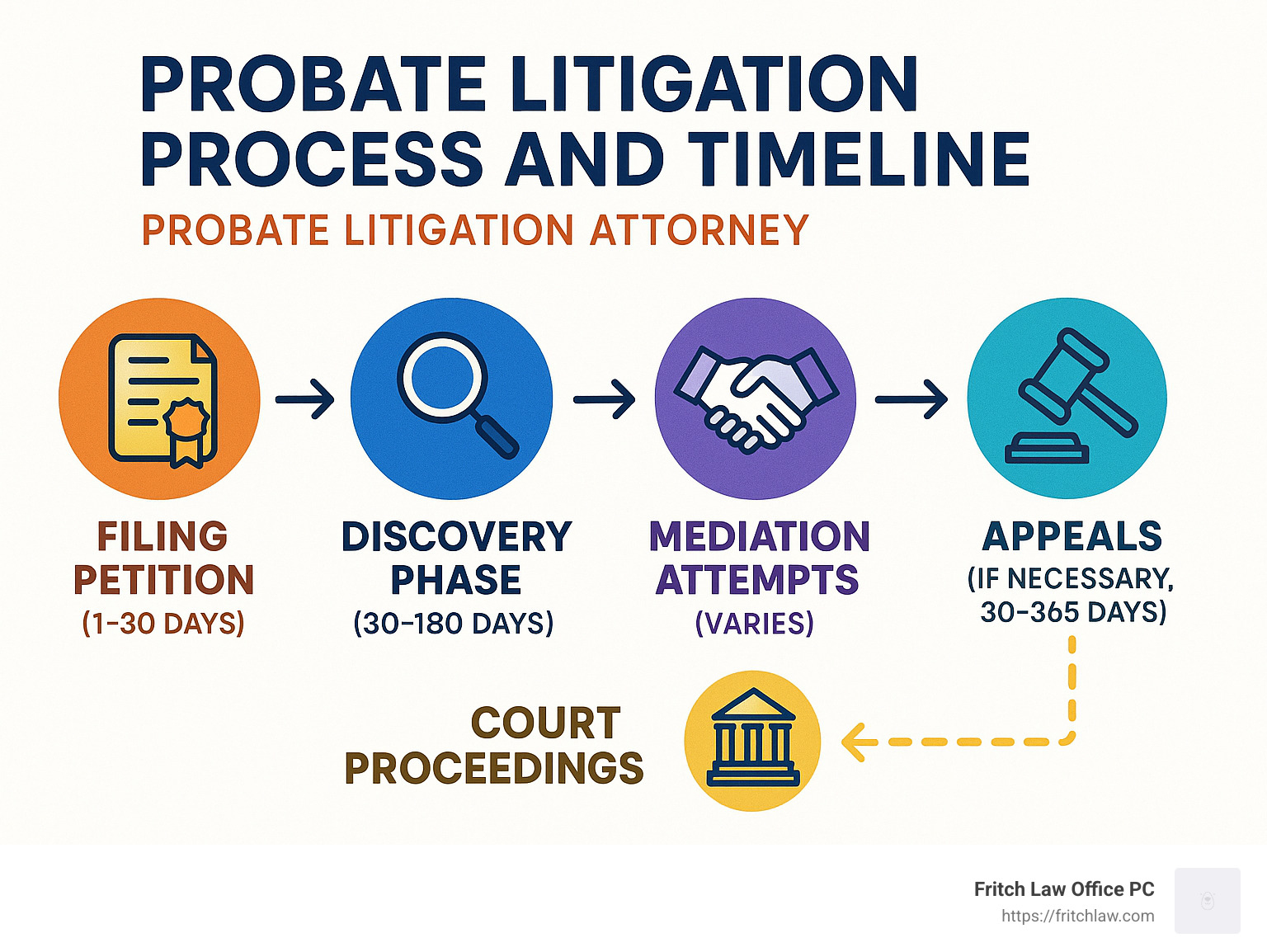
The timeline above gives you a snapshot of what to expect when litigation becomes necessary. While every case is unique, understanding this general process can help reduce some of the uncertainty you may be feeling.
If you’re dealing with probate matters in Indiana, you might find these resources helpful:
– Probate court Indiana
– probate law services indiana
While probate litigation can be challenging, you don’t have to face it alone. Having an experienced probate litigation attorney by your side can make all the difference in resolving these matters efficiently and protecting what rightfully belongs to you.
Probate Litigation 101: Definitions, Roles & Common Grounds
When a loved one passes away, most families hope for a smooth transition of assets. Unfortunately, disagreements sometimes arise that turn the probate process into a contested legal matter. This is where probate litigation comes into play – the formal legal process used to resolve disputes during estate administration.
Unlike routine probate, which is primarily paperwork and administration, probate litigation involves courtroom advocacy when family members or interested parties can’t see eye to eye.
The most common disputes we see in probate litigation include will contests, where someone challenges whether a will truly represents the deceased’s wishes; trust disputes over how assets are being managed or distributed; and claims against executors or trustees for breach of fiduciary duty when they’re not fulfilling their legal responsibilities.
Many clients come to us confused about what actually constitutes grounds for contesting a will or trust. The legal system recognizes several specific situations where challenges are appropriate:
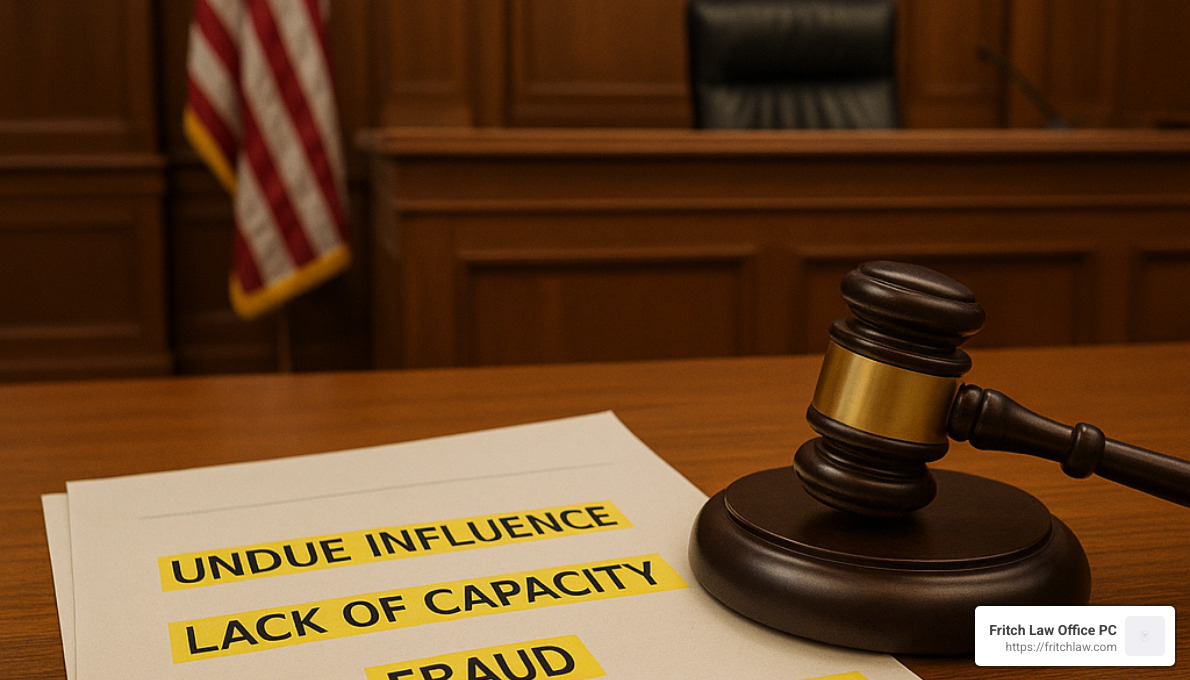
Undue influence occurs when someone exerts excessive pressure on the person creating their will, essentially overriding their free choice. We often see this in situations where a caregiver or family member isolates the elderly person and manipulates them into changing their estate plan.
Lack of capacity means the person didn’t understand what they were doing when they signed their documents. For example, someone with advanced dementia may not comprehend the nature of their assets or who their natural heirs would be.
When someone creates estate documents based on false information or under threats, we can challenge on grounds of fraud or duress. And sometimes wills aren’t properly signed or witnessed, creating technical defects that invalidate the document entirely.
Another common situation arises when someone dies without a valid will, creating what’s legally termed an intestate estate. In these cases, state law determines who inherits, but disputes can still emerge about who qualifies as legal heirs or how to handle complex assets.
Probate Lawyer vs. Probate Litigation Attorney
Many people don’t realize these are different roles until they’re caught in a dispute. Here’s how they differ:
| Probate Lawyer | Probate Litigation Attorney |
|---|---|
| Handles routine estate administration | Specializes in contested probate matters |
| Files necessary probate documents | Represents clients in court proceedings |
| Guides executors through administration | Builds cases with evidence and witnesses |
| Assists with asset distribution | Challenges or defends wills and trusts |
| Helps with creditor notifications | Handles complex legal arguments |
| Focuses on compliance with probate laws | Focuses on advocacy and dispute resolution |
I’ve had clients tell me, “I thought my regular estate attorney could handle this,” only to find that contesting a will requires specialized litigation skills that many estate planning attorneys don’t practice regularly.
What does a Probate litigation attorney do?
A probate litigation attorney does much more than file paperwork. We become your advocate in what can be highly emotional family conflicts.
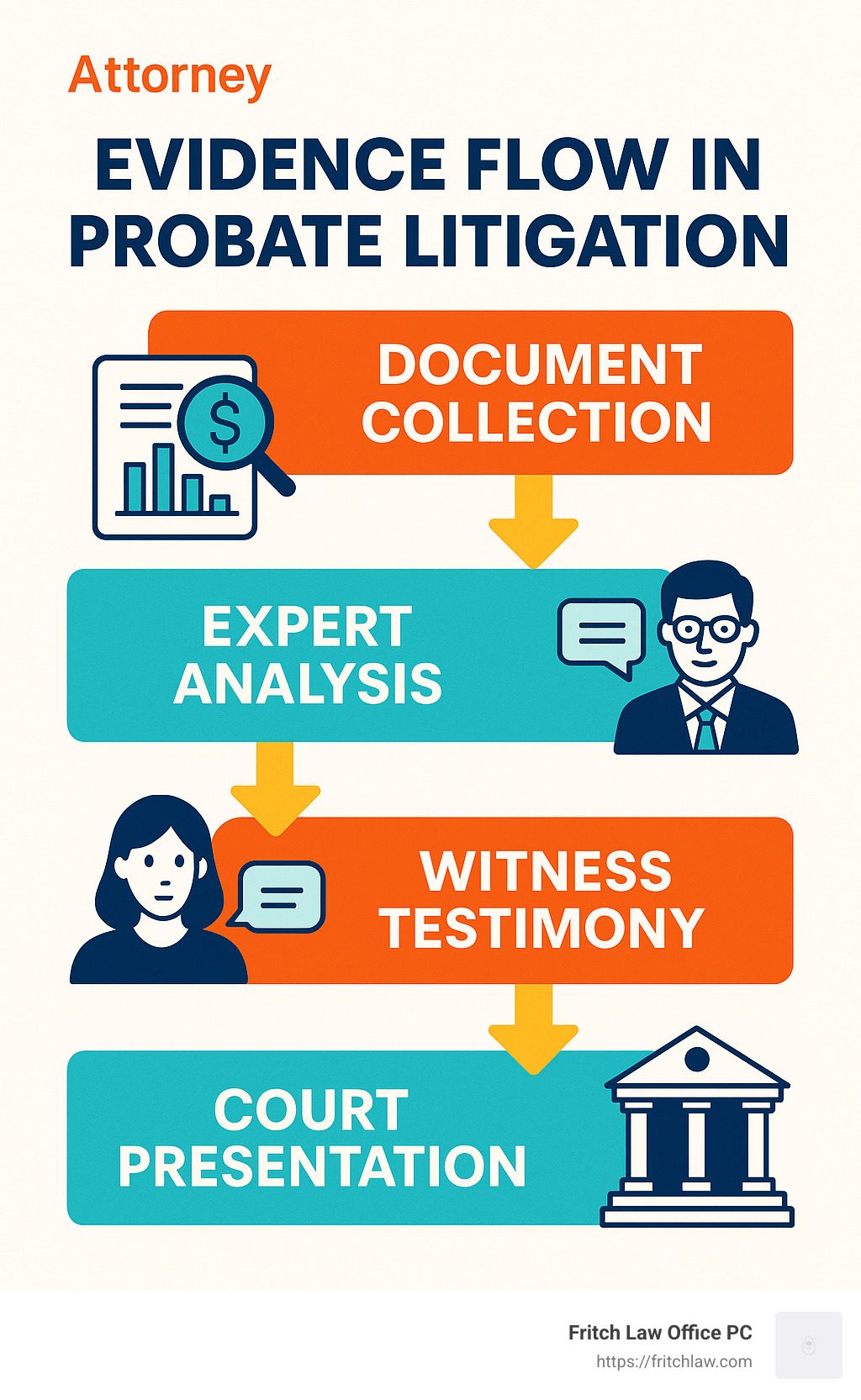
In court, we present your case persuasively, making legal arguments and introducing evidence that supports your position. But our work begins long before we step into the courtroom. We spend significant time on case building – gathering medical records, financial documents, and witness statements that tell the complete story.
Many probate disputes actually resolve through settlement negotiations rather than trials. A skilled probate litigation attorney knows how to find middle ground that protects your interests while avoiding the cost and stress of a full trial.
Complex cases often benefit from expert witnesses. We coordinate with medical professionals who can testify about capacity issues, financial experts who can trace misappropriated funds, or document specialists who can identify forgeries.
The findy phase of litigation (that’s lawyer-speak for the formal evidence-gathering process) is particularly crucial in probate disputes. Through depositions, document requests, and interrogatories, we uncover the facts needed to build a compelling case.
In one case we handled, careful questioning during a deposition revealed that a caregiver had isolated our client’s father from other family members for months before a dramatic will change. This evidence proved pivotal in reaching a favorable settlement for our client.
Whether you’re challenging a suspicious will or defending a valid one, having an experienced probate litigation attorney can make all the difference in protecting your inheritance rights and honoring your loved one’s true wishes.
The Probate Litigation Process: Step-by-Step & Typical Timeline
Understanding what happens during probate litigation can help ease some of the anxiety you might be feeling. While every case has its own unique twists and turns, most follow a predictable path that I’m happy to walk you through.
1. Initial Petition Filing
Everything starts with paperwork – specifically, a petition filed with the probate court. This might be a will contest, an objection to someone being appointed as personal representative, a request to remove a trustee who’s not doing their job, or a demand for an accounting of estate assets. This document lays out your legal grounds and what you’re asking the court to do about it.
I recently helped a client file a petition when her brother, acting as executor, refused to share information about their father’s estate. The petition forced transparency and protected her inheritance.
2. Standing Determination
Before diving into the case itself, the court needs to make sure you have the legal right (or “standing”) to bring the action in the first place. You generally need to be an heir who would inherit without a will, a beneficiary named in estate documents, someone who was removed from a newer version of the will, a fiduciary like an executor, or sometimes, a creditor owed money by the estate.
3. Response Period
After your petition is filed, other interested parties have a limited window to respond – typically 20-30 days in Indiana and many other states. This is a crucial period where the opposition must formally answer or risk a default judgment against them.
4. Findy Phase
This is where your probate litigation attorney really earns their keep. During findy, we gather the evidence needed to build your case through:
- Document requests that uncover important paperwork
- Written questions (interrogatories) that must be answered under oath
- Depositions where witnesses give sworn testimony
- Subpoenas for records from doctors, banks, or other third parties
We’re typically hunting for medical records that show mental capacity (or lack thereof), financial records that reveal suspicious transactions, communications like emails or texts that demonstrate intentions, and witness accounts about the deceased person’s mental state or relationships.

5. Mediation or Settlement Conferences
Many courts require parties to sit down with a mediator before proceeding to trial. This gives everyone a chance to resolve differences without the emotional and financial costs of a full trial. In my experience, about 60-70% of probate disputes find resolution during this phase.
Last year, I helped mediate a case where three siblings were fighting over their mother’s estate. With some guidance, they reached an agreement that preserved both their inheritances and their relationships.
6. Trial Preparation
If settlement talks don’t succeed, we roll up our sleeves and prepare for trial by organizing evidence, preparing witnesses, creating exhibits, and drafting the necessary legal documents.
7. Trial
The trial itself may happen before just a judge or sometimes a jury. It follows a familiar pattern: opening statements, presenting evidence and witnesses, cross-examination, and closing arguments. Probate trials tend to be shorter than other types of litigation – often just a few days.
8. Judgment and Potential Appeals
After trial, the court issues its decision. If either side believes legal errors occurred, they generally have the right to appeal, which can extend the process by months or even years.
Key Deadlines & Documents
Probate litigation comes with strict deadlines that vary depending on where you live. Missing these deadlines can permanently bar your claim, which is why having a knowledgeable probate litigation attorney is so important.
When probate begins, interested parties receive a Notice of Administration, which starts the clock on many deadlines. Will contests must typically be filed within a specific period after the will enters probate (in California, for instance, you have 120 days from the probate petition hearing). Beneficiaries usually have 30-60 days to object to accountings, while some claims like breach of fiduciary duty may have longer statutes of limitation, often 2-4 years.
The documents that prove most crucial include the original will and any amendments, trust documents, financial records of the estate, the deceased’s medical records, communications between the deceased and interested parties, and any prior estate planning documents.
One client told me after we successfully handled her will contest: “I had no idea how much documentation would be needed. Having an experienced probate litigation attorney who knew exactly what to request and how to interpret the records made all the difference.”
The timeline from filing to resolution varies widely, but most probate litigation cases take between 6-18 months to resolve, with complex cases sometimes stretching to two years or more. Patience becomes as important as persistence when navigating these waters.
Choosing & Paying a Probate Litigation Attorney
Finding the right probate litigation attorney isn’t just about legal credentials—it’s about finding someone who’ll stand by you during one of life’s most challenging chapters. This decision can dramatically affect both your case outcome and your peace of mind throughout the process.
Selection Criteria
When you’re interviewing potential attorneys, trust your instincts while considering these important factors:
Look for specialized experience in probate litigation specifically—not just general estate planning. During your consultation, ask directly: “How many cases like mine have you handled?” An attorney who handles probate disputes daily will steer your case more effectively than someone who only occasionally deals with contested matters.
The attorney’s track record matters too. While no lawyer wins every case, someone with a history of favorable outcomes in situations similar to yours brings valuable perspective. One of our clients recently shared, “I chose my attorney after hearing how she had successfully handled a will contest involving similar family dynamics to mine.”
Local knowledge can make a surprising difference. Each probate court has its own procedures, and judges have individual preferences about how cases should be presented. An attorney who regularly appears before your local probate judge already understands these nuances.
Consider the resources available to your potential attorney. Probate litigation often requires testimony from medical experts, forensic accountants, or handwriting analysts. A well-established attorney has these connections already in place.
Pay attention to their communication style during your initial consultation. Do they explain complex legal concepts clearly? Do they listen attentively to your concerns? You deserve an attorney who communicates in a way that works for you—whether that’s detailed daily updates or weekly summaries.
Finally, never underestimate the importance of personal compatibility. You’ll be sharing sensitive family information with this person during a stressful time. The relationship should feel comfortable and built on mutual respect.

Fee Structures
Understanding how you’ll pay for legal services helps prevent surprises during an already stressful time. Probate litigation attorneys typically structure their fees in one of several ways:
Hourly rates are most common for probate litigation. Here in Indiana, expect rates between $200 and $400 per hour, depending on the attorney’s experience and the complexity of your case. When we work on an hourly basis at Fritch Law Office, we provide detailed monthly statements so you can see exactly where your money is going.
Some attorneys offer contingency arrangements, particularly when the dispute involves substantial assets. With this approach, the attorney receives a percentage (typically 30-40%) of whatever you recover. This can make legal representation accessible when you don’t have funds upfront, but remember you’ll pay more in a successful case.
While less common in litigation, flat fees might be available for specific phases of your case. This approach provides certainty about costs but is typically reserved for more predictable matters.
Some clients prefer hybrid arrangements that combine reduced hourly rates with smaller contingency percentages. This alignment of interests can work well in certain situations.
Don’t forget about litigation expenses beyond attorney fees. Court filing fees, expert witness costs, and deposition expenses can add up quickly. Most firms advance these costs and get reimbursed later, but discuss this upfront to avoid surprises.
For a deeper dive into fee structures, check out our detailed guide on Probate Attorney Fees.
“Probate litigation requires both legal acumen and sensitivity. Finding an attorney who possesses both qualities is essential to navigating these emotionally charged disputes effectively.”
When Should I Hire a Probate Litigation Attorney?
Timing matters tremendously in probate litigation. Here are situations when you should reach out to a probate litigation attorney without delay:
If you notice executor misconduct—perhaps they’re using estate funds for personal expenses or favoring certain beneficiaries—don’t wait for the situation to worsen. Early intervention can prevent further asset depletion.
When you’re being denied information you’re legally entitled to receive, it’s a red flag. Executors and trustees have legal obligations to provide accountings and inventories to beneficiaries. If your requests are being ignored, it’s time for legal help.
Pay close attention to filing deadlines. Many jurisdictions give you just 30-120 days to contest a will after it enters probate. Once these deadlines pass, even the strongest case may be permanently barred.
Family disputes that start with tense conversations at the funeral home rarely improve on their own. When communication breaks down among beneficiaries or heirs, professional legal guidance can prevent irreparable family rifts.
Unexpected changes to estate plans should trigger your awareness. If your parent’s will suddenly changed in their final months to benefit a new acquaintance, this warrants investigation.
Suspicion of undue influence calls for immediate action. When someone exercises inappropriate influence over a vulnerable person to change their estate plan, the window to gather evidence (like medical records showing diminished capacity) is often quite narrow.
I recently worked with a client whose brother had convinced their mother to change her trust while she was on heavy medication. By acting quickly, we obtained her pharmacy records showing her mental state was likely compromised during the document signing—evidence that might have been unavailable with delay.
In probate litigation, hesitation can be costly. Many of our most successful cases began with a simple phone call from someone who thought, “Something just doesn’t seem right here.”
Preventing & Resolving Disputes Without Court (plus FAQs)
While we’re fully prepared to fight for you in court when necessary, we’ve seen how probate litigation can drain both wallets and hearts. Let me share some effective ways to resolve inheritance disputes without the courtroom drama.
Mediation
Mediation brings everyone to the table with a neutral third party who helps guide the conversation toward resolution. I’ve seen families who couldn’t speak civilly to each other find common ground through this process.
Mediation keeps your family business private, unlike court proceedings where everything becomes public record. You maintain control over the outcome rather than letting a judge decide your family’s fate. It’s generally less expensive than litigation, and perhaps most importantly, it gives relationships a chance to heal rather than fracturing them further.
One client told me after successful mediation: “I not only preserved my inheritance, but I also preserved my relationship with my sister. That’s something no court victory could have given me.”

Arbitration
Think of arbitration as “Court Lite” – more formal than mediation but less intimidating than a courtroom. An arbitrator hears both sides and makes a binding decision.
The beauty of arbitration is that you can choose an arbitrator with specific expertise in probate matters. The process moves much faster than court proceedings, and decisions are typically final with limited appeal options. For families who can’t reach consensus through mediation but want to avoid lengthy court battles, arbitration offers a middle path.
Early Estate Planning Strategies
The best probate dispute is the one that never happens. Through thoughtful estate planning, you can dramatically reduce the likelihood of conflicts after you’re gone.
Clear documentation is essential. I’ve seen too many wills with vague language that leaves room for multiple interpretations – and multiple arguments. Regular updates to your estate plan after major life events keep everything current and relevant.
Family communication might feel uncomfortable, but discussing your intentions while you’re alive gives everyone a chance to understand your reasoning. Many disputes arise from surprise or perceived unfairness that could have been addressed through open conversation.
No-contest clauses can discourage challenges by stating that anyone who contests the will receives nothing. However, be aware that in Indiana and many states, these clauses won’t be enforced if the person contesting had “probable cause” for their challenge.
For blended families, clear differentiation of assets is crucial. Consider making some gifts during your lifetime, using trusts with independent trustees to reduce suspicion of favoritism, or using life insurance to equalize inheritances outside the probate process.
For more comprehensive strategies, check out our guide on Probate Avoidance Strategies.
Frequently Asked Questions
Who can contest a will?
Not just anyone can challenge a will, regardless of how unfair they think it is. You need legal “standing,” which generally means you must be:
An heir-at-law – someone who would inherit if there was no will (typically spouses, children, and sometimes parents or siblings)
A beneficiary named in either the current will or a previous version
A fiduciary named in current or prior wills
A creditor in limited circumstances
I once had to deliver the difficult news to a client that despite being the deceased’s best friend for 40 years, she had no standing to contest a will that left her out, despite verbal promises of inheritance.
How long does probate litigation take?
When clients ask me this question, I’m always careful not to sugarcoat it. The honest answer is: it depends. Simple disputes might resolve in 6-12 months, while moderately complex cases typically take 1-2 years. High-complexity cases or those involving appeals can stretch beyond 2 years.
Court schedules significantly impact timelines. In some counties, getting a trial date can take many months. The COVID-19 pandemic created backlogs in many probate courts that we’re still working through today.
What are the risks of probate litigation?
Before diving into litigation, I make sure my clients understand what they’re signing up for. The financial costs can be substantial, sometimes exceeding $100,000 for complex cases going to trial.
The emotional toll shouldn’t be underestimated either. I’ve seen litigation create family rifts that never heal. There’s also the uncertainty – even strong cases carry risk because judges and juries can be unpredictable.
The time commitment is significant too. You’ll need to gather documents, prepare for depositions, and potentially attend multiple hearings. And remember that court proceedings become public record, potentially exposing private family matters.

Can I remove an executor or trustee?
Yes, but you’ll need specific grounds, not just personality conflicts. Courts typically require evidence of:
Self-dealing or conflicts of interest, mismanagement of assets, failure to provide accountings, failure to follow the terms of the will or trust, or incapacity affecting their ability to serve.
The process requires filing a petition with the probate court and providing compelling evidence. Courts generally prefer to honor the deceased’s choice of fiduciary unless there are serious problems.
What if the executor won’t share information?
Executors have a fiduciary duty to provide information to beneficiaries, including an inventory of assets, estate accountings, and information about administration.
If you’re being stonewalled, start with a formal written request specifically outlining what information you’re seeking. If that doesn’t work, you can file a petition with the probate court requesting an order compelling disclosure. In extreme cases, you might seek removal of the executor.
In my experience at Fritch Law Office PC, a firmly worded letter from a probate litigation attorney often resolves information disputes without court intervention. Executors who might ignore beneficiaries tend to take notice when legal letterhead arrives.
Conclusion
Probate litigation represents one of the most challenging intersections of law and family dynamics. The technical complexity of probate law combined with the emotional weight of inheritance disputes creates situations where experienced legal guidance is not just helpful—it’s essential.
When you’re facing a potential probate dispute, remember these key points:
-
Act promptly: Probate litigation is governed by strict deadlines that can permanently bar valid claims if missed.
-
Gather documentation: Begin collecting relevant documents, including wills, trusts, financial records, and communications that might support your position.
-
Consider alternatives: Explore mediation or negotiation before committing to litigation, as these approaches often yield satisfactory results with less cost and emotional strain.
-
Choose your attorney carefully: Select a probate litigation attorney with specific experience in your type of dispute and a communication style that matches your needs.
-
Prepare emotionally: Understand that the process may be lengthy and emotionally taxing, regardless of the outcome.
At Fritch Law Office PC, we approach probate litigation with both legal precision and human understanding. We recognize that behind every case file is a family navigating loss, change, and often deep emotional pain. Our approach balances aggressive advocacy with sensitivity to the personal dimensions of these disputes.
Whether you’re a beneficiary concerned about executor misconduct, an heir questioning a suspicious will, or a fiduciary defending against unwarranted challenges, we’re here to provide the guidance and representation you need during this difficult time.
For more information about our probate services or to schedule a consultation to discuss your specific situation, please visit our probate services page or contact our Jasper, Indiana office directly.
Remember: While probate litigation can be complex and challenging, with the right legal guidance, you can steer the process effectively and work toward a resolution that honors both the law and your loved one’s true intentions.