

Indiana probate law: Complete 2026 Guide
Fritch Law Office handles indiana probate law cases for Indiana residents every day. First, our attorneys examine your situation carefully. Next, we identify your strongest legal options. Furthermore, we explain every step in plain language. Therefore, you make confident decisions from day one.
Key Facts About Indiana probate law in Indiana
Indiana courts apply strict 2026 rules to indiana probate law matters. Moreover, experienced attorneys win better outcomes for clients. Additionally, early legal advice prevents costly mistakes. Consequently, clients who hire Fritch Law gain a clear advantage. However, waiting too long weakens your position significantly.
Take Action on Indiana probate law Today
Do not delay your indiana probate law case. First, call our Jasper office directly. Next, we schedule your free consultation immediately. Then, we build a winning strategy for you. Additionally, we represent you at every court hearing. Finally, we resolve your case as fast as possible.

Visit the Indiana Courts website for official legal information. Contact Fritch Law for your free consultation today.
Understanding Indiana Probate Law: A Straightforward Guide
Indiana probate law is the legal process that oversees the distribution of a deceased person’s assets, payment of debts, and settlement of their final affairs. For those seeking quick answers:
| Key Aspects of Indiana Probate Law | Details |
|---|---|
| Required When | Estate exceeds $100,000 or contains solely-owned assets |
| Timeline | Typically 6-12 months to complete |
| Small Estate Option | Affidavit process for estates under $100,000 |
| Filing Deadline | Must be initiated within 3 years of death |
| Creditor Claims | 3 months from notice publication to file |
| Administration Types | Supervised (court oversight) or Unsupervised (minimal court involvement) |
When someone passes away in Indiana, their estate doesn’t automatically transfer to heirs. Indiana probate law creates a structured process that protects both beneficiaries and creditors by ensuring proper asset distribution and debt payment.
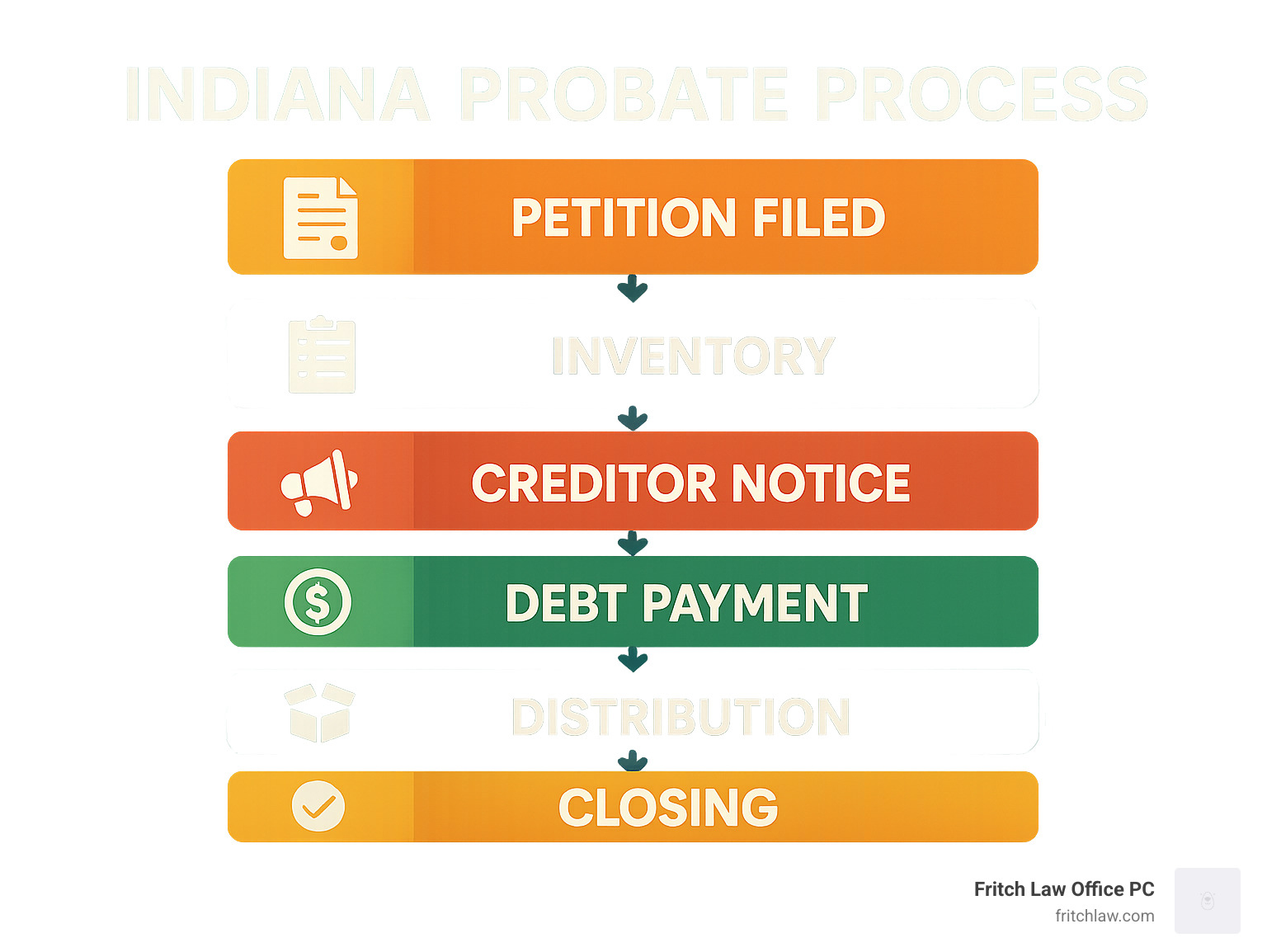
The probate process can feel overwhelming, especially while grieving. You’ll need to file paperwork with the court, notify creditors, inventory assets, pay debts, and distribute remaining property according to the will or state law if no will exists.
I’m David Fritch, with over 40 years of experience as an attorney handling Indiana probate law cases through my firm, Fritch Law Office PC. My background in estate planning and probate administration allows me to guide clients through this complex process with clarity and compassion.
Indiana Probate Law Basics: What & Why
When someone passes away, their affairs don’t just automatically resolve themselves. This is where Indiana probate law steps in – it’s the court-supervised legal process that helps settle a deceased person’s estate properly and fairly. This process is governed by Title 29 of the Indiana Code, specifically the Probate Code (IC 29-1).
Think of probate as the legal roadmap that guides the journey from someone’s passing to the final distribution of their assets. The probate court takes on several important responsibilities during this process – validating the will (if one exists), appointing someone to handle the estate (called a personal representative), overseeing asset inventory, ensuring debts get paid, and making sure remaining assets go to the right people.
One important timing note: Indiana probate law sets a three-year filing deadline after someone passes away. Miss this window, and you’ll likely face significant legal problems that complicate the entire process.
Estates typically fall into one of two categories – solvent (enough assets to cover all debts) or insolvent (not enough to pay everyone). This distinction matters because it determines how creditors get paid and what might remain for heirs.
While Indiana wisely repealed its inheritance tax back in 2013, federal estate tax could still apply to very large estates. That said, with the federal exemption sitting at $13.99 million in 2025, this affects less than 0.1% of estates – meaning most Hoosier families don’t need to worry about this particular tax burden.
What Is “Indiana Probate Law”?
Indiana probate law is the legal framework established by state statutes that governs how we handle a deceased person’s estate. You’ll find these laws primarily in Title 29 of the Indiana Code, which spells out all the procedures, requirements, and standards for probate administration throughout the state.
The probate court serves as the official oversight authority with jurisdiction over validating wills, appointing personal representatives, supervising asset distribution, resolving any disputes that arise, and ensuring the estate is properly administered according to law.
As you steer probate, you’ll encounter several key legal terms:
Decedent refers to the person who has died. The personal representative (called an executor if named in a will or administrator if appointed by the court) is the person authorized to handle the estate. This authority comes through letters testamentary or letters of administration – official court documents that grant this power. The probate estate consists of assets solely owned by the decedent that require court supervision to transfer. Beneficiaries are those named in a will to receive assets, while heirs are people entitled to inherit under intestacy laws when there’s no will.
Why Probate Exists in Indiana
You might wonder why we need this seemingly complex process in the first place. Despite its paperwork and procedures, probate serves several vital purposes for Hoosier families:
First, it helps prevent fraud. Court oversight makes it much harder for someone to make false claims against an estate or ignore the deceased person’s wishes as expressed in their will.
Probate also ensures clear title transfer, especially for real estate. Without this formal process, heirs might struggle to sell inherited property because of clouded or uncertain ownership titles.
The process provides important creditor protection – giving legitimate creditors a fair chance to present claims while also establishing a definite cutoff date after which no further claims can be made.
Finally, Indiana probate law creates an orderly distribution system. This is particularly important when someone dies without a will (intestate), as the law provides a structured framework for determining who inherits what, helping prevent family conflicts and ensuring fair distribution according to state law.
As one of our clients recently shared after we helped settle her father’s estate: “I was completely overwhelmed until we started the probate process. Having clear legal steps to follow gave our family structure during a really difficult time and prevented misunderstandings that could have damaged relationships.”
Probate vs. Non-Probate Assets & Small-Estate Shortcuts
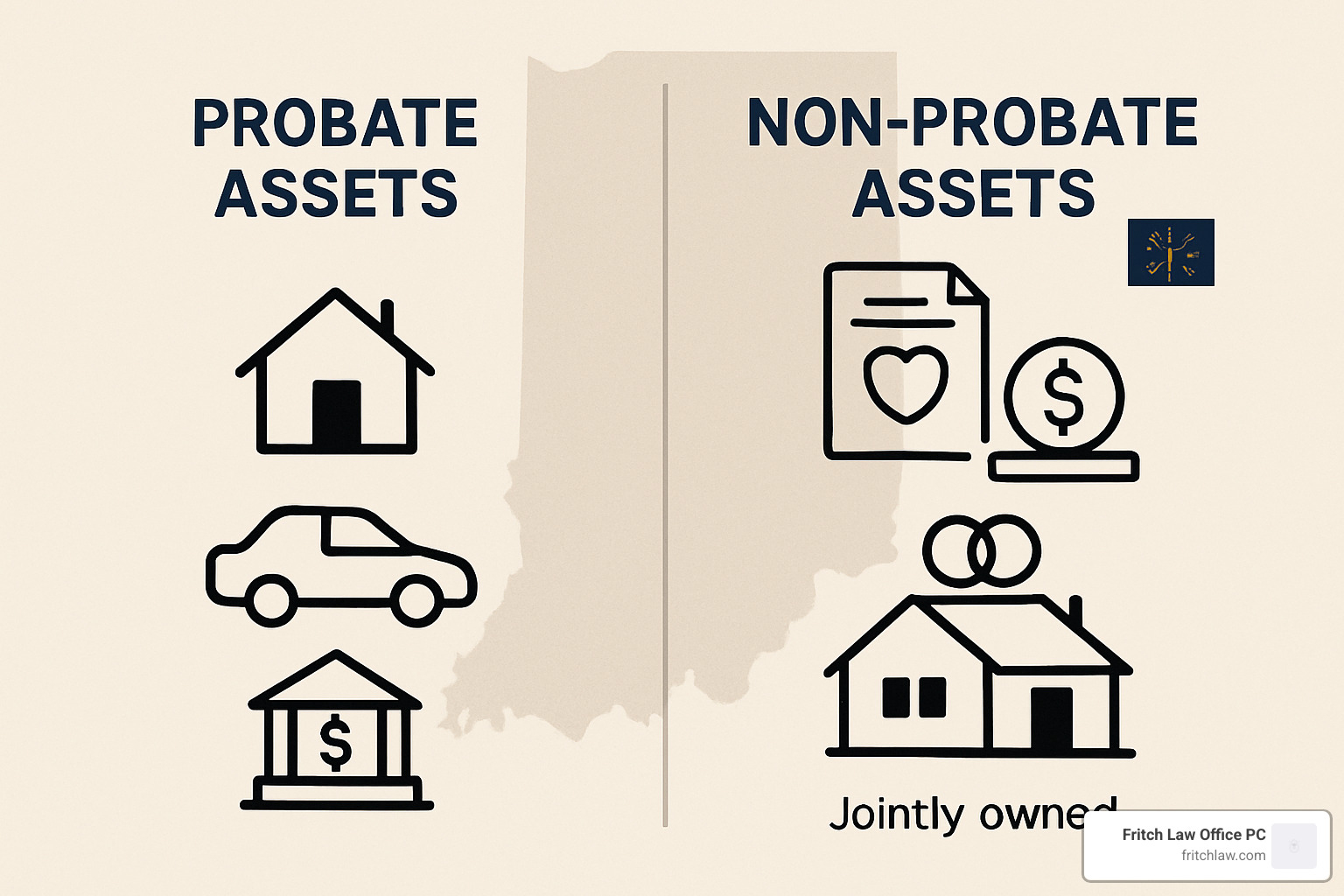
When someone passes away, not all their belongings travel the same path. Understanding which assets must journey through probate court and which can take a detour around it can save you significant time, money, and stress during an already difficult period.
Assets That Must Go Through Indiana Probate
Think of probate assets as those that were “solo performers” in the deceased person’s life. Under Indiana probate law, these typically include:
Property titled solely in the deceased’s name sits at the top of this list. That lakefront cottage with only your uncle’s name on the deed? That needs probate. The same goes for bank accounts without co-owners or beneficiary designations – they’re stuck waiting for the probate process to determine their new home.
Vehicles without transfer-on-death beneficiaries need court supervision too. And don’t forget those personal belongings – from grandmother’s antique dining set to dad’s fishing gear – these items require proper probate channels to find their way to new owners.
Business interests solely owned by the deceased also fall into this category. That small business your loved one built from scratch? Without proper planning, it becomes part of the probate estate.
Assets That Skip Probate
Now for the good news – many assets can bypass probate entirely with proper planning. These “express lane” assets include:
Property held in joint tenancy or tenancy by entirety (common between spouses) transfers automatically to the surviving owner. I’ve seen clients’ relief when they find their family home won’t be tied up in court because it was jointly owned.
Financial accounts with payable-on-death (POD) or transfer-on-death (TOD) designations go directly to named beneficiaries. Similarly, life insurance proceeds and retirement accounts with designated beneficiaries skip the probate process entirely.
Assets tucked safely in a living trust avoid probate too – one reason many Hoosiers establish these planning tools. And Indiana’s transfer-on-death deeds for real estate provide another valuable probate-avoidance strategy.
Indiana Small-Estate Affidavit & Real Estate Passage
Indiana offers a helping hand for smaller estates through simplified procedures:
For estates valued at $100,000 or less (a threshold raised from $50,000 after June 30, 2022), heirs can often use a small estate affidavit instead of formal probate. This streamlined process requires waiting 45 days after death, then preparing a sworn statement that meets requirements under IC 29-1-8-1. With this document and a death certificate in hand, heirs can often collect bank accounts, vehicles, and other personal property without court proceedings.
For real estate specifically, Indiana permits a “devolution of real estate” affidavit to be recorded with the county recorder, transferring property title without full-blown probate. This document can be a real lifesaver when the only significant asset is the family home.
Even when estates exceed the small estate threshold, unsupervised administration offers a middle ground with fewer court appearances and filings. This option works when the estate can pay all its debts, the will authorizes it, or all heirs consent to the arrangement. For many families I’ve worked with, this approach strikes the perfect balance between legal oversight and efficiency.
For more details about navigating probate court in Indiana, you might find helpful information at our Probate Court Indiana resource page.
Intestate Succession Rules When There’s No Will
When someone dies without a will in Indiana, state law becomes their posthumous estate planner through intestate succession rules (IC 29-1-2-1):
A surviving spouse typically receives half the estate when children are also in the picture. This increases to three-fourths if parents (but no children) survive, and the entire estate if neither children nor parents remain.
Children or their descendants share whatever portion doesn’t go to the spouse. If there’s no surviving spouse, the children inherit everything equally, with a deceased child’s share passing to their children (known as “per stirpes” distribution).
When no spouse or descendants survive, parents are next in line, followed by siblings and their descendants. More distant relatives like grandparents, aunts, uncles, and cousins inherit only when closer family members aren’t available.
Only when absolutely no family can be found does the estate “escheat” to the State of Indiana – a rare occurrence indeed.
A special rule worth noting: a childless second spouse receives only 25% of real property the deceased owned with a previous spouse or inherited from them, though they receive their normal share of other assets.
For more comprehensive guidance on probate law services available in Indiana, please visit our Probate Law Services Indiana page.
The Indiana Probate Process & Administration Options

Navigating the Indiana probate law process might seem overwhelming at first, but it follows a predictable path. Think of it as a journey with clear signposts along the way. While each estate is unique, understanding these steps can help you feel more in control during a difficult time.
Step 1: Open the Estate in Court
The probate journey begins with filing paperwork in the county where your loved one lived. You’ll need to gather several important documents:
A certified death certificate, the original will (if one exists), and information about who stands to inherit. You’ll also need to provide a rough estimate of the estate’s assets and their values.
Most people file in the county where the deceased person lived. Filing fees typically range from $120 to $170, depending on the county. If your loved one owned property in another county or state, you might need additional proceedings there (called ancillary probate).
“When my husband passed,” one client shared with me, “I was surprised to learn we needed to file in two counties because of a small hunting property he owned across the state line.”
For more detailed information about starting the process, visit our page about Indiana Probate Law.
Step 2: Appointment of Personal Representative
Once your petition is approved, the court appoints someone to handle the estate’s affairs. This person is called the personal representative.
If there’s a will, the court typically appoints the person named in the will (the executor). Without a will, Indiana probate law follows a specific order: first the surviving spouse, then children, parents, siblings, and finally creditors or other interested parties.
The appointed person must swear an oath to faithfully perform their duties and may need to post a bond (like an insurance policy) unless the will waives this requirement or all beneficiaries agree to skip it.
The court then issues “Letters Testamentary” (with a will) or “Letters of Administration” (without a will). These official documents give the personal representative legal authority to act on behalf of the estate.
Step 3: Notice to Heirs & Creditors
Communication is a crucial part of the probate process. The personal representative must notify everyone with a potential interest in the estate:
Published notice must appear in a local newspaper once a week for two consecutive weeks, following the requirements of Sec. 7 Notice Statute.
Direct notice must be mailed within one month to all known heirs, beneficiaries, and creditors. This starts the clock for creditors to file claims.
Under Indiana probate law, creditors have three months from the first publication date to file claims. Miss this deadline, and their claims are typically barred by IC 29-1-14-1 creditor rule.
For creditors who should have received direct notice but didn’t, the window extends to two months after actual notice, but never beyond nine months after death.
Step 4: Inventory & Valuation
Within 60 days of appointment, the personal representative must create a detailed inventory of all probate assets. This includes real estate, bank accounts, investments, vehicles, personal belongings, and business interests owned solely by the deceased.
Each asset needs a fair market value as of the date of death. For unique or valuable items like real estate or antiques, professional appraisals may be necessary.
In supervised administration, this inventory becomes part of the public court record. However, in unsupervised administration, it’s typically shared only with interested parties—one of the privacy advantages of the unsupervised option.
“The inventory process was eye-opening,” a client once told me. “We finded a small investment account my father had opened decades ago that none of us knew existed.”
Step 5: Pay Debts, Expenses, and Taxes
Before anyone inherits, the estate must settle its obligations. Indiana probate law establishes a specific order for paying debts:
First come administration costs, then funeral expenses, followed by taxes, medical expenses from the final illness, rent for the deceased’s residence, public assistance (including Medicaid recovery), and finally all other valid debts.
If there aren’t enough assets to cover everything, this priority order determines who gets paid first. Lower-priority creditors might receive partial payment or nothing at all.
The personal representative must also file final income tax returns and, if needed, estate tax returns. While Indiana no longer has an inheritance tax, federal estate tax may apply to very large estates.
For more information about the costs involved, check out our page on Probate Lawyer Fees.
Step 6: Distribute Assets & Close Estate
After all debts and expenses are paid, the remaining assets can finally go to the rightful heirs or beneficiaries.
In supervised administration, the personal representative files a detailed accounting with the court showing all money that came in and went out, along with the proposed distributions. After court approval, assets are distributed and beneficiaries sign receipts.
In unsupervised administration, the process is more streamlined. The personal representative distributes assets according to the will or law, collects receipts, and files a closing statement with the court certifying that all duties have been fulfilled.
Once everything is distributed and documented, the personal representative requests to be discharged, ending their legal responsibility for the estate.
Supervised vs. Unsupervised Administration Under Indiana Probate Law
Indiana probate law offers two main paths through the probate process:
Supervised administration involves regular court oversight. The court must approve most significant actions, and formal accountings must be filed. While this provides maximum protection, it’s typically more time-consuming and expensive. It’s required when the will specifies it, the estate can’t pay all its debts, beneficiaries disagree, or there are complex disputes.
Unsupervised administration involves minimal court involvement after the initial appointment. No formal accountings are filed with the court, making the process faster and less expensive. This option is available when the estate can pay all its debts, the will authorizes it (or all beneficiaries consent), and there are no significant disputes.
“The unsupervised option saved our family both time and money,” one grateful client explained. “Since we all agreed on how things should be handled, we didn’t need the court looking over our shoulder at every step.”
For more information about strategies to minimize probate complexity, visit our page on Probate Avoidance Strategies.
Costs, Timelines, Creditor Claims & Disputes

When families ask me about probate, two questions almost always come up first: “How much will this cost?” and “How long will it take?” These practical concerns are completely understandable when you’re already dealing with the emotional weight of losing a loved one.
Typical Indiana Probate Costs
The financial aspect of probate in Indiana involves several components that can add up. Court filing fees typically range from $120-$170 just to open the estate. Then there are publication costs—those legally required newspaper notices—which usually run between $100-$200.
“I was surprised by all the little expenses that popped up,” one client told me. “Having a clear breakdown from the beginning really helped us budget properly.”
The personal representative (executor) is entitled to reasonable compensation for their work, typically ranging from 1-5% of the estate value, depending on complexity. This fee may be specified in the will or determined based on the work involved.
Attorney fees form another significant expense, structured either as hourly rates or a percentage of the estate value. Other costs might include appraisal fees for real estate or valuable collections, and bond premiums if required and not waived in the will.
The total cost varies dramatically based on several factors:
– The size and complexity of the estate
– Whether you choose supervised or unsupervised administration (unsupervised typically costs less)
– Whether any disputes arise requiring additional court hearings
– How efficiently the personal representative and attorney handle matters
How Long Does Probate Take?
Under Indiana probate law, the timeline for completing probate typically spans six months to a year for straightforward estates. More complex situations can stretch to 18 months or longer.
The process usually unfolds like this:
– 1-2 months to open the estate and have the personal representative appointed
– 3 months for the required creditor claim period
– 2-6 months to inventory assets, pay debts, file tax returns, and resolve disputes
– 1-2 months to distribute assets and close the estate
I often remind clients that certain situations inevitably extend this timeline. Real estate sales, tax complications, will contests, business valuations, and difficulty locating heirs can all add months to the process. Supervised administration also typically takes longer than unsupervised administration.
Indiana probate law requires probate to be initiated within three years of death—after that, complications multiply significantly.
Creditor Deadlines & Claim Resolution
The clock starts ticking for creditors as soon as the estate notice is published. Under Indiana probate law, creditors have just 3 months from the first publication date to file their claims.
If a creditor should have received direct notice but didn’t, they get up to 2 months after receiving actual notice—but no more than 9 months after the date of death, regardless of circumstances.
“Understanding these deadlines was crucial,” shared one client. “A credit card company tried filing a claim five months after we published notice, and we were able to have it properly denied.”
The personal representative must carefully review each claim for validity. Valid claims are paid according to priority if the estate has sufficient assets. In cases where the estate is insolvent (more debts than assets), claims must be paid in the statutory priority order.
When a claim is denied, the creditor has three months to file a lawsuit to pursue it further. After that, the claim is permanently barred.
Common Probate Disputes and Their Resolution
Even in seemingly straightforward estates, disagreements can emerge. Will contests are perhaps the most common, challenging the will’s validity based on the testator’s capacity, undue influence, improper execution, or even fraud.
Executor disputes also frequently arise, with beneficiaries questioning the personal representative’s actions. These might involve allegations of mismanagement, self-dealing, failure to follow the will’s terms, or unreasonable delays.
Ambiguous will provisions can spark heated debates about what the deceased actually intended. I’ve seen families divide over a single unclear sentence in an otherwise straightforward document.
Asset valuation disputes often emerge too, especially with unique or sentimental items where fair market value becomes difficult to establish.
Most courts strongly encourage resolution outside of litigation when possible. Mediation often provides a cost-effective alternative to formal court hearings, preserving both estate assets and family relationships. However, when necessary, these disputes may proceed to formal court hearings or even jury trials.
As one client wisely noted after a successfully mediated family dispute: “In the end, we realized mom would have hated to see us fighting over her things. Finding middle ground through mediation helped us remember what really mattered.”
Avoiding or Minimizing Probate Through Estate Planning

While probate serves important purposes, many Hoosiers prefer to minimize or avoid it altogether. Whether you’re concerned about privacy, costs, or simply want to make things easier for your loved ones, Indiana probate law offers several legitimate paths to transfer assets outside the court process.
Designing a Probate-Light Estate Plan in Indiana
Creating an estate plan that minimizes probate doesn’t have to be complicated. Many of my clients are surprised at how straightforward the process can be.
A revocable living trust serves as the cornerstone of most probate-avoidance strategies. This flexible arrangement allows you to transfer assets into the trust’s ownership while maintaining complete control during your lifetime. You’ll serve as the trustee, managing everything exactly as you do now, but with a crucial difference – when you pass away, those assets transfer directly to your beneficiaries without court involvement.
“I was initially hesitant about setting up a trust,” shared one Jasper client, “but now I sleep better knowing my children won’t have to deal with probate during an already difficult time.”
Complementing your trust with a pour-over will provides an important safety net. This special type of will captures any assets you might have forgotten to transfer into your trust and “pours” them into it after your passing. While these overlooked assets will still require probate, they’ll ultimately follow your trust’s carefully designed distribution plan.
Beneficiary designations represent another powerful tool in your probate-avoidance toolkit. By properly naming beneficiaries on life insurance policies, retirement accounts, and investment accounts, these assets transfer directly to your chosen recipients regardless of what your will says. Many banks also offer payable-on-death (POD) designations for checking and savings accounts, while Indiana allows transfer-on-death (TOD) registrations for vehicles and securities.
Strategic asset titling rounds out a comprehensive approach. Holding property as joint tenants with right of survivorship means your share automatically transfers to the surviving owner when you pass away. Married couples benefit from tenancy by entirety, which offers similar probate avoidance plus additional creditor protection. For real estate, Indiana’s transfer-on-death deed allows you to name beneficiaries while maintaining complete ownership during your lifetime.
Benefits & Cautions of Probate Avoidance
The advantages of bypassing probate are compelling for many Indiana families.
Privacy ranks high on the list – unlike probate proceedings, which create public records anyone can access, trust administration remains confidential. This privacy protects your family’s financial details and inheritance decisions from curious neighbors or potential predators.
Speed and efficiency matter tremendously to beneficiaries. Assets held in trust or transferred through beneficiary designations can often reach your loved ones within weeks rather than the months or even years sometimes required for probate.
The cost savings can be substantial as well. While establishing probate-avoidance tools requires some upfront investment, these expenses typically pale in comparison to the combined court costs, attorney fees, and personal representative commissions associated with probate.
Many clients also appreciate the continuity of management probate avoidance provides. There’s no awkward period where assets are frozen or income flow interrupted while awaiting court appointments and approvals.
However, probate avoidance isn’t without potential drawbacks. Creating trusts and other tools involves upfront costs that might not make financial sense for smaller estates. These arrangements also require ongoing maintenance – assets acquired after creating your trust must be properly titled, and beneficiary designations need regular review to reflect life changes.
The creditor protection provided by probate’s defined claim period is also worth considering. Without probate’s clear cutoff for claims, trustees sometimes face uncertainty about when it’s safe to distribute assets.
For properties with mortgages, some lenders express concerns about transfer-on-death deeds, though these issues can usually be resolved with proper planning. And very complex estates might actually benefit from court oversight, particularly when family dynamics suggest potential conflicts.
Role of Advance Directives & Living Wills
While focusing on asset transfers, don’t overlook the equally important incapacity planning components of a comprehensive estate plan.
A healthcare power of attorney designates someone you trust to make medical decisions if you cannot speak for yourself. This document works alongside your living will or advance healthcare directive, which specifies your wishes regarding life-sustaining treatment in terminal situations.
Complementing these healthcare documents, a financial power of attorney appoints someone to handle financial matters during periods of incapacity. This powerful tool allows bill payment, investment management, and other financial tasks to continue seamlessly even if you’re temporarily or permanently unable to manage them yourself.
These advance directives help your family avoid guardianship proceedings – another type of court intervention that can prove costly and emotionally draining. They ensure your wishes guide decisions during vulnerable periods and spare loved ones the burden of guessing what you would have wanted.
As one client recently told me after completing her comprehensive estate plan: “The peace of mind is priceless – knowing I’ve made things easier for my family no matter what happens.”
To learn more about creating your own probate-avoidance strategy, visit our Asset Protection Lawyer and Living Will Attorney pages or explore our Probate Avoidance Strategies resources.
Frequently Asked Questions about Indiana Probate Law
How long after death can you open probate in Indiana?
If you’re wondering about timing, Indiana probate law establishes a clear deadline: you must initiate probate within three years after your loved one’s death. This isn’t just a suggestion—it’s a firm legal requirement that protects everyone involved in the estate process.
What happens if you miss this deadline? Unfortunately, serious legal complications can arise that make settling the estate significantly more challenging. While limited exceptions do exist, they’re quite rare and typically require special court approval.
I’ve worked with families who finded assets years after a loved one passed, and the three-year mark had already elapsed. These situations are often much more complicated to resolve. If you’re approaching this deadline, don’t delay—connect with an experienced probate attorney right away to protect your family’s rights and interests.
What assets are exempt from Indiana probate law?
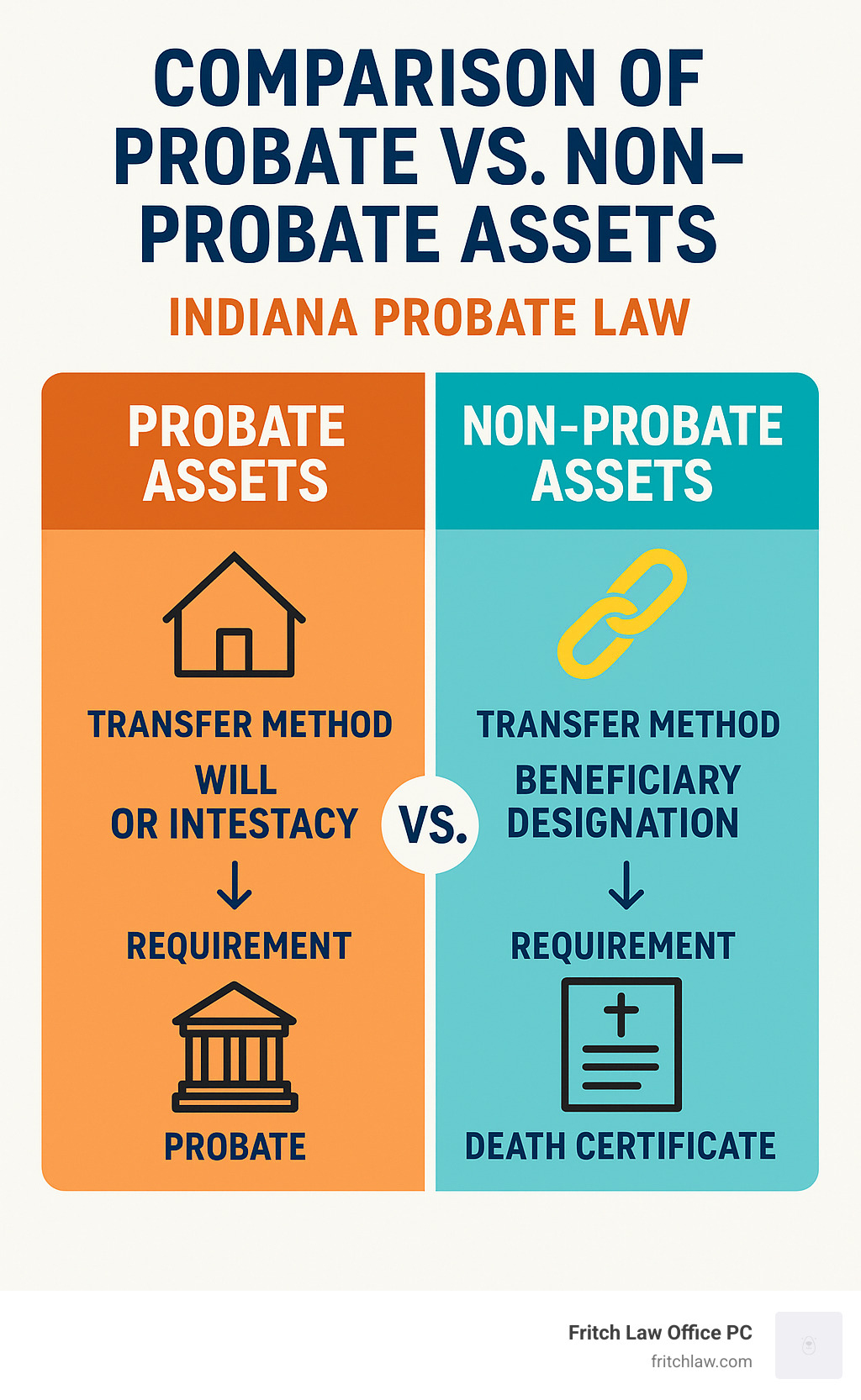
Not everything your loved one owned needs to go through probate. Indiana probate law recognizes several types of assets that transfer automatically to new owners without court involvement:
Property held jointly with right of survivorship passes directly to the surviving owner, while assets held in a properly funded living trust skip probate entirely and transfer according to the trust terms. Life insurance proceeds and retirement accounts (like IRAs and 401(k)s) go straight to the named beneficiaries, not through probate.
Banking and investment accounts with payable-on-death or transfer-on-death designations also bypass the probate process. In Indiana, even real estate with transfer-on-death deeds and vehicles with transfer-on-death registrations can avoid probate.
These non-probate transfers typically require only a death certificate and some simple paperwork rather than months of court proceedings. Many families I’ve worked with are surprised—and relieved—to find how many assets can actually skip the probate process entirely with proper planning.
Do all estates pay taxes during Indiana probate?
Good news for most Indiana families: the tax situation during probate is often simpler than you might fear.
First, Indiana repealed its inheritance tax effective May 2013, so if your loved one passed away after this date, you won’t owe any state inheritance tax—regardless of the estate’s value.
As for federal estate tax, it currently affects only very wealthy estates. For deaths in 2025, the exemption stands at $13.99 million per person. This means more than 99.9% of estates owe absolutely no federal estate tax. However, be aware this exemption is scheduled to decrease at the end of 2025, which could affect future estate planning.
That said, income taxes still need attention during probate. The personal representative must file the deceased person’s final income tax return covering January 1st through their date of death. If the estate generates income during administration (like interest, dividends, or rental income), estate income tax returns may also be necessary.
Property taxes continue to accrue on any real estate owned by the deceased until the property transfers to heirs or sells, so these bills need to be managed during the probate process as well.
I often find that while most families are relieved to learn they won’t face estate or inheritance taxes, they’re grateful for guidance on handling the income tax obligations that do remain. Proper planning and timely filing can help avoid unnecessary penalties or interest.
Conclusion
Navigating Indiana probate law can feel overwhelming, but understanding the process helps transform a challenging time into a manageable journey. Whether you’re planning ahead for your loved ones or serving as a personal representative, knowing your options makes all the difference.
At Fritch Law Office PC in Jasper, Indiana, we walk alongside you through every step of the probate process. Our decades of experience with Indiana probate law allow us to provide the guidance you need when it matters most.
“The peace of mind that comes from having an experienced attorney handle the probate process is invaluable,” shared one client whose family we recently guided through settling their father’s estate. “It allowed us to focus on honoring his memory rather than drowning in paperwork.”
We help families determine whether probate is necessary, choose between administration types, complete court filings accurately, properly notify all interested parties, and ensure assets are distributed according to your loved one’s wishes. Our approach emphasizes clear communication and compassionate support during what can be an emotionally difficult time.
Beyond handling existing probate matters, we work with clients to develop thoughtful estate plans that minimize future complications for their families. A little planning today can save your loved ones significant stress, time, and expense tomorrow.
As you consider your next steps with Indiana probate law, remember these essential points:
Many assets can bypass probate entirely through joint ownership, beneficiary designations, and trusts. Estates valued under $100,000 may qualify for simplified procedures that save both time and money. While the process typically takes 6-12 months, proper planning and experienced guidance can help things move as efficiently as possible.
The three-year window to initiate probate after death means timely action is important. Creditors have limited time to file claims, creating a clear endpoint for potential estate obligations. And perhaps most importantly, thoughtful estate planning can dramatically reduce the complexity your loved ones will face.
For personalized assistance with probate matters or forward-looking estate planning, contact our office for a consultation. We’re committed to providing knowledgeable guidance with a human touch during life’s most challenging transitions.
Our approach at Fritch Law Office is simple – we handle the legal complexities so you can focus on what matters most: honoring your loved one’s legacy and supporting your family through a time of transition. More info about our Probate Services