

Indiana tenant eviction rights: Complete 2026 Guide
Fritch Law Office handles indiana tenant eviction rights cases for Indiana residents every day. First, our attorneys examine your situation carefully. Next, we identify your strongest legal options. Furthermore, we explain every step in plain language. Therefore, you make confident decisions from day one.
Key Facts About Indiana tenant eviction rights in Indiana
Indiana courts apply strict 2026 rules to indiana tenant eviction rights matters. Moreover, experienced attorneys win better outcomes for clients. Additionally, early legal advice prevents costly mistakes. Consequently, clients who hire Fritch Law gain a clear advantage. However, waiting too long weakens your position significantly.
Take Action on Indiana tenant eviction rights Today
Do not delay your indiana tenant eviction rights case. First, call our Jasper office directly. Next, we schedule your free consultation immediately. Then, we build a winning strategy for you. Additionally, we represent you at every court hearing. Finally, we resolve your case as fast as possible.

Visit the Indiana Courts website for official legal information. Contact Fritch Law for your free consultation today.
Why Understanding Your Indiana Tenant Eviction Rights Matters
Indiana tenant eviction rights are designed to protect you from illegal landlord actions and guarantee a fair court process. If you’re facing eviction, understanding these rights is your first line of defense.
Key Indiana Tenant Eviction Rights:
- Court Order Required: A landlord cannot evict you without a court order.
- No Self-Help Evictions: It is illegal for landlords to change locks, shut off utilities, or remove your belongings to force you out.
- Proper Notice: You must receive a formal written notice before any eviction lawsuit begins.
- Right to Defend: You have the right to present your case and challenge the eviction in court.
- 10-Day Rent Notice: For non-payment, you must receive a 10-day notice to pay or quit.
Landlords cannot handle evictions on their own. As one Indiana legal resource notes, “A landlord must follow the eviction process in order to have a tenant evicted for any reason.” This means they must adhere to strict legal procedures, and any violation of these rules could lead to the dismissal of your case.
Understanding these rights can mean the difference between losing your home and successfully defending your tenancy. Whether the issue is late rent, a lease violation, or an illegal lockout, knowing what landlords can and cannot do puts you in a stronger position.
I’m David Fritch, an experienced lawyer who has spent 40 years helping clients with complex legal situations, including Indiana tenant eviction rights cases. At Fritch Law Office PC, I’ve seen how proper legal guidance can protect tenants from unfair treatment and illegal eviction tactics.
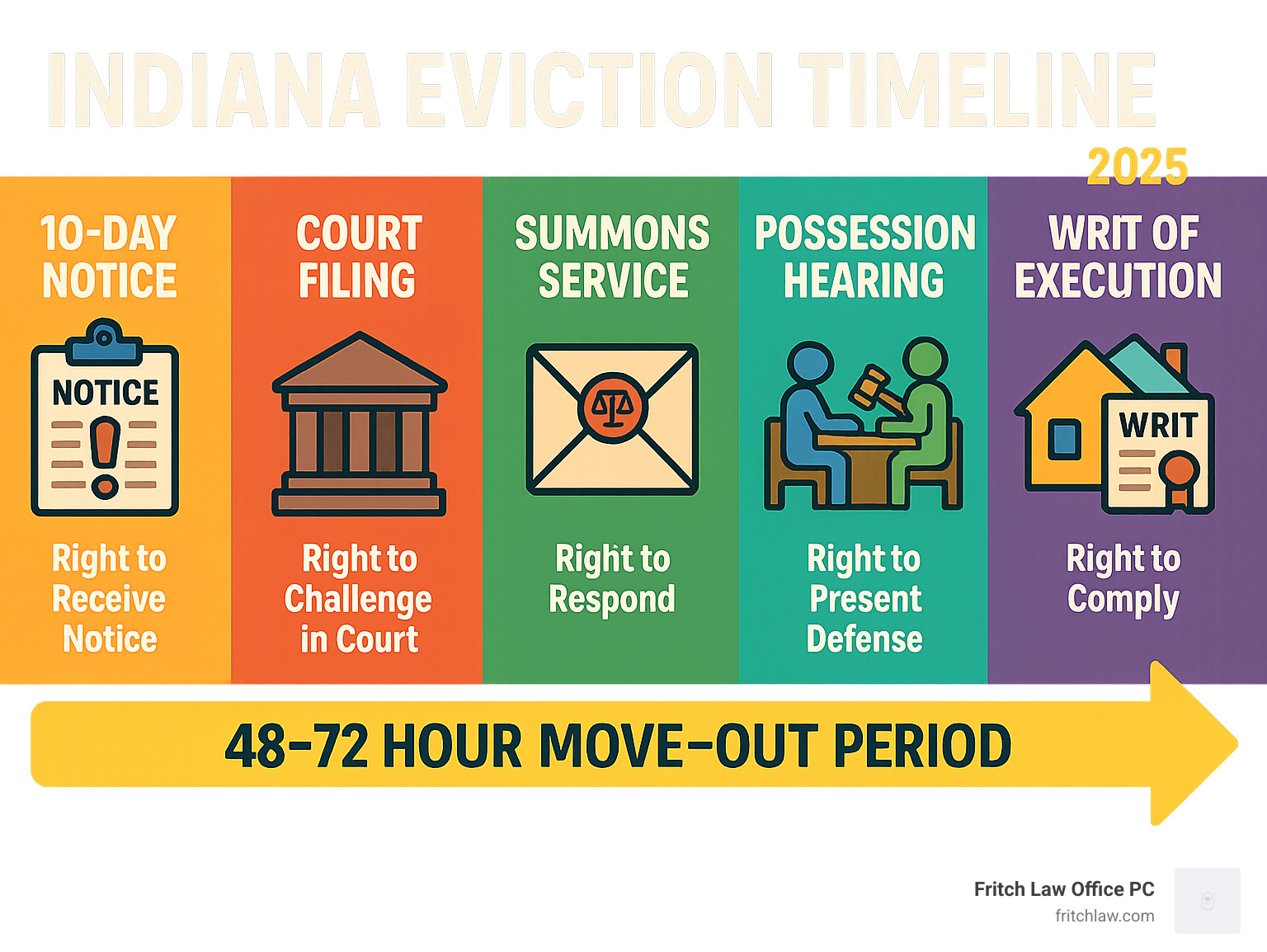
Indiana tenant eviction rights terms at a glance:
- attorney for tenants near me
- housing lawyers for tenants
- what is considered landlord retaliation in indiana
Understanding Legal Grounds for Eviction in Indiana
An eviction is a formal legal process, and a landlord needs a valid, legally recognized reason to start it. They cannot evict you arbitrarily; they must have legitimate “cause.”
- Non-Payment of Rent: This is the most common reason. If you’re behind on rent, your landlord must give you a 10-day notice to pay before filing in court. This notice provides a window to pay the amount due and stop the eviction.
- Lease Violations: Violating terms of your lease, such as having an unauthorized pet or creating disturbances, can be grounds for eviction. The landlord must still provide proper notice.
- Illegal Activity: Committing illegal acts on the property is a serious violation. For these cases, landlords must provide a 45-day notice to vacate.
- Holdover Tenants: If you stay past your lease expiration without permission, you are a holdover tenant. Landlords must give 30 days’ notice to end a month-to-month tenancy or 90 days’ notice for a yearly lease.
- Property Damage: Deliberately damaging the property, known as “waste,” is another legal ground for eviction. In severe cases, this can lead to immediate removal proceedings.
Your lease agreement is the foundation of your tenancy. It outlines your responsibilities and your landlord’s obligations. These reasons for eviction must be legitimate and provable in court, which is where your Indiana tenant eviction rights become critical.
For more details, see More info about Indiana Landlord Laws and the governing statutes in Indiana Code Title 32 Article 31.
The Eviction Notice: Your First Warning

Before filing a lawsuit, a landlord must give you a formal written notice. This document serves as an official warning, stating the problem and providing a deadline to fix it. When you receive a notice, read it carefully. Check for correct names, addresses, dates, and a clear reason for the eviction. Proper service (delivery) of the notice is also required by law. Any errors in the notice or its delivery can be a defense in court.
Types of Indiana Eviction Notices and Timelines
Understanding the type of notice you receive is key to protecting your Indiana tenant eviction rights.
- 10-Day Notice to Pay Rent: For late rent. You have 10 days to pay the full amount owed to stop the eviction process.
- Notice to Cure or Quit: For lease violations other than non-payment. It gives you a “reasonable amount of time” to fix the issue (e.g., remove an unauthorized pet).
- 45-Day Notice to Vacate: For serious violations like illegal activity. This notice does not offer a chance to fix the problem; it demands you move out.
- 30-Day Notice to Quit: Used to end a month-to-month tenancy without cause. The landlord simply wants to end the tenancy.
- 90-Day Notice to Quit: Used to end a yearly lease that is not being renewed.
Responding to a notice is critical. If you can fix the problem, do so within the deadline. If you dispute the notice, communicate with your landlord in writing and keep copies of everything. A notice is the first step, not the final word.
Illegal Evictions vs. The Legal Court Process
Your landlord cannot just kick you out, no matter the circumstances. They must obtain a court order first. Any attempt to force you out without going through the courts is an illegal “self-help eviction” under Indiana tenant eviction rights law.

Landlords are prohibited from taking matters into their own hands. Here’s what they cannot legally do:
- Change Locks: A landlord cannot legally change your locks, add deadbolts, or remove doors to keep you out.
- Shut Off Utilities: It is illegal to cut your electricity, water, gas, or heat to pressure you into moving, even if you are behind on rent.
- Remove Your Belongings: Your landlord cannot take your personal property from your home or prevent you from accessing it without a court order.
- Forcible Removal: Only law enforcement officers with a court-issued “Writ of Possession” can physically remove you from the property.
The legal court process is entirely different. It begins after proper notice is given, when the landlord files a complaint in small claims court. You will then be served with a summons notifying you of the lawsuit and your court date. At the hearing, a judge will hear both sides and make a decision.
Protecting Your Indiana Tenant Eviction Rights Against Illegal Actions
If your landlord attempts an illegal eviction:
- Call the police immediately. An illegal lockout is a criminal offense.
- Document everything. Take photos or videos of changed locks or shut-off utilities. Keep a detailed log of events.
- Seek legal counsel. An experienced lawyer can help you get a court order to regain entry and can sue your landlord for damages. Landlords who perform illegal evictions may have to pay your court costs and attorney’s fees.
For more information, see More info about Eviction Laws in Indiana.
What to Do Immediately After Receiving an Eviction Notice
An eviction notice is a call to action, not a final judgment. Your response is critical.
- Do not ignore it. Missing the deadline on the notice gives your landlord a major advantage.
- Review your lease. Compare the claims in the notice to the terms of your lease agreement.
- Document everything. Keep the notice, rent receipts, bank statements, and all communication with your landlord.
- Communicate in writing. If you try to resolve the issue, create a paper trail. Use certified mail or email with read receipts.
- Seek legal advice. A lawyer can help you understand your options and protect your Indiana tenant eviction rights, even if you believe you are at fault.
Your goal is to either resolve the issue before a lawsuit is filed or build a strong defense. For a breakdown of the process, see More info about the Indiana Tenant Eviction Process in 5 Steps.
Defending Your Case: A Tenant’s Guide to the Eviction Hearing
If your landlord files an eviction lawsuit, you must appear in court. If you don’t show up, the court will likely issue a “default judgment,” meaning your landlord wins automatically.

Indiana eviction hearings typically happen in small claims court and have two parts:
- The Possession Hearing: This first hearing determines if the landlord has the right to regain possession of the property. It usually happens quickly, often within weeks of the filing.
- The Damages Hearing: This hearing, which may occur later, determines if money is owed for things like unpaid rent or property damage.
To prepare for court, gather all your evidence. Bring your lease, rent receipts, bank statements, notices, emails, text messages, and any repair requests. Organize everything chronologically. Photos, videos, and witness testimony can also be powerful evidence. Prepare what you want to say to the judge in advance, sticking to the facts calmly and clearly.
Common Defenses and Your Indiana Tenant Eviction Rights
Several common legal defenses can protect your Indiana tenant eviction rights:
- Improper Notice: The landlord must follow strict notice requirements. If they gave you the wrong type of notice, an incorrect timeline, or served it improperly, the case may be dismissed.
- Landlord Retaliation: A landlord cannot evict you for exercising a legal right, such as reporting unsafe conditions to a health department or requesting necessary repairs.
- Breach of Warranty of Habitability: Landlords must provide safe and habitable housing. If they failed to do so after you gave them proper notice of the problems, this can be a defense.
- Discrimination: It is illegal to evict a tenant based on race, color, religion, sex, national origin, familial status, or disability under the Fair Housing Act. Some local ordinances offer additional protections.
- Landlord Accepted Partial Rent: If your landlord accepted a partial rent payment after serving a notice, they may have waived their right to evict you for that specific non-payment.
- False Allegations: If the landlord’s claims are untrue (e.g., they claim property damage but you have proof otherwise), you can present your evidence to dispute it.
An eviction filing can harm your rental history, so take the proceedings seriously. For more on your rights, visit More info about your Tenant Rights in Indiana.
Can I Withhold Rent for Repairs in Indiana?
No. In Indiana, you generally cannot withhold rent or use rent money to make repairs. Unlike some states, Indiana law does not allow for “repair and deduct.” If you stop paying rent for any reason, you can be evicted for non-payment.
If your landlord fails to make necessary repairs, you should:
- Continue to pay your rent on time.
- Notify your landlord of the issue in writing. Keep a copy of the dated notice.
- Allow the landlord access to make the repairs.
- Seek legal recourse if they fail to act. You can contact your local health department or sue the landlord in small claims court for damages caused by their failure to repair. In severe cases where the unit is uninhabitable, you may have grounds to terminate the lease, but you should seek legal advice before doing so.
After the Verdict: Understanding Your Indiana Tenant Eviction Rights Post-Hearing
If a judge rules against you, you will be given a specific date to move out, often within 48-72 hours. If you don’t leave by this deadline, the landlord can get a Writ of Execution (or Writ of Possession) from the court. This document authorizes law enforcement to remove you.
Once the sheriff or constable receives the writ, they will typically give you a final 48-72 hours to leave voluntarily. If you remain, they have the legal authority to physically remove you and your belongings. This is the only legal way a tenant can be forcibly removed.
An eviction judgment creates a public record that can make it harder to find housing in the future. In some limited circumstances, you may be able to pursue eviction sealing to hide the record from public view. If you believe the judge made a legal error, you may be able to appeal the judgment, but this is a complex process with strict deadlines that requires immediate legal guidance.
For more details on your options after a judgment, visit More info about your Tenant Rights after an Indiana Eviction.
Handling Personal Belongings After an Eviction
Indiana tenant eviction rights protect your personal property even after an eviction. A landlord cannot simply take or dispose of your belongings without a court order.
If you leave property behind, the landlord must get a court order to remove it. They must then have the items moved and stored by a professional storage company (a “warehouseman”). The landlord must notify you where your items are stored.
You have 90 days to claim your belongings from the storage facility. You will be responsible for paying the moving and storage fees. If you do not claim your property and pay the fees within 90 days, the storage company may sell it to cover their costs under a warehouseman’s lien.
It is always best to take all your belongings with you when you move.
Your Security Deposit After an Eviction
Being evicted does not mean you automatically forfeit your security deposit. Your Indiana tenant eviction rights still apply.
By law, a landlord must return your security deposit within 45 days of you moving out, as long as you provide a forwarding address in writing. If they keep any portion of the deposit, they must give you an itemized list of deductions.
Landlords can legally deduct for unpaid rent and damages beyond normal wear and tear. They cannot charge for routine issues like faded paint or worn carpet from regular use. The distinction is important: large holes in walls are damage, but minor scuffs are normal wear and tear.
If your landlord fails to return your deposit or provide the list within 45 days, you can sue them in small claims court. If you win, you may recover the full deposit, court costs, and attorney’s fees.
Always provide a forwarding address in writing when you leave to protect your rights. For more on this topic, see Indiana Security Deposit Laws.
Finding Help: Legal and Financial Resources for Indiana Tenants
Facing an eviction is challenging, but you don’t have to do it alone. Numerous resources in Indiana can help you understand your Indiana tenant eviction rights. Reaching out early is key.

- Indiana Legal Services (ILS): This statewide non-profit offers free civil legal assistance, including court representation, to eligible low-income residents. Their “Renting in Indiana” handbook is an excellent resource.
- Local Legal Aid Societies: Many counties have organizations that offer free or low-cost legal services to those who qualify based on income.
- Emergency Rental Assistance (ERA) Programs: If you are behind on rent, these government-funded programs may be able to help you catch up on payments and avoid eviction. Your local township trustee can often help you access these funds.
- Indiana 2-1-1: This free service connects you with local resources for housing, utilities, food, and legal aid.
Where to Find Free or Low-Cost Legal Assistance
- Indiana Courts Self-Help Center: This official site provides forms and information to help you understand court procedures, though it cannot offer legal advice.
- University Legal Clinics: Law schools like Indiana University and Notre Dame have clinics where law students, supervised by professors, provide free legal services to the community.
- Fair Housing Center of Central Indiana: If you believe your eviction is discriminatory, this organization can provide assistance and guidance.
- Community Navigators: These local non-profit or government programs can help connect you with social services, including rental assistance and legal aid referrals.
For a guide on finding legal help, you can refer to More info about Free Eviction Lawyers for Tenants.
Here are some key phone numbers to keep handy:
- Indiana Legal Services: (844) 243-8570
- Fair Housing Center of Central Indiana: (317) 644-0673
If you are in an emergency situation, such as an illegal lockout, call the police first. For other legal questions about your Indiana tenant eviction rights, contacting one of these organizations or an experienced private attorney is your best course of action.
Conclusion
Facing an eviction is stressful, but Indiana tenant eviction rights provide crucial protections. Your landlord cannot simply kick you out; they must follow a strict legal process. Understanding this process is your greatest advantage.
The most important takeaways are:
- Act Quickly: The moment you receive a notice, the clock starts ticking. A prompt response can change the outcome.
- Self-Help Evictions are Illegal: Landlords cannot change locks, shut off utilities, or remove your belongings to force you out.
- Documentation is Key: Keep records of everything—rent receipts, communications, and photos. This is your evidence.
- The Process Has Rules: Landlords must follow proper procedures. Their mistakes can become your defense.
While you can represent yourself, an experienced lawyer can make a significant difference. At Fritch Law Office PC, we understand the challenges you’re facing and are committed to providing the personalized, client-focused representation you need.
Your rights don’t disappear when you receive an eviction notice. They protect you throughout the entire process and beyond. If you are facing eviction, don’t wait to get help. The sooner you understand your options and build a defense, the better your chances of securing a fair outcome under the law.
Contact an Indiana tenant lawyer for help with your case