
Eviction process in indiana: Complete 2026 Guide
Fritch Law Office handles eviction process in indiana cases for Indiana residents every day. First, our attorneys examine your situation carefully. Next, we identify your strongest legal options. Furthermore, we explain every step in plain language. Therefore, you make confident decisions from day one.
Key Facts About Eviction process in indiana in Indiana
Indiana courts apply strict 2026 rules to eviction process in indiana matters. Moreover, experienced attorneys win better outcomes for clients. Additionally, early legal advice prevents costly mistakes. Consequently, clients who hire Fritch Law gain a clear advantage. However, waiting too long weakens your position significantly.
Take Action on Eviction process in indiana Today
Do not delay your eviction process in indiana case. First, call our Jasper office directly. Next, we schedule your free consultation immediately. Then, we build a winning strategy for you. Additionally, we represent you at every court hearing. Finally, we resolve your case as fast as possible.

Visit the Indiana Courts website for official legal information. Contact Fritch Law for your free consultation today.
Why Understanding Indiana’s Eviction Laws Can Save You Time, Money, and Stress
The eviction process in Indiana is a strict legal procedure. With one of the highest eviction rates in the country—16 filings per 100 rental households in Indianapolis alone—it’s crucial for both landlords and tenants to understand their rights and the required steps to avoid costly mistakes. Missing a single deadline can invalidate an eviction, forcing a landlord to start over.
The 5 Key Steps of Indiana Evictions:
- Notice Period – Landlord serves proper written notice (10-45 days depending on reason)
- Court Filing – Landlord files eviction lawsuit with local court
- Court Hearing – Both parties present their case to a judge
- Judgment – Court issues decision on possession and damages
- Enforcement – Sheriff removes tenant if they don’t vacate voluntarily
Critical Timelines:
- 10 days to pay rent or move (non-payment notices)
- 30 days notice for month-to-month lease termination
- 48-72 hours to vacate after court judgment
- 2 weeks to 4 months for complete eviction process
I’m David Fritch, and at Fritch Law Office PC, I’ve spent 40 years helping clients with complex legal situations. I have guided both landlords and tenants through the eviction process in Indiana, ensuring they understand their rights and obligations under state law.
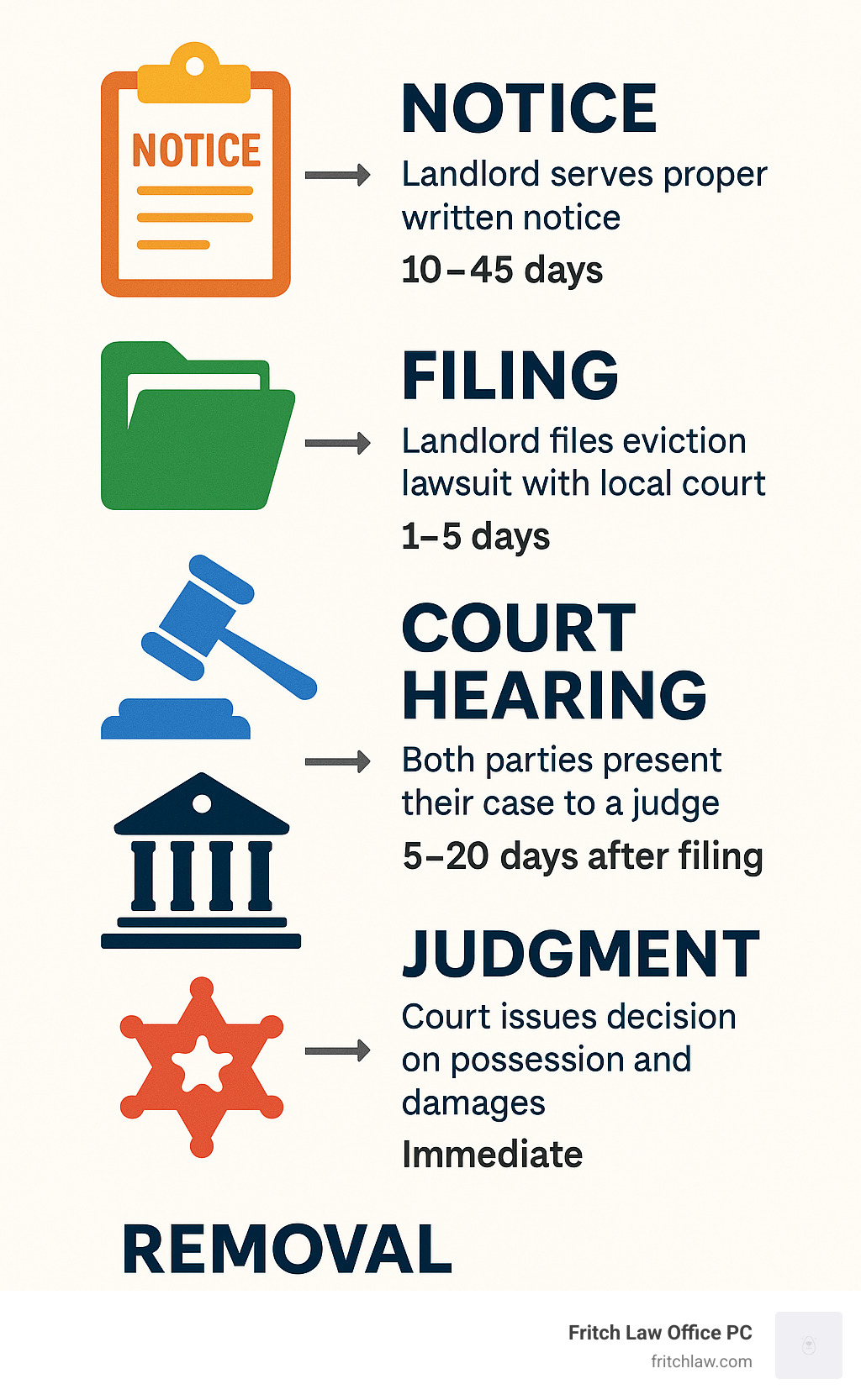
Eviction process in Indiana terms to remember:
Understanding the Legal Grounds for Eviction in Indiana
A landlord cannot evict a tenant without legal justification. Indiana law requires specific legal grounds, usually stemming from a breach of the lease agreement, before the eviction process in Indiana can begin.

The lease is a binding contract that outlines the duties of both parties. When these rules are broken, eviction becomes a legal possibility. The main reasons that can legally justify starting an eviction are detailed below.
Non-Payment of Rent
This is the most common reason for eviction. When rent is not paid by its due date, the landlord must provide the tenant with a 10-day notice to pay rent or move. This notice gives the tenant 10 days to pay the full amount owed, including any late fees specified in the lease. If the tenant pays within this period, the eviction process stops. If they fail to pay, the landlord can proceed with filing an eviction lawsuit. The legal requirement for notice ensures tenants receive fair warning.
Lease Violations
Lease agreements include rules to protect the property and ensure peace among residents. Common violations include property damage, unauthorized pets, noise complaints, and having unauthorized occupants.
For most lease violations, landlords must provide a “notice to cure or quit.” This notice identifies the violation and gives the tenant a reasonable amount of time to fix it. Indiana law does not set a specific timeframe, but it must be sufficient for the tenant to address the problem. If the issue is resolved, the matter is closed. If not, the landlord can proceed with the eviction process in Indiana. Landlords have a duty to notify tenants properly of any violations.
Evictions cannot be retaliatory. You can learn more about what is considered landlord retaliation in Indiana.
Illegal Activity or Committing Waste
For severe violations like illegal activity or “committing waste” (significant property damage), landlords can issue an “unconditional quit notice.” This requires the tenant to move without a chance to fix the issue. Examples include creating a public nuisance, engaging in drug activity, or intentional property destruction.
In these cases, landlords may be able to seek emergency possessory orders from the court to expedite the process. The Indiana Code on waste addresses actions that significantly devalue a property.
End of Lease Term (Holdover Tenants)
Evictions can also occur when a lease ends. For a month-to-month tenancy, landlords must provide a written 30-day notice to quit, informing the tenant that the rental agreement is ending. The termination of month-to-month tenancy rules in Indiana law specify these requirements.
For a fixed-term lease, no notice is required for the lease to end on its specified date. If the tenant remains after the lease expires, they become a “holdover tenant,” and the landlord can begin eviction proceedings.
Understanding these legal grounds is essential for navigating the eviction process in Indiana. For more information on rental regulations, see Indiana Landlord Laws.
The Step-by-Step Eviction Process in Indiana
Once legal grounds are established, the landlord must follow Indiana’s formal court procedure. The eviction process in Indiana requires strict adherence to timelines and documentation, as any error can invalidate the case and force the landlord to start over.

Step 1: Serving the Correct Eviction Notice
The process begins with serving the correct written notice. This document is the legal foundation of the case, and the type of notice depends on the reason for eviction.
| Reason for Eviction | Notice Type | Notice Period | Cure Option? |
|---|---|---|---|
| Non-payment of Rent | 10-Day Notice to Pay | 10 days | Yes |
| Lease Violation (curable) | Notice to Cure or Quit | “Reasonable” time | Yes |
| Month-to-Month Tenancy End | 30-Day Notice to Quit | 30 days | N/A |
| Illegal Activity/Waste/Nuisance | 45-Day Notice to Vacate | 45 days | No |
For non-payment of rent, a 10-Day Notice to Pay Rent is required. For curable lease violations, a Notice to Cure or Quit is used. To end a month-to-month tenancy, a 30-Day Notice to Quit is necessary. For serious issues like illegal activity, a 45-Day Notice to Vacate is served.
Proper service is crucial. The notice can be delivered in person to the tenant, left with another adult at the residence, or posted on the door if no one is home (usually with a copy also sent by mail). The landlord must document the service method as proof for court.
Step 2: Filing the Eviction Lawsuit in Court
If the tenant fails to comply with the notice, the landlord can file an eviction lawsuit (a Complaint for Ejectment or Unlawful Detainer) in the small claims court of the property’s county. The landlord must complete a complaint form detailing the reasons for the eviction and pay filing fees, which are typically around $97 but can vary. Since court procedures may differ by county (e.g., Vigo County vs. Hamilton County), it’s wise to check with the local court clerk.
After filing, the court issues a summons, which officially notifies the tenant of the lawsuit and the court date. The summons must be formally served to the tenant, usually by a sheriff or process server.
For a detailed breakdown, review How to Understand Indiana Tenant Eviction Process in 5 Steps.
Step 3: The Court Hearing and Judgment
The court hearing is where both parties present their case to a judge. The primary hearing is the possession hearing, where the judge decides who has the legal right to the property. Both sides present evidence, such as the lease, payment records, and photos.
If a tenant fails to appear in court, the judge will likely issue a default judgment in the landlord’s favor. This is why attending the hearing is critical for tenants.
A damages hearing, which may occur separately, determines any money owed for unpaid rent, fees, or property damage. If the court rules for the landlord, it issues a judgment for possession. The landlord can then request a Writ of Execution, the court order authorizing law enforcement to remove the tenant.
For more on these procedures, see Eviction Laws in Indiana.
Step 4: Removal of the Tenant
The final step is the physical removal of the tenant, which can only be performed by law enforcement. With a Writ of Execution, the landlord coordinates with the Sheriff’s Office to schedule the removal. The tenant is typically given 48 to 72 hours notice to vacate. For severe violations, this period can be shorter.
If the tenant does not leave by the deadline, the Sheriff will return to forcibly remove them and their belongings. Landlords are strictly forbidden from performing “self-help” evictions, such as changing the locks or shutting off utilities, before the sheriff has completed the removal. Only after law enforcement has officially removed the tenant can the landlord legally change the locks and secure the property.
Tenant Rights and Landlord Prohibitions
The eviction process in Indiana includes significant protections for tenants, and landlords must follow strict rules. The Fair Housing Act and state laws ensure that evictions are conducted fairly and legally, preventing landlords from taking matters into their own hands.

A Tenant’s Rights and Defenses in the Indiana Eviction Process
Tenants facing eviction in Indiana have several important rights and potential defenses:
- Right to Proper Notice: The eviction must begin with a legally valid notice that is delivered correctly and provides the required response time. An improper notice can invalidate the case.
- Right to a Court Hearing: A landlord cannot remove a tenant without a court order. Tenants have an absolute right to appear in court and present their case.
- Defense of Landlord Retaliation: A landlord cannot evict a tenant as payback for exercising a legal right, such as reporting a housing code violation or joining a tenant’s union.
- Breach of Warranty of Habitability: If the landlord has failed to maintain a safe and livable property, this may serve as a defense or support a counterclaim for damages.
- Proof of Payment or Compliance: The most direct defense is providing documentation that rent was paid or that a lease violation was corrected within the notice period. Keep all receipts, bank statements, and communications.
For more guidance on tenant protections, see Indiana Tenant Eviction Rights.
Illegal “Self-Help” Evictions Landlords Must Avoid
Landlords are strictly prohibited from “self-help” evictions, regardless of the tenant’s actions. Attempting to bypass the legal process can result in severe penalties.
Illegal actions include:
- Changing the locks: Only a sheriff can legally remove a tenant, after which the landlord can change the locks.
- Shutting off utilities: Cutting off essential services like water, heat, or electricity without a court order is illegal.
- Removing tenant belongings: A landlord cannot remove a tenant’s personal property from the home without court authorization.
- Harassment: Using threats or intimidation to force a tenant to leave is illegal and can damage a landlord’s case.
- Physical removal by the landlord: Only a law enforcement officer with a court order can physically remove a tenant.
The consequences of illegal evictions can be severe, including lawsuits for damages, court costs, and attorney’s fees. Following the correct eviction process in Indiana is the only legal path forward.
After the Eviction: Property and Legal Resources
The eviction process in Indiana doesn’t end when the tenant leaves. Post-judgment procedures, especially concerning abandoned personal property and finding legal help, are critical to avoiding further complications.
What Happens to a Tenant’s Personal Property?
Indiana law has specific rules for tenant property left after an eviction. A landlord cannot simply dispose of it.
First, the landlord must obtain a court order authorizing the removal of the belongings. Without this, the landlord risks legal trouble. Once the order is granted, the property must be moved to a storage facility for a 90-day storage period. The landlord must provide notice to the tenant (if a forwarding address is available), informing them where their property is stored and how to retrieve it.
The storage facility typically holds a warehouseman’s lien on the items, meaning the tenant must pay the storage fees to get their property back. If the property is not claimed and the fees are not paid within the 90-day window, the facility may proceed with the sale of abandoned property to cover its costs. Certain essential items, like medical equipment or work tools, may be subject to different rules under the Indiana Code on abandoned property.
Where to Find Legal Assistance for the Eviction Process in Indiana
Navigating the eviction process in Indiana can be challenging. Several resources are available for assistance.
- Indiana Legal Services and the Indianapolis Legal Aid Society are non-profit organizations that provide free or low-cost civil legal assistance to eligible low-income residents.
- Township Trustee assistance programs throughout Indiana may offer rental and utility assistance that can sometimes prevent an eviction.
- Hiring an experienced attorney is often the most effective way to protect your interests in complex cases. An attorney can ensure proper procedure is followed, represent you in court, and help you avoid common pitfalls.
At Fritch Law Office PC in Jasper, Indiana, we provide personalized, client-focused legal representation. Whether you need help from our Eviction Lawyers for Landlords or are a tenant seeking information about Free Eviction Lawyers for Tenants, understanding your options is the first step toward a better outcome.
Frequently Asked Questions about Indiana Evictions
Here are answers to common questions about the eviction process in Indiana.
How long does the eviction process typically take in Indiana?
The eviction process in Indiana can take anywhere from 2 weeks to 4 months. The total time depends on several factors: the required notice period (10, 30, or 45 days), the local court’s schedule, and whether the case is contested or uncontested. An uncontested eviction where the tenant doesn’t appear in court is much faster than a contested case that may require multiple hearings and a lengthier legal battle.
Can a landlord evict a tenant without a court order in Indiana?
Absolutely not. A landlord cannot legally evict a tenant in Indiana without a court order. “Self-help” actions like changing the locks, shutting off utilities, or removing a tenant’s belongings are illegal. A landlord who attempts these tactics can face a lawsuit for damages and may be ordered by police to allow the tenant back into the property. The only narrow exception involves clear property abandonment, but this can be difficult to prove and is legally risky for the landlord.
What happens if a tenant misses their eviction court date?
Missing an eviction court date is a critical mistake for a tenant. When a tenant fails to appear, the judge will almost always issue a default judgment in the landlord’s favor. This means the tenant automatically loses the case without presenting a defense. The court will then issue an order of possession, authorizing the Sheriff to remove the tenant from the property.
Attending court is crucial, even if you believe you will lose. It provides an opportunity to speak with the judge, negotiate a payment plan or more time to move with the landlord, or present any defenses you may have. Simply showing up gives you a chance to influence the outcome.
Conclusion
Navigating the eviction process in Indiana requires a clear understanding of the law. We’ve covered the legal grounds for eviction, the step-by-step court process, and the rights of both landlords and tenants. Following these procedures correctly is essential to avoid costly mistakes and protect your interests.
The process is complex, with varying timelines and requirements depending on the circumstances. What works for a non-payment case may not apply to a lease violation. Because of this complexity, seeking legal guidance is a critical step toward a favorable outcome.
At Fritch Law Office PC in Jasper, Indiana, we understand that behind every eviction case are real people dealing with stress. Our personalized, client-focused approach means we take the time to understand your unique situation and guide you through the process step by step.
For personalized assistance from an experienced Landlord Tenant Attorney, contact our office. We’re here to help you steer these challenging situations with confidence and clarity.