Why Understanding Revocable Trusts Can Transform Your Estate Plan
What is a revocable trust? A revocable trust is a legal arrangement where you transfer assets to a trust during your lifetime, while maintaining complete control to modify or cancel it at any time. Also known as a living trust, it allows you to manage your property during your life and provides clear instructions for distribution after your death.
Key Features of a Revocable Trust:
- Complete Control: You can change, amend, or revoke the trust anytime while you’re alive and mentally competent.
- Three Main Players: The grantor (you), trustee (manager), and beneficiaries (recipients).
- Probate Avoidance: Assets in the trust skip the lengthy court probate process.
- Privacy Protection: Unlike wills, trust documents remain private after death.
- Incapacity Planning: Provides seamless asset management if you become unable to handle your affairs.
While revocable trusts offer significant benefits, they aren’t a one-size-fits-all solution. A revocable trust works like a container for your assets with specific rules. You place assets inside it, and upon your death, your chosen successor trustee distributes them according to your wishes—all without court involvement. As one estate planning presentation noted, “The only explicit call to action is to consult an estate planning professional, as doing it alone is not recommended.”
I’m David Fritch, and with 40 years of experience as both an attorney and CPA, I’ve helped clients understand what is a revocable trust and determine if it fits their goals. My background in tax planning and estate law provides insight into how these trusts work in practice.
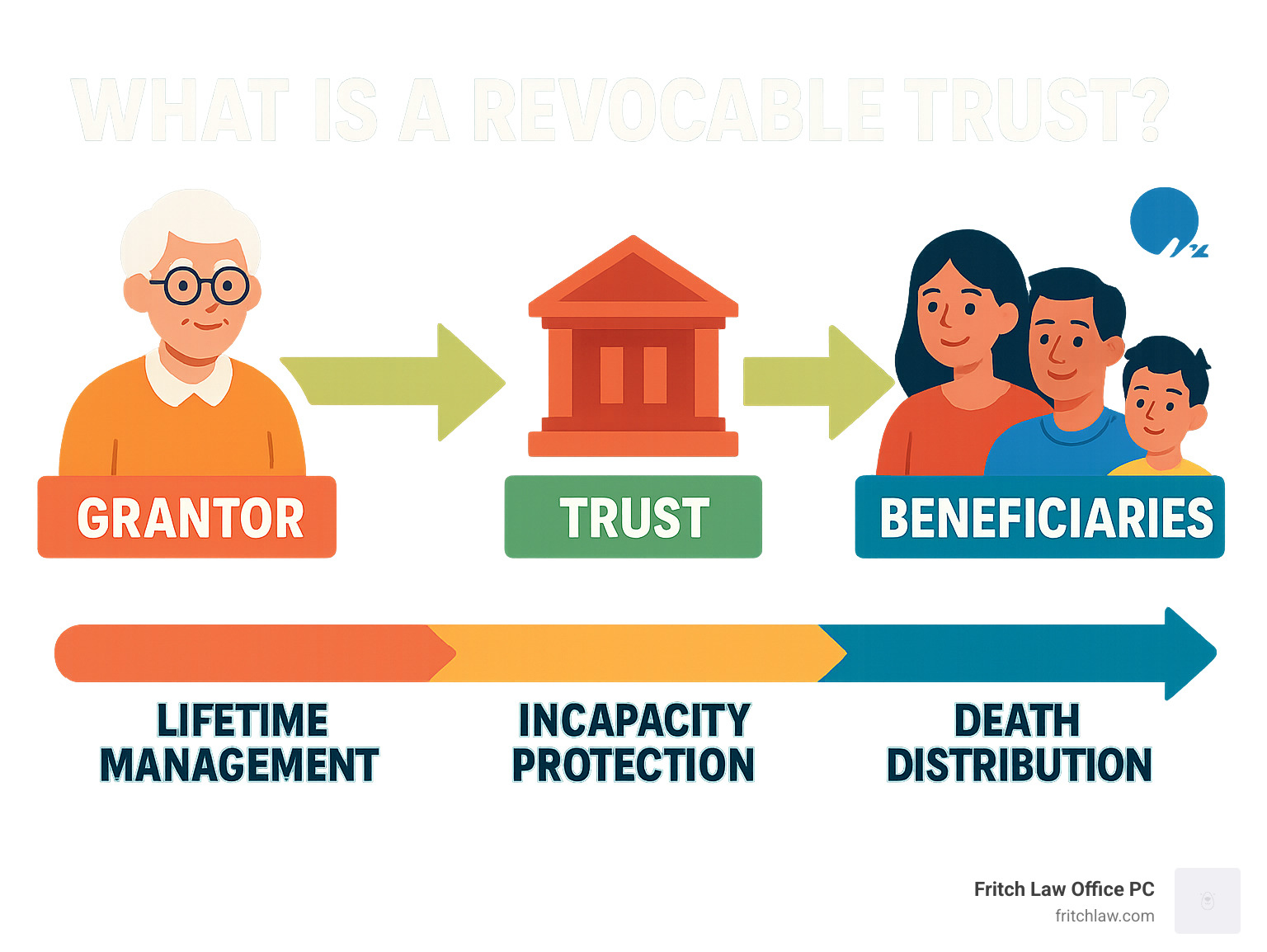
What is a Revocable Trust? The Key Players and Concepts
At its core, a revocable trust is a legal entity that owns property, established through a document called a trust agreement. This agreement outlines how your property will be managed and distributed. It’s a flexible tool, as you can amend or even undo it during your lifetime.
Understanding what is a revocable trust requires knowing the key players:
- Grantor (or Settlor): The person who creates the trust and transfers assets into it. This is usually you.
- Trustee: The person or entity responsible for managing the trust’s assets according to the trust agreement.
- Beneficiary: The individuals or organizations who will benefit from the assets in the trust.
As the Consumer Financial Protection Bureau explains, a revocable living trust is “an arrangement set up through a legal document that gives someone the power to make decisions about another person’s money or property held in the trust.”
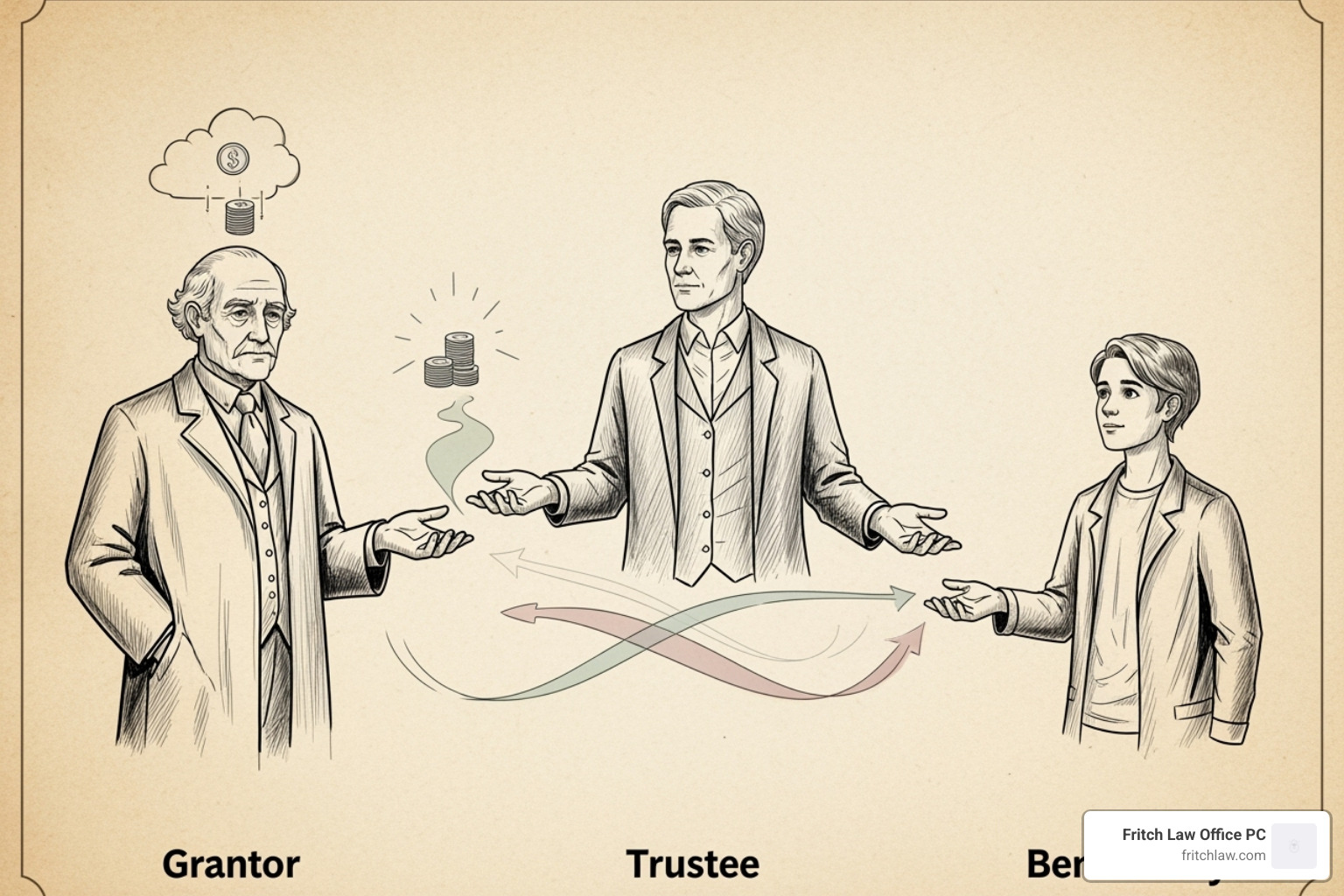
The Three Core Roles Explained
Initially, the grantor often fills all three roles: grantor, trustee, and primary beneficiary. This means you maintain complete control over your assets. You can add or remove assets, change beneficiaries, and alter the trust’s terms at any time while you are alive and mentally competent.
The real power of a revocable trust emerges when you name a successor trustee. This person or entity steps in to manage the trust if you become incapacitated or pass away. This planning for incapacity allows for continuous management of your finances without court intervention, like a guardianship. The trustee has a fiduciary duty to act in the best interest of the beneficiaries, and you can read a guide for trustees on managing someone else’s money for more information.
Funding Your Trust: What Assets Can Be Included?
A living trust is only effective once you put assets into it. This process is called funding the trust or retitling assets. You must legally transfer ownership of your assets from your individual name into the name of the trust. An unfunded trust provides no benefits.
Most assets can be transferred into a revocable trust, including:
- Real Estate: Your home and other properties, which is useful for avoiding ancillary probate if you own property in multiple states.
- Financial Accounts: Bank accounts and brokerage accounts.
- Valuable Personal Property: Jewelry, artwork, and collectibles.
However, certain assets should generally not go into a revocable trust without careful planning due to tax implications or specific rules:
- Retirement Accounts (IRAs, 401(k)s): These have beneficiary designations that usually override a trust.
- Health Savings Accounts (HSAs): These also have specific tax rules and beneficiary designations.
- Life Insurance Policies: You can name the trust as a beneficiary, but the policy itself is not usually transferred into the trust.
- UGMA/UTMA Accounts: These are already structured for minors and don’t need to be in a trust.
How a Revocable Trust Functions: From Creation to Distribution
The beauty of a revocable trust lies in its dynamic nature. It’s an active tool that offers flexibility and control over your assets throughout your lifetime and beyond. As the American Bar Association points out, revocable trusts are a key part of estate planning for many families because they adapt to life’s journey.

During the Grantor’s Lifetime
As the grantor, you retain full power to manage, amend, or even revoke your revocable trust. You can change beneficiaries, modify distribution plans, add or remove assets, or dissolve the trust entirely. Most people serve as their own trustee, handling finances as they always have. For income tax purposes, the trust is transparent, and no separate trust tax return is usually required.
A key strength of a revocable trust emerges if you become incapacitated. Your named successor trustee can immediately step in to manage your trust assets, pay bills, and ensure your care without needing a court-appointed guardian. This avoids a public, time-consuming, and expensive guardianship process, ensuring your wishes are honored without burdening your loved ones. For more information on managing financial affairs, you can refer to our article about Attorney Fees for Power of Attorney.
After the Grantor’s Death
Upon your death, the revocable trust becomes irrevocable, meaning its terms are fixed. Your successor trustee takes over, managing and distributing the trust’s assets according to your instructions.
The most significant advantage here is probate avoidance. Since the trust owns the assets, they bypass the public, costly, and time-consuming probate court process. This allows for a quicker, more private, and cost-effective transfer of assets to your beneficiaries.
The successor trustee’s duties include gathering and valuing assets, paying final debts and taxes, and distributing the remaining assets as you specified. This can involve lump-sum payments, staggered distributions, or holding assets in trust for specific purposes like education. Our firm in Jasper, Indiana, has extensive experience helping families with the post-death administration of trusts. Learn more about our Probate Law Services Indiana.
The Great Debate: Advantages vs. Disadvantages of a Revocable Trust
Is a revocable trust the right choice for you? The answer depends on your unique family situation and financial picture. It’s about balancing the benefits and drawbacks to see what aligns with your goals. Considering your potential Estate Planning Cost is a great first step in this conversation.
Key Advantages of a Revocable Trust
Many people choose a revocable trust for the significant peace of mind and simplicity it offers to loved ones. The primary benefits include:
- Probate Avoidance: Properly funded trusts bypass the lengthy, public, and costly probate court process, allowing beneficiaries to receive their inheritance much faster.
- Privacy: Unlike a will, which becomes a public document, a trust’s terms remain private, keeping details about your assets and beneficiaries confidential.
- Incapacity Management: If you become unable to manage your finances, your chosen successor trustee can immediately step in without needing a court-appointed guardianship.
- Avoiding Ancillary Probate: If you own real estate in multiple states, a trust avoids the need for separate, costly probate proceedings in each state.
- Control Over Distribution: You can specify exactly how and when beneficiaries receive their inheritance, which is useful for providing for minors, staggering payments, or setting conditions.
- Immediate Asset Availability: A successor trustee can quickly access trust assets to pay immediate expenses without the delays of probate.
Common Disadvantages and Misconceptions
While the advantages are compelling, it’s crucial to understand the drawbacks and common misunderstandings:
- Higher Upfront Costs: Setting up and funding a trust generally costs more than a simple will. However, this initial expense can lead to savings later by avoiding probate fees. For a deeper dive, see our article on How Much Does a Revocable Trust Cost?.
- Administrative Complexity: You must actively manage the trust, ensuring new assets are properly titled in its name to receive its benefits.
- No Tax Advantages: A common misconception is that revocable trusts save on estate or income taxes. For tax purposes, the assets are still considered part of your personal estate. As one source notes, “Revocable trusts are not tax shelters and provide no tax benefits.”
- No Creditor Protection: During your lifetime, assets in a revocable trust are generally not protected from your creditors.
- Funding Requirement: A trust is ineffective if not properly funded. Failure to retitle assets into the trust means they will still go through probate.
- Not a Replacement for a Will: A trust works with a special “pour-over will,” which acts as a safety net for forgotten assets and is the only document where you can name guardians for minor children.
Revocable Trusts vs. Other Estate Planning Tools: A Head-to-Head Comparison
Building a solid estate plan involves understanding how different legal tools work together. A will and different types of trusts each play a vital role. Creating a comprehensive plan that fits your needs is key, and an experienced Estate Planning Attorney in Indiana can help guide you.
Revocable Trust vs. Irrevocable Trust
The main difference is in the name: a revocable trust can be changed, while an irrevocable trust generally cannot. This distinction has huge implications for asset management and protection.
A revocable trust offers maximum flexibility. As the grantor, you maintain complete control, but this means assets are not protected from creditors and offer no special tax benefits. Its primary purpose is probate avoidance and incapacity management.
An irrevocable trust involves giving up control over the assets placed within it. This lack of flexibility is what provides powerful asset protection from future creditors and lawsuits. It can also offer significant tax advantages for large estates and play a role in long-term care planning.
Choosing between them depends on your goals. For flexibility and probate avoidance, a revocable trust is often ideal. For asset protection and tax planning, an irrevocable trust may be the better strategic choice.
Revocable Trust vs. a Will
A common question is whether a trust replaces a will. The answer is no; they serve different but complementary purposes.
Here’s a side-by-side comparison:
| Feature | Revocable Trust | Last Will and Testament |
|---|---|---|
| Effectiveness | Becomes effective upon creation and funding. | Becomes effective only upon your death. |
| Probate | Avoids probate for assets titled in the trust. | Requires probate for assets titled in your individual name. |
| Privacy | Private document, terms are not public record. | Public record once filed with the probate court. |
| Incapacity Planning | Provides seamless management if you become incapacitated. | Does not address incapacity; requires separate Power of Attorney. |
| Cost (Upfront) | Generally higher due to complexity and funding. | Generally lower, simpler to draft. |
| Cost (Post-Death) | Can be lower by avoiding probate fees and delays. | Can be higher due to probate fees and legal costs. |
| Guardian for Minors | Cannot appoint guardians for minor children. | The only document that can appoint guardians for minor children. |
| Funding Required | Yes, assets must be retitled into the trust. | No, directs distribution of individually owned assets. |
A revocable trust excels at probate avoidance and incapacity planning. However, a will is still essential. We almost always recommend a “pour-over will” to act as a safety net, catching any assets not transferred to the trust. Crucially, a will is also the only legal document where you can name guardians for minor children. Understanding the nuances of these documents and Indiana Probate Law is where our experience can make a difference.
Practical Guide to Setting Up and Maintaining Your Trust
Setting up a revocable trust is a precise legal process that benefits from professional guidance to ensure it’s valid under state laws, like those in Indiana. It’s the foundation for your financial future, and an Estate Planning Attorney Consultation is a great place to start.

Key Steps in Creating a Trust
Establishing a revocable trust involves several important steps:
- Drafting the Trust Document: An experienced attorney will craft a customized agreement that reflects your wishes, names your successor trustees and beneficiaries, and sets the rules for managing and distributing your assets.
- Choosing a Successor Trustee: This is a critical decision. You’ll select a trusted, financially responsible person or entity (like a bank) to manage your assets if you cannot and distribute them after your death.
- Funding the Trust: A trust is only effective if it holds assets. This means legally changing the title of your assets (like real estate deeds and bank accounts) from your individual name into the name of the trust.
- Ongoing Maintenance: A trust is not a “set-it-and-forget-it” tool. We recommend reviewing your plan regularly, especially after major life events like births, deaths, or marriages, to ensure it remains aligned with your goals.
Understanding the Costs and Other Considerations
It’s natural to wonder about the costs. While initial Estate Planning Attorney Fees for a trust are higher than for a will, this can lead to significant savings later by avoiding probate.
Other key points to remember:
- FDIC Insurance: Cash accounts in a trust are insured by the FDIC. As of April 1, 2024, funds are insured up to $250,000 per beneficiary (up to five beneficiaries, for a maximum of $1.25 million per bank), providing a substantial safety net.
- Complexity: Trusts are more complex than wills due to the drafting, funding, and administration involved. However, this complexity provides greater control, privacy, and the benefit of probate avoidance.
Given the intricacies of trust law and the importance of proper funding, consulting an experienced estate planning attorney is crucial to ensure your trust is legally sound and customized to your needs.
Conclusion
After exploring what is a revocable trust, it’s clear this is a powerful and flexible estate planning tool. It offers peace of mind by bypassing the public probate process, keeping your financial details private, and ensuring seamless asset management if you become incapacitated. It gives you a clear voice for how your property is handled during your lifetime and beyond.
However, a revocable trust is not a magic bullet. Key takeaways are that it offers no special tax breaks or creditor protection during your lifetime and requires careful funding by retitling assets. It works best when paired with a “pour-over will” and other essential documents.
Deciding if a revocable trust is right for you depends on your unique circumstances and goals. There is no one-size-fits-all answer, which is why professional guidance is so important.
At Fritch Law Office PC in Jasper, Indiana, we provide personalized, client-focused legal representation. We can help you understand your options and craft an estate plan that aligns with your family’s needs.
Don’t leave your legacy to chance. Let’s work together to ensure your wishes are honored. Start your Indiana estate plan today and gain the peace of mind you deserve.