
Understanding How Probate Court Works: A Necessary Legal Process
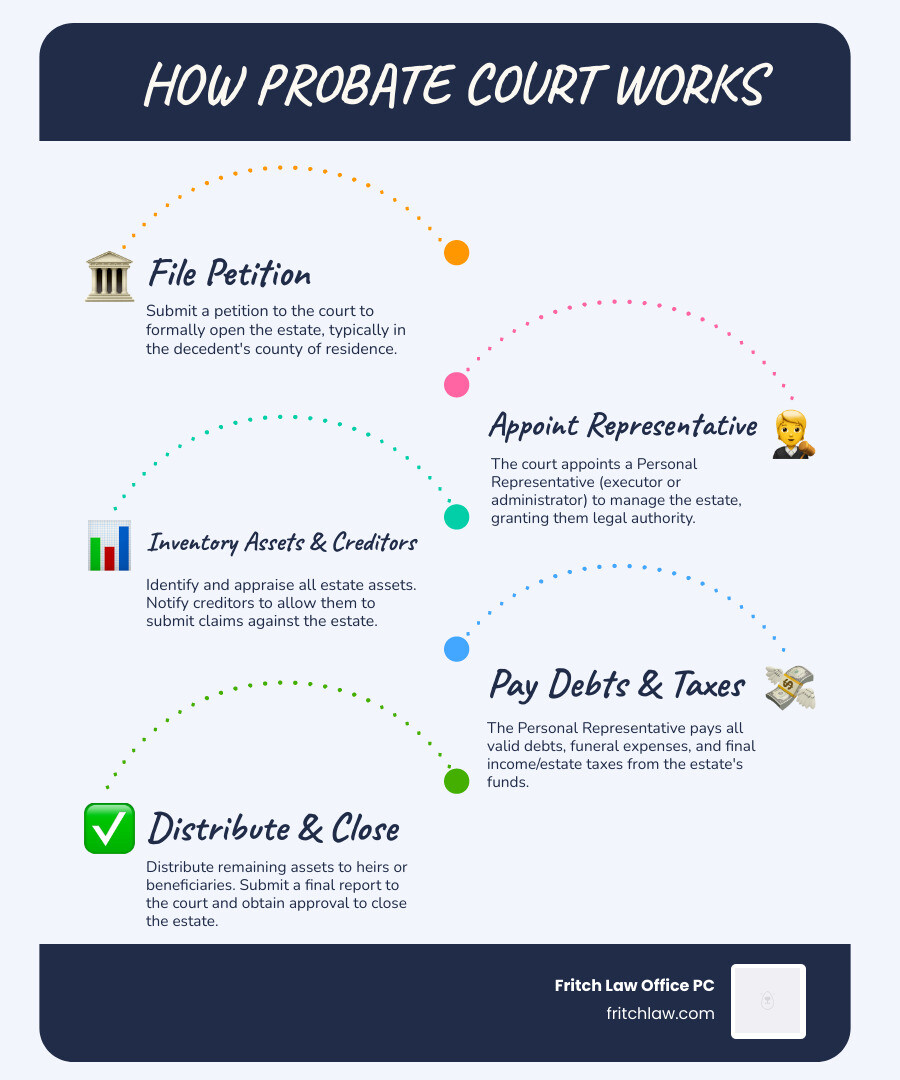
How does probate court work? Probate court is a legal process where a judge oversees the distribution of a deceased person’s estate. It validates their will and ensures debts are paid before assets are transferred to beneficiaries. The process typically involves these key steps:
- Filing a petition to open the estate.
- Appointing a personal representative (executor or administrator).
- Inventorying assets and notifying creditors.
- Paying debts and taxes from the estate.
- Distributing remaining assets to beneficiaries.
- Closing the estate with court approval.
Losing a loved one is difficult, and the legal procedures that follow can feel complex. The probate process exists to protect everyone involved by ensuring the deceased’s wishes are honored, creditors are paid, and beneficiaries receive their rightful inheritance. Understanding the basic steps can help families steer this challenging time with more confidence.
Most probate proceedings follow a predictable pattern, though the timeline varies based on estate size, the existence of a valid will, and family agreement. Simple estates without disputes can take six to nine months, while complex cases may extend beyond a year.
David Fritch has spent over 40 years helping families with probate proceedings as both an attorney and CPA. His experience includes guiding personal representatives through estate administration and helping families understand their rights.
Essential how does probate court work terms:
- does indiana law require estate to go through probate
- indiana law executor probate
- indiana probate law small estate
What is Probate Court and Who is Involved?
Probate court is the legal body that oversees the probate process—the procedure for distributing an estate after someone dies. It is a court-supervised process that validates a will, ensures assets are collected and debts are paid, and distributes the remaining property to the correct heirs or beneficiaries. This framework provides for the orderly transfer of assets and the resolution of any disputes.
The rules governing probate are set at the state level, so the specifics of how does probate court work can vary. However, the core function remains consistent: to provide a legal and transparent method for settling a deceased person’s estate.
To learn more about how we can help, please explore More info about our Probate services. You can also find general information on Wills and Estates information from the ABA.
The Key Parties in a Probate Case
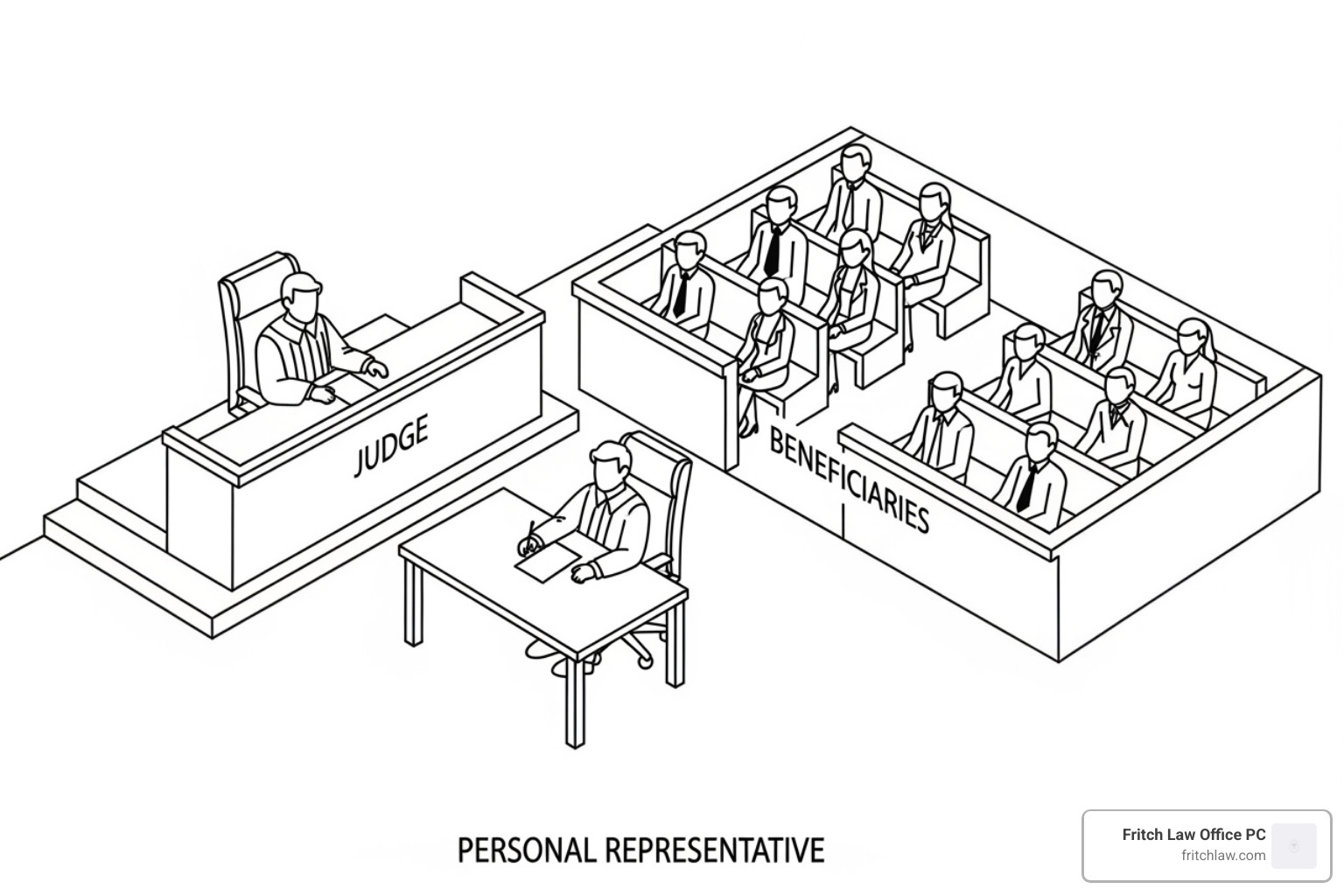
Navigating probate involves several key players, each with distinct roles. Understanding who these parties are helps explain how does probate court work.
- Decedent: The legal term for the person who has passed away.
- Probate Judge: The judge who presides over the court, overseeing the process, validating the will, appointing the personal representative, and resolving disputes.
- Personal Representative: The individual appointed by the court to manage the estate. In Indiana, they are often called the “personal representative.”
- Executor vs. Administrator: If the decedent had a will naming someone to manage their estate, that person is the executor. If there was no will, or the named executor cannot serve, the court appoints an administrator, typically a close relative.
- Heirs and Beneficiaries: The individuals or entities entitled to receive assets from the estate. “Beneficiaries” are named in a will, while “heirs” inherit according to state law when there is no will.
- Creditors: Individuals or entities to whom the decedent owed money. The probate process includes a period for creditors to make claims against the estate.
- Estate Planning Attorney: An experienced probate attorney guides the personal representative and family through the complexities of probate, providing legal advice and preparing court documents. For more information, please visit More info about our Estate Planning and Probate Attorney services.
Probate vs. Non-Probate Assets
A crucial part of understanding how does probate court work is differentiating between probate and non-probate assets. This determines which assets are subject to the court-supervised process.
-
Probate Assets: These are assets owned solely by the decedent that must go through probate to be legally transferred. Examples include:
- Solely-owned property: Real estate, bank accounts, and personal property titled only in the decedent’s name.
- Tenancy in Common Property: The decedent’s share of property owned as “tenants in common.”
- Assets without a named beneficiary: A life insurance policy or retirement account where no beneficiary is named or the beneficiary is deceased.
-
Non-Probate Assets: These assets transfer directly to a survivor or beneficiary upon death, bypassing probate. This saves time, money, and maintains privacy. Examples include:
- Joint Tenancy with Right of Survivorship: Property where the surviving owner automatically inherits the deceased’s share.
- Life Insurance Policies & Retirement Accounts (401k, IRA): Proceeds are paid directly to the named beneficiary.
- Assets in a Living Trust: Property is managed and distributed by a trustee according to the trust’s terms.
- Payable-on-Death (POD) / Transfer-on-Death (TOD) Accounts: Bank or brokerage accounts with a designated beneficiary.
Understanding these distinctions is vital for estate planning. Our team can help you understand More info on Indiana Non-Probate Claims Law and how it impacts your situation.
The Step-by-Step Guide: How Does Probate Court Work?
Understanding how does probate court work is clearer when broken into steps. While details vary by state, the court procedure follows a pattern designed to protect all parties. The process typically takes six to nine months for straightforward cases, but disputes can extend the timeline.
The legal requirements, while seemingly complex, exist to prevent fraud, ensure debts are paid, and provide a clear record for property transfers. Let’s walk through each stage of the timeline.

Step 1: Filing a Petition to Open the Estate
The process begins by filing key documents with the probate court in the county where the deceased lived.
- Filing the will: The original will is filed with the court, usually within 30 days of death.
- Petition for probate: This formal document asks the court to open a probate case and, if there is a will, to validate it and appoint the named executor.
- Submitting the death certificate: A certified copy of the death certificate is required as official proof of death.
For specific guidance on procedures in Indiana, please refer to More info on Indiana Probate Court.
Step 2: Appointing a Personal Representative
Next, the court appoints someone to manage the estate, granting them legal authority to act on its behalf.
- Court appointment: The judge reviews the petition and appoints a suitable person.
- Executor vs. Administrator: The person named in the will (executor) has first priority. If there is no will, the court appoints an administrator, typically following a legal priority list (e.g., spouse, then adult children).
- Issuing Letters: The court issues Letters Testamentary (for an executor) or Letters of Administration (for an administrator). These documents are the official proof of authority needed to manage estate assets.
- Fiduciary duty: The personal representative has a legal duty to act honestly and in the best interests of the estate.
- Posting a bond: The court may require a bond, which is an insurance policy to protect the estate from mismanagement. Many wills waive this requirement.
Step 3: Inventorying Assets and Notifying Creditors
The personal representative must determine what the estate owns and notify creditors.
- Identifying and appraising assets: The representative locates all assets (bank accounts, real estate, personal property) and has them appraised to determine their value as of the date of death.
- Creating an inventory: A detailed list of all assets and their values is filed with the court.
- Notifying creditors: A notice is published, typically in a local newspaper, to inform potential creditors of the death and the deadline for submitting claims.
- Creditor claim period: Creditors have a limited time (often a few months) to file claims. After this period, late claims are usually barred.
Step 4: Managing the Estate: Paying Debts and Taxes
Before beneficiaries receive anything, the personal representative must pay the estate’s valid debts and taxes.
- Paying valid claims: The representative reviews all creditor claims, disputes any invalid ones, and pays the legitimate debts.
- Priority of debts: Debts are paid in an order set by state law. Administrative costs, funeral expenses, and final medical bills typically have the highest priority.
- Filing tax returns: The representative must file the decedent’s final personal income tax return. An estate income tax return may also be required if the estate earns income during administration.
- Estate tax: Federal estate taxes apply only to very large estates (over $12.92 million for 2023). Most estates do not owe federal estate tax.
Step 5: Distributing Assets and Closing the Estate
This is the final stage, where assets are transferred to beneficiaries and the estate is formally closed.
- Final accounting: The representative prepares a detailed report of all money that came into and went out of the estate. This is filed with the court for approval.
- Petition to distribute assets: A formal request is made to the court for permission to distribute the remaining assets.
- Transferring property: Once approved, assets are transferred to the beneficiaries. This involves preparing new deeds for real estate, distributing funds, and delivering personal items.
- Closing the estate: After all duties are complete, the court issues an order discharging the personal representative and officially closing the estate.
Key Scenarios and Considerations in Probate
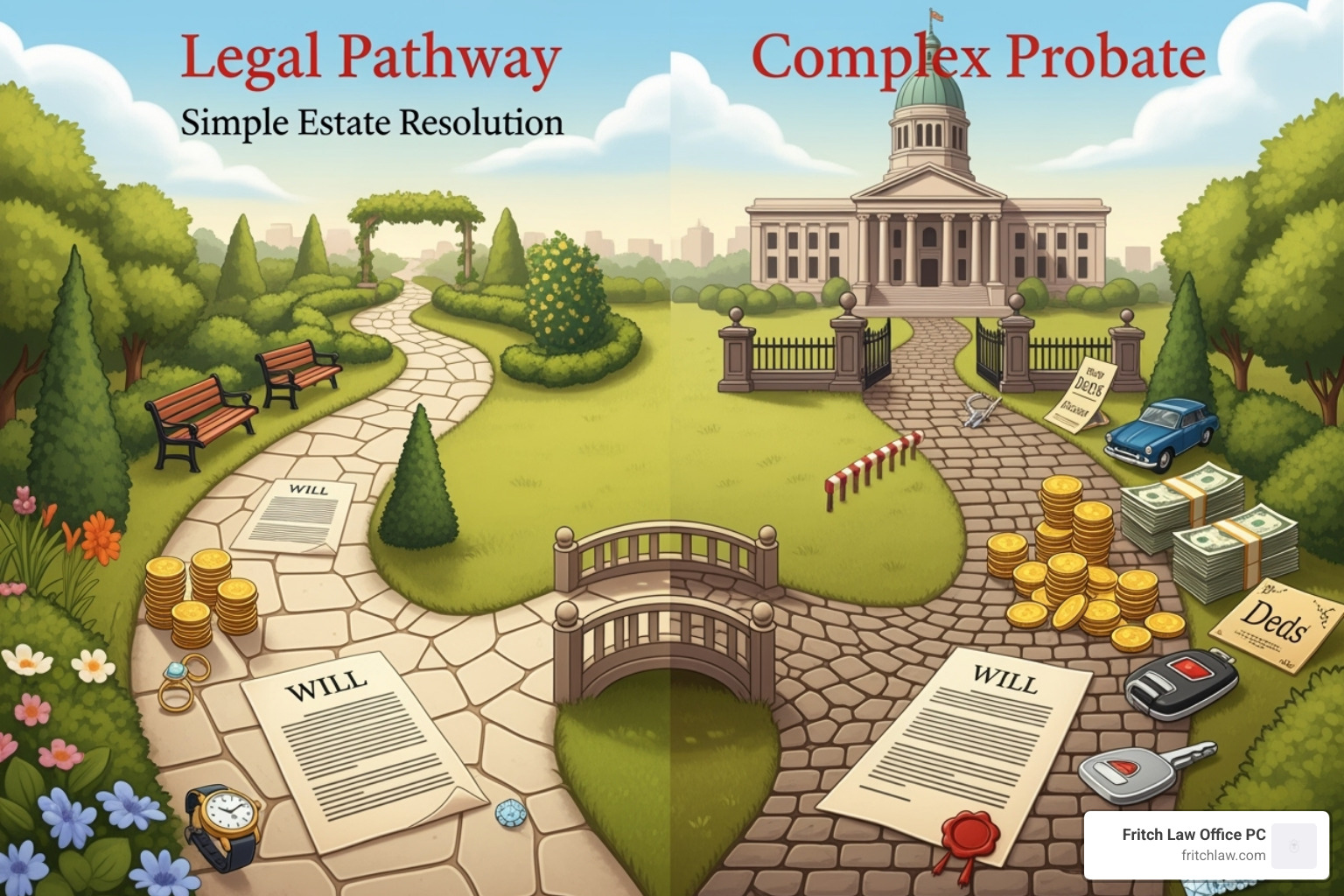
While the general steps of how does probate court work are consistent, the process can change based on specific circumstances like the existence of a will or disputes among heirs.
How does probate court work when there is no will (Intestacy)?
When someone dies without a valid will (intestate), the court relies on state intestate succession laws to distribute property. These laws act as a default will, defining heirs based on family relationships.
- State-determined heirs: Assets typically go to the surviving spouse and children. If there are none, property may pass to parents, siblings, or other relatives in an order defined by law.
- Appointing an administrator: Since no executor was named, the court appoints an administrator to manage the estate, usually a close relative.
- Increased court supervision: Intestate cases often require more court oversight to ensure the administrator follows the complex succession laws, which can make the process longer and more costly.
For more insights, see More info on Indiana Probate Law.
How does probate court work with Formal vs. Informal Proceedings?
Many states offer different types of probate. The choice affects how does probate court work regarding court oversight and timeline.
Informal probate is a simplified process with less court oversight, making it faster and more affordable. It is used for straightforward, uncontested estates, usually where there is a valid will.
Formal probate involves more court supervision and required hearings. It is necessary when a will’s validity is questioned, there are disputes among heirs, or the estate is complex.
| Feature | Informal Probate | Formal Probate |
|---|---|---|
| Court Oversight | Minimal, generally handled by a probate registrar | Significant, involves judge and required hearings |
| Complexity | Simpler, less time-consuming | More complex, can be lengthy |
| When Used | Uncontested estates, clear will, no complications | Will validity questioned, conflict, complex administration |
When is Probate Required in Indiana?
Whether probate is needed in Indiana depends on the type and value of the assets owned at death.
- Small estate affidavit: For estates below a certain value threshold, Indiana allows for a simplified process called a small estate affidavit to transfer assets without full probate, saving time and money.
- Real estate ownership: If the deceased owned any real estate solely in their name, probate is almost always required to legally transfer the title.
- Value of personal property: The total value of personal property (bank accounts, vehicles, etc.) often determines if an estate can use the small estate process or if it requires full probate.
To learn about Indiana’s specific thresholds, review More info on Indiana’s Small Estate laws.
Timeline, Costs, and Avoiding the Probate Process
When families ask how does probate court work, their primary concerns are often the timeline and cost. Understanding these factors can help you prepare for the process and explore ways to simplify it for your loved ones through estate planning.
For those considering their options, we provide information about More info on the Average Cost of a Will and Trust.
How Long Does Probate Take and What Are the Costs?
The probate timeline varies, but a straightforward estate typically takes six to nine months. Several factors influence the duration:
- Estate complexity: Simple estates are faster. Larger estates with businesses or multiple properties can take a year or more.
- Will contests: Disputes among heirs can significantly extend the timeline, sometimes by years.
- Court caseload: The speed of the local probate court can affect how quickly a case progresses.
Probate costs generally range from 3% to 5% of the estate’s value. These expenses include:
- Court filing fees
- Probate lawyer fees
- Personal representative compensation
- Appraisal fees for valuable assets
- Bond premiums, if required by the court
Common Strategies to Avoid or Simplify Probate
Several effective estate planning strategies can help minimize or completely avoid the probate process.
- Living Trusts: Assets placed in a living trust are not part of the probate estate. A successor trustee distributes them directly to beneficiaries according to the trust’s terms, avoiding court involvement entirely.
- Joint Ownership: Property held in “joint tenancy with right of survivorship” automatically passes to the surviving owner without probate.
- Beneficiary Designations: Life insurance policies, retirement accounts (IRAs, 401ks), and annuities can pass directly to named beneficiaries.
- Payable-on-Death (POD) and Transfer-on-Death (TOD) Accounts: Bank accounts (POD) and brokerage accounts or vehicle titles (TOD) can be set up to transfer directly to a beneficiary upon death.
- Lifetime Gifts: Gifting assets during your lifetime reduces the size of your probate estate. Federal law allows for significant annual gifts without tax implications.
These strategies are not one-size-fits-all. We can help you explore More info on Probate Avoidance Strategies that fit your family’s goals.
Frequently Asked Questions about How Probate Court Works
Families often have questions about specific challenges they might face. Here are some common concerns we hear about how does probate court work when complications arise.
What happens if a will is contested or there are disputes among heirs?
A will contest can turn the probate process into a prolonged legal battle. A will can be challenged on several grounds:
- Undue Influence: The challenger claims the deceased was manipulated or pressured into creating or changing the will.
- Lack of Capacity: The challenger believes the deceased was not mentally competent (due to dementia, medication, etc.) when they signed the will.
- Invalid Execution: The will was not signed or witnessed according to strict state law requirements.
These disputes lead to probate litigation, where a judge hears evidence to resolve the conflict. This can be a lengthy and costly process. A Probate Litigation Attorney can protect your interests in such a situation.
Can the person named as executor refuse the role?
Yes. Being an executor is a significant responsibility, and a named individual can decline the role. If they choose not to serve, they can file a formal renunciation with the court.
When this occurs, the court will appoint an alternate. If the will names a successor executor, that person is next in line. If not, the court appoints an administrator based on a priority list set by state law (usually starting with the surviving spouse). This highlights the importance of naming a successor in your will.
Are all debts paid from the estate?
Yes, the estate is responsible for paying the decedent’s valid debts before assets are distributed to beneficiaries. However, this does not mean family members are personally responsible for those debts.
- Priority of Creditors: Debts are paid in a specific order defined by state law. Administrative costs, funeral bills, and taxes are typically paid first.
- Insolvent Estates: If debts exceed assets, the estate is insolvent. Creditors are paid according to legal priority until the money runs out; some may not be paid in full.
- Limited Liability: The personal representative and family members are generally not personally liable for the decedent’s debts. The debts are paid from estate assets only. An exception might exist if a family member co-signed a loan.
Conclusion
Navigating legal procedures after losing a loved one is challenging. Understanding how does probate court work can make this time more manageable for your family.
Probate is a necessary process that ensures a loved one’s wishes are honored, debts are paid, and assets reach the right people. While it can seem complex, it is a structured process designed to protect everyone involved. From filing the initial petition to distributing assets, knowing what to expect can reduce stress.
The importance of estate planning cannot be overstated. Thoughtful preparation with tools like wills, trusts, and beneficiary designations can significantly simplify or even avoid probate for your loved ones, saving them time, money, and emotional energy.
At Fritch Law Office PC, we understand every family’s situation is unique. We have helped many families in Jasper, Indiana and the surrounding areas steer probate with patience and care. Our client-focused approach means we take the time to guide you through each step.
Whether you are managing an estate, planning your own, or simply want to understand your options, you don’t have to face these challenges alone. Seeking guidance from an experienced Indiana probate lawyer can make all the difference. We are here to help you protect your family’s interests and honor your loved one’s memory.
Contact us for help with your probate needs today for guidance and peace of mind.